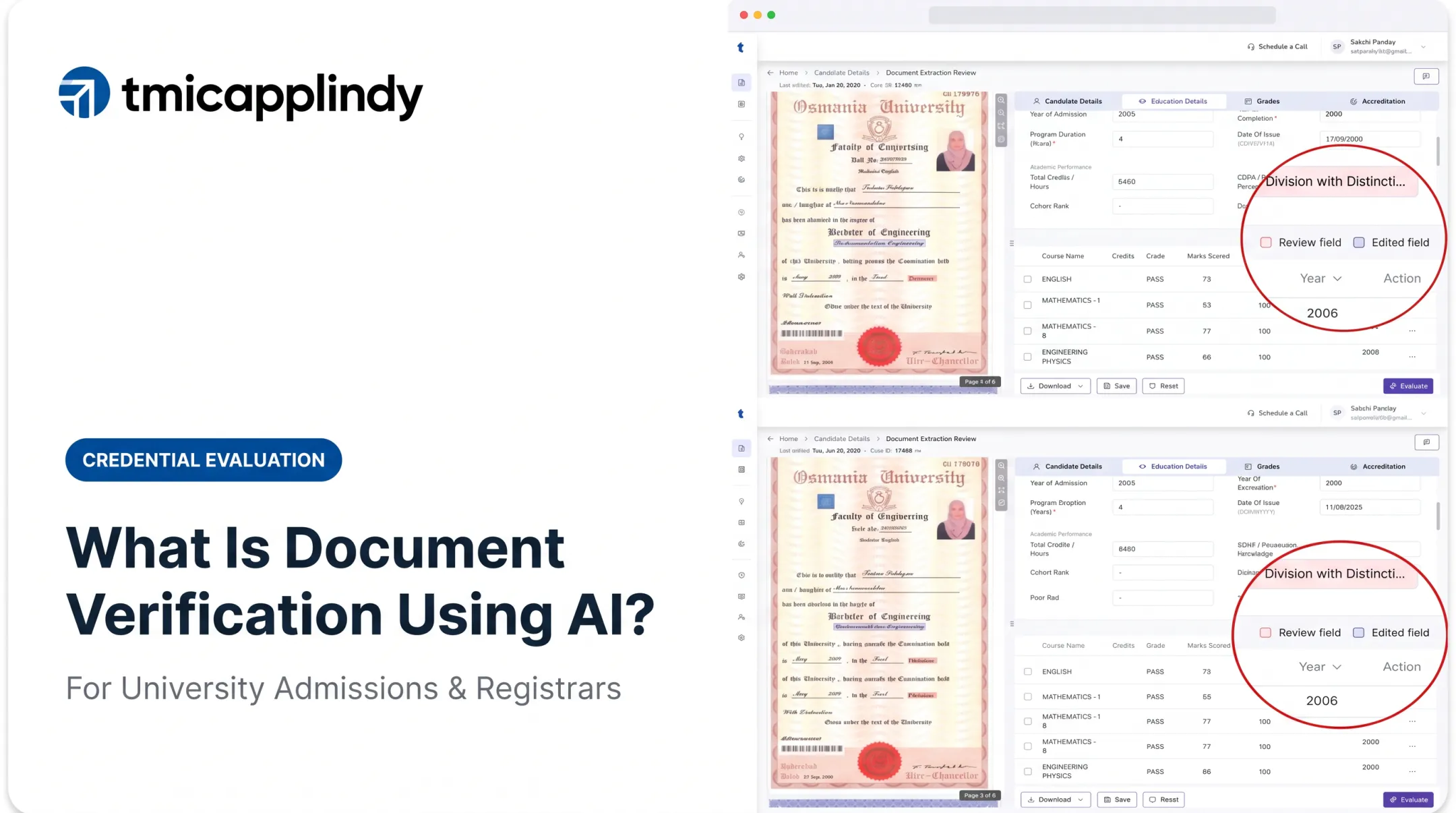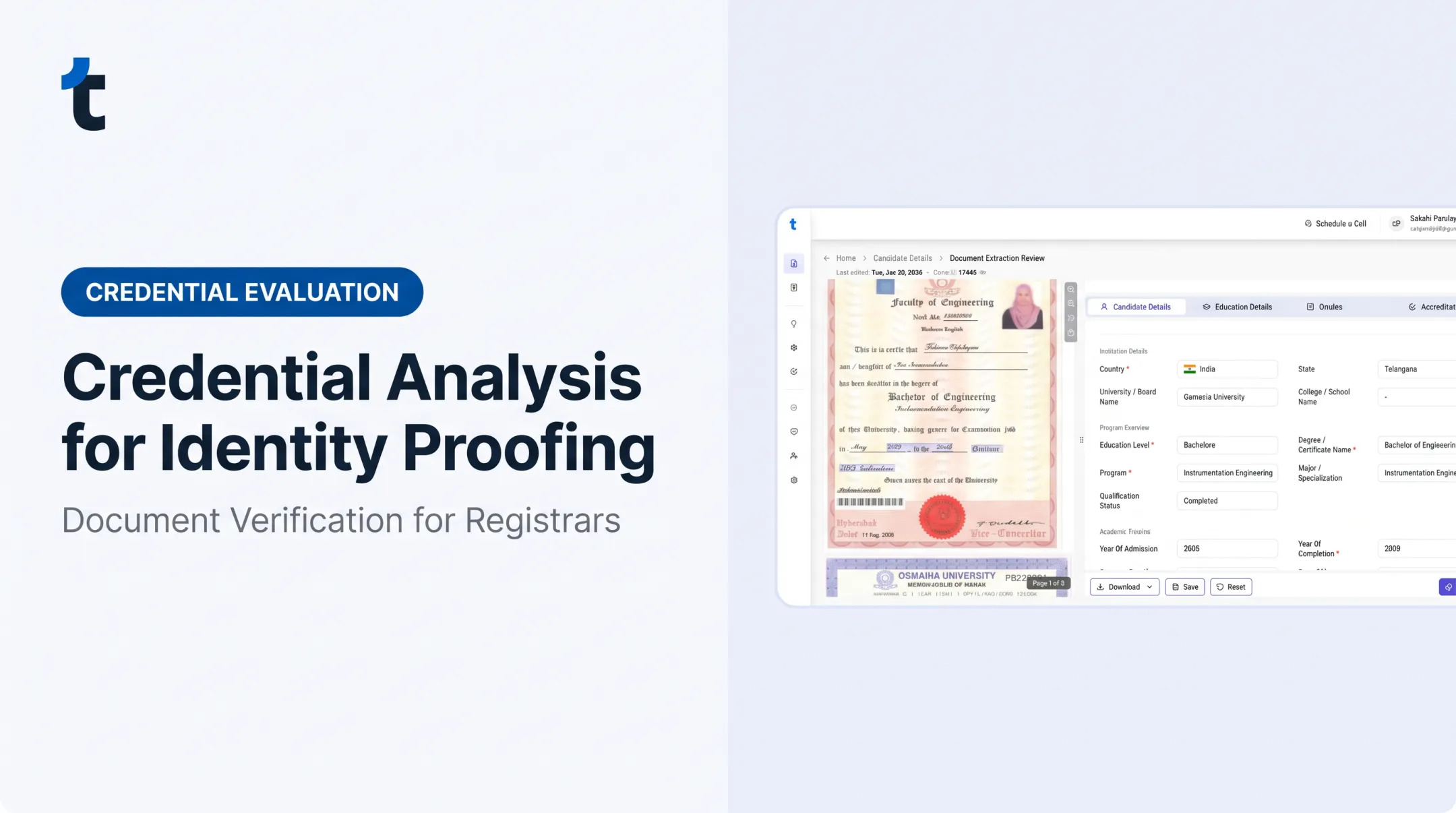

Manual review means re-typing grades into spreadsheets, chasing down grading-scale conversions, and making judgment calls under deadline pressure. A recent AACRAO survey of 270 U.S. institutions found that admissions offices manage a dozen or more processes with an average team of just 18 full-time staff. That's a lot of workload spread thin.
Verification automation with AI combines document intelligence, configurable rules, source checks, and human review to validate academic records and push trusted data into admissions or student information systems. This guide covers how the workflow operates, what AI can and can't verify on its own, and how to evaluate a platform built for the job.
Key Takeaways
- Verification automation goes beyond OCR: extraction, normalization, validation, policy checks, fraud detection, and system sync
- Let AI handle routine, high-volume reviews and flag ambiguous or high-risk records for staff
- Score platforms on accuracy, explainability, security certifications, policy flexibility, and integrations
- Track results against your baselines: processing time, backlog size, exception rates, and staff hours saved
What Is Verification Automation in Higher Education?
Verification automation in admissions and registrar operations differs from identity verification or healthcare eligibility checks. The scope is narrower and more specialized. It validates that an academic record, the institution behind it, and the coursework it describes are credible enough to support an institutional decision.
Extracting data from a transcript and verifying it are two different problems. Pulling a GPA off a PDF is a data task. Confirming that the issuing institution is accredited, the grading scale was applied correctly, and the document hasn't been altered is a verification task. Platforms that stop at extraction leave the harder work to staff.
Who This Supports
Verification automation touches several workflows across a campus:
- Undergraduate and graduate admissions review
- International admissions and credential evaluation
- Transfer-credit articulation
- Registrar operations and degree audits
- Nursing and other professional-license credential review
- Third-party credential evaluation services
Manual vs. Automated Workflows
| Manual Workflow | Automated Workflow |
|---|---|
| Staff retype transcript data by hand | AI extracts fields directly from source documents |
| Results handed off via spreadsheets or CSV exports | Verified data syncs directly to CRM/SIS |
| Review decisions vary by reviewer | Policies applied consistently across reviewers |
| Source traceability requires manual file hunting | Every field links back to its exact source location |
| Exceptions discovered late, often after errors occur | Low-confidence items routed to review before ingestion |
Platforms like TruEnroll are built specifically for this distinction. Rather than treating a transcript like any other document, the system identifies the institution, applies registrar-configured grading policies, and only then hands a structured, source-traceable record to admissions staff.
How Verification Automation Works in Higher Education
The workflow runs from the moment a document lands in the system to the moment verified data appears in a CRM or SIS. Each stage solves a distinct bottleneck in that path.

Intake Through Validation
- Intake – The system accepts PDFs, scans, photos, and electronic records, regardless of language or layout
- Extraction – OCR, computer vision, and language models identify student, institution, course, grade, credit, and date fields
- Normalization – Units, dates, course codes, and grading scales get converted into structured data institutional systems can use
- Validation – Extracted information is checked against configured policies, known institution data, and source documents
TruEnroll's zero-template Vision AI processes unstandardized layouts across 50+ languages without manual bounding boxes or per-school templates. Extractions return in roughly three seconds.
Decision Support Through Synchronization
Once data is validated, the system supports decision-making without replacing institutional judgment:
- Decision support calculates credit applicability, degree equivalency, and course-level matching, while final authority stays with institutional staff
- Exception handling routes low-confidence fields, missing information, or fraud indicators to a human reviewer
- Synchronization sends verified, traceable data to CRMs and SIS platforms without rekeying or CSV exports
Real-time processing suits individual application reviews as they arrive. Batch processing handles application surges or historical backlog clearing.
TruEnroll scales to over 100,000 application cycles, which helps during enrollment peaks when volume spikes without warning. The platform combines transcript extraction, credential evaluation, credit articulation, fraud detection, and secure synchronization in a single pipeline rather than stitching together separate tools.
What AI Can Verify and Automate in Academic Records
Multimodal AI now handles unstandardized domestic and international transcripts, including dense tables, institutional seals, mixed-language text, and inconsistent formatting. But some records are genuinely difficult, not because of poor scan quality, but because of what the grades mean.
A Real Interpretation Problem
AACRAO's February 2025 white paper on Indian grading practices documents exactly this. IIT Madras uses "S" for Superior at the top of its scale, while most institutions use "O" for Outstanding.
An 8-point grade at IIT Madras equates to a B under the institution's local scale, but AACRAO EDGE recommends treating it as an A equivalent based on the numerical value. A student with a final GPA of 8.25, which translates to an A average, could be misplaced in the B range if an evaluator reads the letter grade alone.
That's the line between extraction and interpretation. Getting the characters right isn't the same as understanding what they mean in context.
What Gets Automated
- Identifying institutions, programs, credentials, courses, grades, and credits
- Mapping coursework to academic taxonomies such as CIP and SCED
- Applying rules for grade exclusions, repeated courses, and unit conversions
- Interpreting global grading systems and flagging unusual scales for review rather than presenting a conversion as final
Transcript Forensics
Document fraud doesn't always look obvious. TruEnroll's forensics engine checks each document against more than 70 fraud indicators, including watermarks, logos, signatures, and formatting inconsistencies. A typical scan clears in under three seconds. It also cross-references the issuing institution against accreditation data to flag unrecognized schools before a decision gets made.

Field-level provenance adds another layer of trust. Every structured value traces back to its exact coordinates on the original PDF, so a reviewer can verify a GPA or course grade with one click instead of re-opening the source file and hunting for it.
Where AI Hits Its Limits
AI runs into trouble with missing source data, document formats it hasn't seen before, conflicting records, or institutional policies that require judgment calls. Confidence thresholds and human escalation close that gap.
Example: An international transfer applicant submits a transcript in Portuguese with a non-standard grading scale. The system translates the document, normalizes the grades to a U.S. equivalent, checks for tampering, and flags one unusual grade-table format for reviewer attention.
A TruEnroll case example recorded 96% forensics and accreditation confidence while surfacing this kind of variation. Human staff review the flag, confirm the equivalency, and make the admissions call.
Benefits and Use Cases of Verification Automation
The operational payoff shows up in measurable outcomes: shorter review queues, less manual entry, fewer spreadsheet errors, faster decisions, and more consistent policy application across reviewers.
Where it applies:
- Application review and initial screening
- Transfer-credit articulation
- International credential evaluation
- Registrar audits and enrollment verification
- Professional-program admissions (nursing boards, for instance)
- Third-party credential evaluation services
Measured Results
The University of Cincinnati partnered with Parchment and reported an 80% reduction in transfer transcript data-entry time, documented in an AACRAO 2025 conference session. That figure describes one institution's data-entry workflow specifically, not a universal benchmark for backlog reduction or fraud detection accuracy across every school.
TruEnroll's own operational data points in a similar direction: institutions using the platform report a 90% decrease in peak evaluation backlogs and save more than 35 minutes of staff time per transcript file, turning what used to be a multi-week evaluation into a same-day or sub-three-minute review.

Audit-Ready Accountability
When multiple reviewers, campuses, or intake periods apply the same grading policies, consistency becomes a compliance issue, not just an efficiency one. Audit-ready, source-traceable records give institutions a defensible trail if a decision gets questioned months later.
Applicants feel the difference too. Faster decisions, fewer repeat document requests, and clearer status updates all reduce the anxiety that comes with waiting on an admissions outcome. None of that requires fancier technology. It just needs a workflow that does not stall on manual bottlenecks.
Security, Governance, and Human Oversight
Systems processing student PII carry real regulatory weight. FERPA requires schools to limit access to records based on legitimate educational interest, and that obligation extends to third-party vendors acting as "school officials" under the institution's direct control.
Baseline security expectations for any platform:
- Encryption in transit and at rest
- Tenant or cloud data isolation
- Role-based access controls
- Immutable audit logging
- Documented incident response procedures
- Secure integration practices for CRM/SIS connections
TruEnroll holds SOC 2 Type II, ISO 27001, and ISO 27701 certifications, encrypts data with AES-256 at rest and TLS 1.3 in transit, and maintains 100% U.S. data residency. Certification signals control maturity, but it doesn't replace an institution's own compliance review. Ask vendors directly.
Governance Questions Worth Asking
- Is our data ever used to retrain public AI models?
- How are model outputs monitored over time, and how are changes documented?
- How is bias or inconsistent output tested?
- Can reviewers challenge or correct an automated result, and how quickly?
Human-in-the-Loop, Not Human-Replaced
AI handles extraction and routine validation. Trained staff review low-confidence results, fraud alerts, and policy exceptions, and they retain final say on decision implications.
TruEnroll's workflow reflects this directly: blurry scans and unusual grading scales get routed automatically to a one-click reviewer queue, and any extracted value can be overridden in under five seconds with full source tracking.
Vendor-question checklist:
- Who owns the data, and where does it reside?
- How transparent is the model's decision logic?
- What does the audit trail actually capture?
- What access controls exist, and are they role-based?
- How secure are the CRM/SIS integration points?
- What uptime SLA and support hours are guaranteed?
- How long is data retained, and can we control that?
How to Choose and Implement a Verification Automation Platform
Selecting a platform means testing it against the messiest records your institution actually receives, not a clean demo file.
Selection Criteria
- Accuracy across domestic and international records, languages, scripts, and grading systems
- Zero-template processing that handles new document formats without manual setup
- Configurable policies for grading, repetitions, exclusions, unit conversion, and transfer credit
- Field-level provenance, confidence scores, and complete audit history
- Direct integrations with your existing CRM and SIS, including supported formats
- Security certifications and data isolation guarantees
TruEnroll checks these boxes with native integrations into Slate, Banner, and Salesforce, support for 150+ pre-configured grading systems, and 99.4% extraction accuracy with full field-level traceability.
A Phased Rollout
- Establish a baseline – Document current review volume, turnaround time, backlog, and exception rates
- Run a representative pilot – Include routine, international, incomplete, and historically difficult records
- Configure policies – Set confidence thresholds, escalation routes, and integration mappings
- Compare human vs. AI output – Document where the system succeeds, fails, or needs more rules
- Train stakeholders – Admissions, registrar, IT, and security teams all need defined ownership
- Expand gradually – Monitor outcomes and revisit configuration as document types change
Most TruEnroll implementations take 4 to 6 weeks, with CRM integration typically wrapping up in 1 to 2 weeks, supported by dedicated integration engineers rather than an institution's already-stretched IT staff.

Frequently Asked Questions
What is automated verification?
Automated verification uses software, AI, rules, and source checks to validate information or documents. In higher education, it adds institutional policy controls and human review before any record informs an admissions or enrollment decision.
What are the four main methods of verification?
Common approaches include document inspection, database or source verification, identity checks where relevant, and human or expert review. Which methods apply depends on the credential type and the institution's specific workflow.
How does AI verification work in higher education?
The process runs through intake, extraction, normalization, policy checks, and fraud screening, with confidence-based routing sending uncertain cases to human reviewers. Verified results then sync directly with admissions or SIS systems.
Is AI verification accurate and secure for student records?
Accuracy depends on document coverage, validation rules, and confidence thresholds paired with human oversight. Security depends on encryption, access controls, auditability, and certifications such as SOC 2 Type II and ISO 27001.
Can AI verification replace admissions or registrar staff?
No. AI automates repetitive processing and surfaces exceptions, but qualified staff still own ambiguous records, policy interpretation, fraud decisions, and final admissions or credit determinations.