
Student information verification systems exist to reconcile that mess. They confirm that submitted records are complete, consistent, and tied to the right person, whether the institution is processing an application, an enrollment update, or a residency form.
This matters more than ever. In AACRAO's October 2025 admissions-staffing survey of 270 institutions, 54% identified staff burnout as a core staffing problem. Manual record-checking is a big part of that load.
Verification is not the same as just collecting data or logging someone in. This guide walks through the full process: submission, matching, validation, human review, secure synchronization, and the audit trail that ties it all together.
Key Takeaways
- Systems compare submitted student data against authoritative records, documents, and institutional rules
- A typical workflow moves through collection, matching, validation, exception handling, human review, and system updates
- Checks cover identity, enrollment, academic credentials, contact details, residency, and required forms
- Role-based access, encryption, audit trails, and retention rules protect student data
- Faster decisions still leave policy and final admissions judgment with the institution
What Is a Student Information Verification System?
A student information verification system is a software platform or connected workflow that checks whether student-related information is accurate, complete, current, and tied to the right student. Institutions pull records from application portals, scanned documents, email, third-party evaluators, and legacy systems—and those sources rarely agree on formatting or even basic facts.
That gap creates confusion between four related but distinct concepts:
| Term | What it actually checks |
|---|---|
| Verification | Whether information matches a trusted source or meets a defined requirement |
| Authentication | Whether a person is authorized to access an account or system |
| Validation | Whether information follows an expected format or rule |
| Data entry | Simply recording what someone submitted, with no check at all |
The U.S. Department of Education's guidance on FERPA draws this same line: institutions must use reasonable methods to authenticate who is requesting access to education records, which is a separate task from confirming a transcript itself is genuine.
What Gets Checked, and Where Scope Changes
Depending on the workflow, verification might cover:
- Identity attributes and dates of birth
- Enrollment status and prior institutions attended
- Transcripts, credentials, and course-level data
- Residency information and emergency contacts
- Signed institutional forms and consent records
Scope shifts with the team using the system. Admissions usually centers on identity and academic records; the registrar leans toward enrollment status and transcript integrity; a student portal may focus almost entirely on contact details or consent forms.

These systems do not make admissions decisions, replace official records, or prove every document is authentic on their own. A flagged record still needs a person to close the loop.
How Does a Student Information Verification System Work?
Verification runs as a controlled sequence. Information is collected, compared against trusted evidence and institutional rules, routed for review when something is uncertain, then sent to the systems that need it.
Initiation and Data Collection
A verification case usually starts from one of these triggers:
- Student application submission
- Transcript upload
- Profile update
- Required portal field prompt
Inputs arrive as web forms, scans, PDFs, images, API feeds, or records pulled from an SIS or CRM. Each field's source matters:
- Self-reported data needs more scrutiny than institution-generated data
- Document-derived fields depend on scan quality and formatting
- Third-party sourced information carries its own trust level
Common friction points at this stage include incomplete submissions, unreadable scans, inconsistent name spellings, missing identifiers, and duplicate profiles.
Extraction, Normalization, and Record Matching
Once data arrives, the system extracts relevant fields from forms and documents, then standardizes formats, since a date written as "03/15/1999" and "15-Mar-1999" needs to resolve to the same value before anything can be compared.
Identity resolution relies on multiple identifiers and contextual signals together, not one field alone. That reduces false matches between similarly named students.
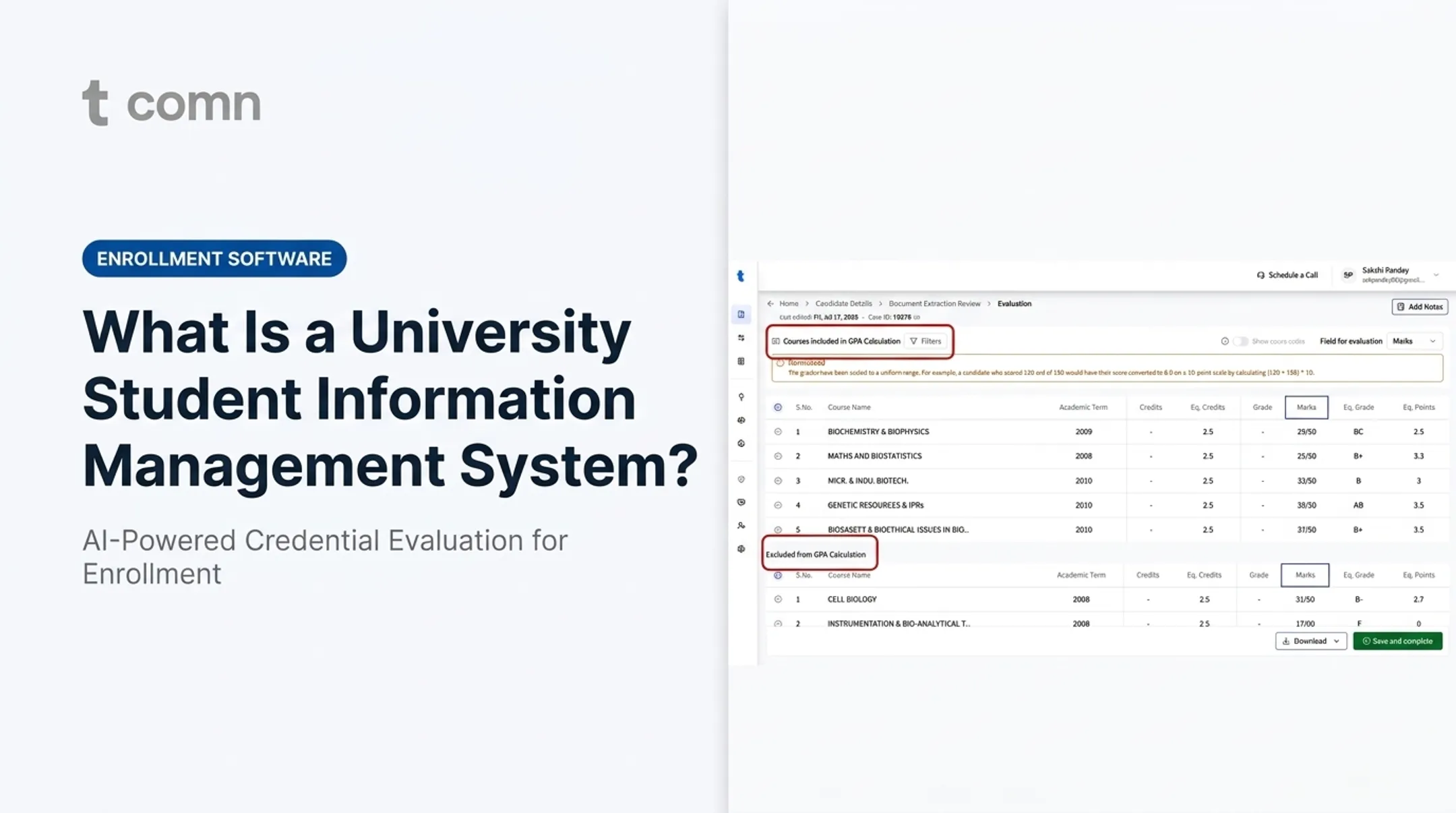
TruEnroll is one example of a platform built for this stage. It processes unstandardized domestic and international transcripts without template setup, supports more than 50 languages, and works across 150+ pre-configured grading systems.
Verified fields then route into connected higher-education systems.
Validation, Rules, and Integrity Checks
Here the system compares collected information against authoritative records, required fields, and institutional policy. It checks for:
- Missing data or contradictory dates
- Duplicated records across systems
- Invalid formats or unexpected grading scales
- Discrepancies between a document and an existing student profile
Policy logic can enforce institution-specific rules, such as grade exclusions, course-repetition handling, unit conversions, or transfer-credit requirements. Document integrity checks may flag tampering, unrecognized institutions, or suspicious inconsistencies.
A flag is an exception for review, not proof of wrongdoing. Treating it as misconduct evidence before a human reviews the case is a mistake institutions should avoid.
On the compliance side, FERPA guidance states that signed and dated consent is generally required before disclosing personally identifiable information from education records. Specific regulatory exceptions apply. This is guidance, not a substitute for an institution's own legal counsel.
Confidence Scoring, Exceptions, and Human Review
Results typically land in categories like verified, rejected, incomplete, mismatched, or requiring review. Human review stays essential for:
- Unusual name formats or transliterations
- International records with unfamiliar structures
- Conflicting information across sources
- Cases that could affect admissions or enrollment outcomes
Good reviewer tools include side-by-side source comparison, field-level provenance, comment threads, and escalation queues. TruEnroll, for instance, links each extracted field to its exact source-document coordinates, giving reviewers one-click verification or manual override rather than a blind approve/reject choice.
An effective system also records who reviewed a case, what evidence they looked at, what changed, and when, building an audit-ready history as it goes.
Output, Synchronization, and Ongoing Updates
The final output might be a verified field set, an exception status, a completed form, or a corrected student record. Approved data then syncs to the SIS, CRM, admissions platform, or reporting environment through integrations or controlled exports.
A Student Information System (SIS), as EDUCAUSE defines it, is software managing student information across admissions, registration, grades, and degree audits. It's not the same as the verification layer, which may feed into it or read from it without being the SIS itself.
Audit logs, source links, and version history support corrections, appeals, and reporting. Verification is rarely one-and-done either: contact details, enrollment status, and eligibility often need rechecking as student circumstances change.

Where Are Student Information Verification Systems Used?
Verification workflows show up across nearly every stage of the student lifecycle.
They most often support:
- Admissions teams: Review applications, confirm academic documents, catch duplicate or incomplete records, and route exceptions before a decision is made
- Registrar and enrollment offices: Handle record updates, transfer-credit processing, enrollment-status confirmation, and keep administrative systems in sync
- Student portals and family-facing systems: Collect addresses, emergency contacts, technology agreements, and consent forms while showing students what remains outstanding
International Admissions and Credential Evaluation
Foreign scripts, unfamiliar grading systems, and unrecognized institution names make international records harder to process. Verification tools can normalize formats, translate content, and surface reference data.
Even so, the U.S. Department of Education is clear that the receiving institution remains the authority for recognizing prior foreign education. Some schools evaluate credentials internally; others refer applicants to outside evaluation services.
Selecting a System
When those use cases are defined, institutions evaluating a verification platform should weigh:
- Integration depth with existing SIS and CRM platforms
- Document flexibility for both structured and unstructured records
- Human-review controls, including field-level traceability
- Fraud and anomaly detection capabilities
- Security posture, including access management and certifications
- Data-retention policies and measurable workflow outcomes
TruEnroll is one example built around these criteria: it pairs transcript processing and fraud detection (screening for more than 70 indicators) with direct routing into platforms such as Slate, Banner, or Salesforce. Product integrations evolve, so institutions should confirm current platform support before signing anything.

Conclusion
Student information verification systems work by combining data collection, source comparison, rules-based validation, anomaly detection, human review, and controlled synchronization into one traceable sequence.
Speed is one clear payoff: a 90% drop in peak evaluation backlogs. Institutions also gain cleaner records, clearer provenance for every field, stronger fraud awareness, and better-supported decisions for admissions and registrar staff.
Before adopting a system, institutions should map their data sources, policies, integration needs, and privacy obligations, then match those against the human oversight they want to keep in the loop. The right fit depends less on feature lists and more on where the current process actually breaks down.
Frequently Asked Questions
How is student status verified?
Verification usually requires an institution-issued identifier, application or enrollment details, and supporting documents submitted through the school's official portal. Exact requirements vary by institution, so confirm with the issuing registrar or admissions office directly.
What is a SIS database?
A Student Information System (SIS) is the central software environment institutions use to manage applications, enrollment, courses, grades, transcripts, and student status. The "database" is the stored data; the SIS is the broader application managing it.
What information do student information verification systems check?
Common checks include identity, contact details, enrollment status, academic records, submitted documents, eligibility information, and institution-specific required forms. Exact scope depends on the workflow and institutional policy.
What is the difference between student information verification and authentication?
Verification checks whether information is accurate or supported by evidence. Authentication checks whether a person is authorized to access a particular account or system. They're related tasks, but they solve different problems.
Are student information verification systems secure?
Security depends on implementation. Strong platforms combine access controls, encryption, secure SIS/CRM integrations, audit logs, and retention policies with independent assurances such as SOC 2 Type II or ISO 27001—because not every system handles student data the same way.