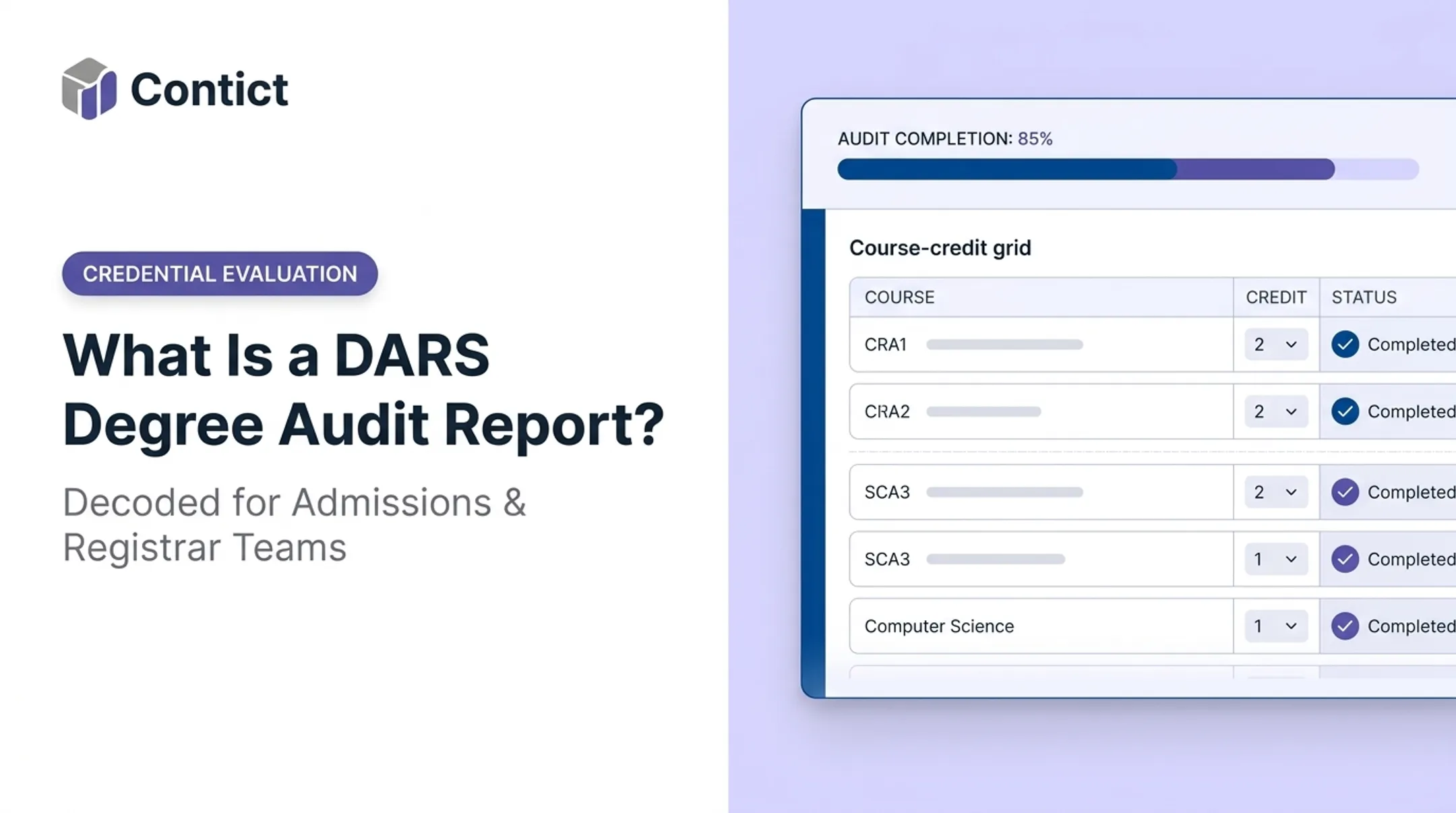

A degree audit compares a student's completed, transferred, and in-progress coursework against the specific requirements for their program. It matters to more than just students. Academic advisors, registrars, admissions teams, and transfer-credit staff all rely on it for course planning, graduation review, and day-to-day academic decisions.
The catch: what looks like a simple checklist on screen is actually the output of complex institutional rules and data pipelines. In an EDUCAUSE 2018 undergraduate technology study, 95% of students aware of degree-audit tools rated them useful. That's a strong endorsement, but usefulness isn't the same as infallibility. Here's how audits actually work, what changes their results, and where a human still needs to step in.
Key Takeaways
- Degree audits map academic records to program, catalog-year, and policy requirements in one view.
- They surface credits, grades, general education, major requirements, electives, transfer equivalencies, and GPA rules.
- Results update when new grades, transfer evaluations, or approved exceptions post to the student record.
- "Complete" status still needs advisor and registrar verification before graduation is official.
What Is a Degree Audit and Why Do Universities Use It?
A degree audit shows whether a student's academic record satisfies the published requirements for a specific credential.
Yale's University Registrar describes it as an advising tool that compares completed coursework and current enrollment against graduation requirements. It tracks major and distributional requirements alongside credit totals toward graduation.
Not a Transcript, Not Advising, Not Certification
People often conflate these three things, but they serve different purposes:
- A transcript records academic history. It's a factual, chronological record of every course and grade.
- Advising interprets options and policies. An advisor helps a student decide what to do with the information an audit provides.
- Degree certification is the formal, final confirmation that a student has met every requirement. Yale explicitly states its audit is unofficial and not an official academic transcript.
A favorable audit isn't a diploma guarantee. Dickinson College's registrar is direct about this: the audit doesn't replace advising and doesn't officially certify completion. That confirmation comes from the registrar and the relevant academic department.
What Requirements Does an Audit Actually Track?
Most degree audits evaluate a mix of the following:
- Total credit hours and residency rules (credits earned at the institution)
- General education or core curriculum courses
- Major, minor, and free elective requirements
- Prerequisite sequences
- Minimum grades in specific courses
- Cumulative or program-specific GPA thresholds
Universities use audits to apply these overlapping rules consistently across thousands of students. Staff and students get one shared view of progress. Without it, registration, transfer-credit review, academic intervention, and commencement prep would each need a separate manual check.
How a Degree Audit Works
A degree audit isn't a single lookup. It's a multi-step process that runs every time a student's record changes.
- Select the program and catalog year — the specific degree, concentration, and requirement year the student is held to.
- Retrieve the academic record — completed courses, grades, credits, repeats, withdrawals, and in-progress work.
- Classify coursework — sort each course into a requirement category.
- Apply requirement rules — check credit values, minimum grades, prerequisites, and attributes.
- Identify gaps — flag what's satisfied, in progress, or still outstanding.
- Present results — display the audit for the student and advisor to review.
The University of Iowa encodes its General Catalog requirements based on the semester a program was declared, while the University of Illinois notes that the catalog year on record determines which version of a requirement displays. Change that catalog year, and the rules underneath can shift entirely.

How Courses Get Matched to Requirements
Systems match courses using course codes, equivalencies, attributes, prerequisites, minimum grades, and credit values. UC Davis's registrar explains that its audit automatically applies completed and in-progress courses to programmed requirements, and can reposition a course to a different requirement block if that recalculates as the better fit.
A single course can satisfy one requirement category while also affecting other constraints, such as total credit count or GPA. A biology elective might fill a science requirement and push a student's science-GPA subtotal at the same time.
When a Human Has to Step In
Not every gap resolves automatically. Common exception types include:
- Course substitutions
- Waivers for specific requirements
- Exclusions for repeated or renewed coursework
- Academic renewal (excluding older grades from GPA calculations)
- Changes of major that reset the applicable catalog year
California State University, San Bernardino categorizes these requests as swaps, inserts, or other waivers, all of which route through the registrar for approval before they take effect. Utah's registrar notes something similar: approved academic renewal excludes discounted courses from total hours and GPA, but a student still needs to run a fresh audit to confirm the change registered.
A Simple Example
Picture a junior's audit showing: general education complete, a major requirement in progress this semester, one unmet lab prerequisite, and a three-credit elective shortfall. The student and advisor use that snapshot to plan the next two registration cycles — prioritizing the lab prerequisite early, since it may gate other major courses down the line.
Where Verified Transcript Data Feeds This Process
None of this works without clean, accurate source data. Document-processing platforms like TruEnroll support the workflow by handling the data ingestion audits depend on, while the university's policy engine still decides what counts.
TruEnroll processes domestic and international academic records and keeps field-level traceability back to the original document. Typical outputs that feed the audit include:
- Course-by-course details, recalculated GPAs, and recognized credit totals
- Course-equivalence mapping aligned to CIP and SCED codes
- Verified transfer mappings synced into systems such as Slate and Ellucian Banner
That way, the transfer credit block in a student's audit reflects processed, policy-checked data rather than a manual spreadsheet entry. Registrar rules still govern what counts.
Where Degree Audits Are Applied and What Affects Them
Degree audits show up repeatedly across a student's academic life, not just at graduation time:
- Transfer-credit review, when a student first enrolls
- Program declaration, when a major or concentration is formally set
- Advising and registration, ahead of each term
- Major or concentration changes, mid-program
- Pre-graduation checks, typically a term or two before completion
- Final degree clearance, right before conferral
The University of Richmond's registrar reviews audits and registrations for graduation applicants at multiple points, including after add/drop, not just once at the end.
What Can Change an Audit's Result
Three categories of inputs drive changes:
Student and program inputs set which requirements the audit applies:
- Catalog year
- Degree type, major, minor, or concentration
- Program changes
- Academic standing
Academic-record inputs refresh what the student has completed or attempted:
- Newly posted grades
- Transfer equivalencies
- Repeated courses
- In-progress work, test credit, withdrawals, and incomplete grades
Policy and data dependencies enforce the institution's rules on that record:
- Prerequisite logic
- Minimum grades and GPA thresholds
- Residency rules
- Course attributes and approved substitutions
Some of these run automatically as records update. Others only surface when someone actively reviews the audit at an advising session or graduation checkpoint.
The University of Colorado Boulder recommends students pull an up-to-date audit every semester. That is a solid baseline, though the smarter habit is checking whenever something on the record changes, not just on a fixed schedule.

Common Issues and When a Degree Audit May Not Be Enough
Three misconceptions cause most of the confusion around degree audits:
- "Every completed course automatically fulfills a requirement." Not true. A course has to match specific attributes, prerequisites, and minimum grades to count.
- "An audit is the same as a transcript." It isn't. A transcript is the historical record; the audit interprets that record against one program's rules.
- "A 'complete' status means I'm graduating." It means the audit's rules are satisfied. Final clearance still requires registrar and department sign-off.
Operational Problems Behind Confusing Results
Several common data issues create audits that look wrong even when they aren't:
- Missing or unprocessed transfer equivalencies (UNT notes transfers appear only after the official record is processed)
- Incorrect program declarations on file
- Outdated catalog rules still attached to a student's record
- Delayed grade posting
- Duplicate records or manual substitution errors
- Course attributes that were never configured correctly
When You Need a Human, Not Just a Refresh
Some situations require advisor or registrar judgment instead of an automated rerun:
- Unusual transfer histories spanning multiple institutions
- Interdisciplinary or self-designed programs
- Policy exceptions already approved but not yet applied
- Disputed course equivalencies
- Accreditation-specific requirements tied to licensure programs
- The final degree check itself
Dickinson's registrar puts it plainly: the displayed audit is neither an official transcript nor an official notice of degree completion. It's a planning tool, not a substitute for the people responsible for verifying it.

Conclusion
A degree audit turns two messy inputs, a student's academic record and a program's requirements, into one structured view of completed work, courses in progress, and remaining requirements. That structure only holds up if the underlying data does too: current program rules, complete academic records, correctly evaluated transfer credit, and documented exceptions.
For institutions processing transfer records at scale, that data quality challenge compounds fast. Platforms like TruEnroll help close the gap by returning source-traceable, policy-aligned credit and GPA data that syncs directly into the systems registrars already use.
Two habits keep audits reliable as transcript and articulation volume rises each admissions cycle:
- Students should check their audit regularly, not only before graduation
- Staff should treat it as a strong first read, not a final answer
Frequently Asked Questions
What is a degree audit?
It's a requirement-tracking report that evaluates a student's progress toward a specific degree. It isn't a complete replacement for advising or official degree certification.
How does a degree audit work?
The system compares a student's academic record against their program, catalog-year, credit, grade, and policy requirements. It then flags each requirement as completed, in progress, or outstanding for review.
Is a degree audit the same as a transcript?
No. A transcript records academic history exactly as it happened. A degree audit interprets that history against one particular program's requirements.
How often should degree audits be run?
Run it whenever coursework, grades, transfer credit, or program details change, plus at every advising session and graduation-planning milestone. Institutional refresh schedules vary, so don't rely solely on automatic updates.
What does a degree audit look like?
A typical audit might show general education complete, a major course currently in progress, one unmet prerequisite, and a remaining elective-credit shortfall. Exact categories and thresholds vary by institution.