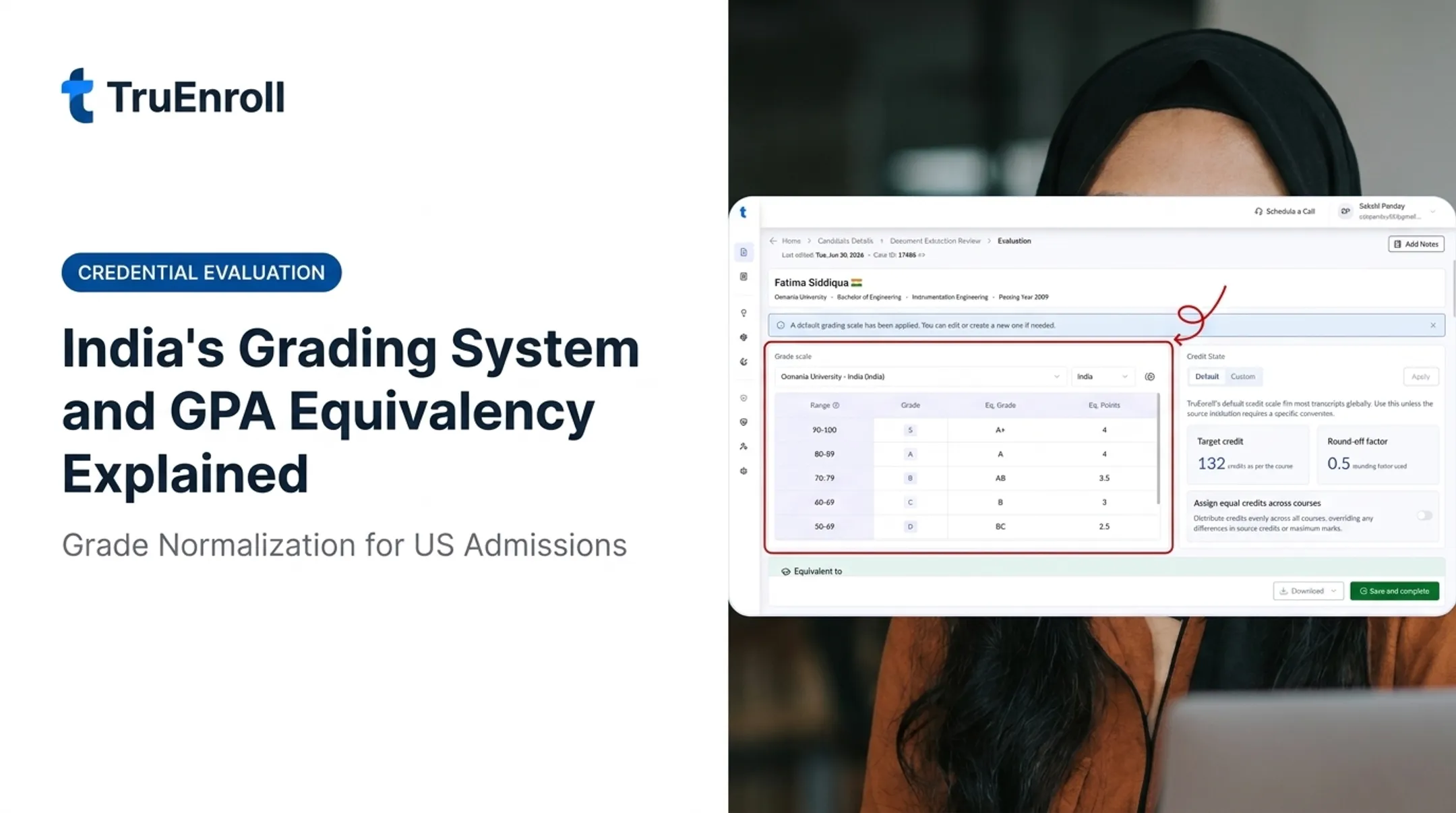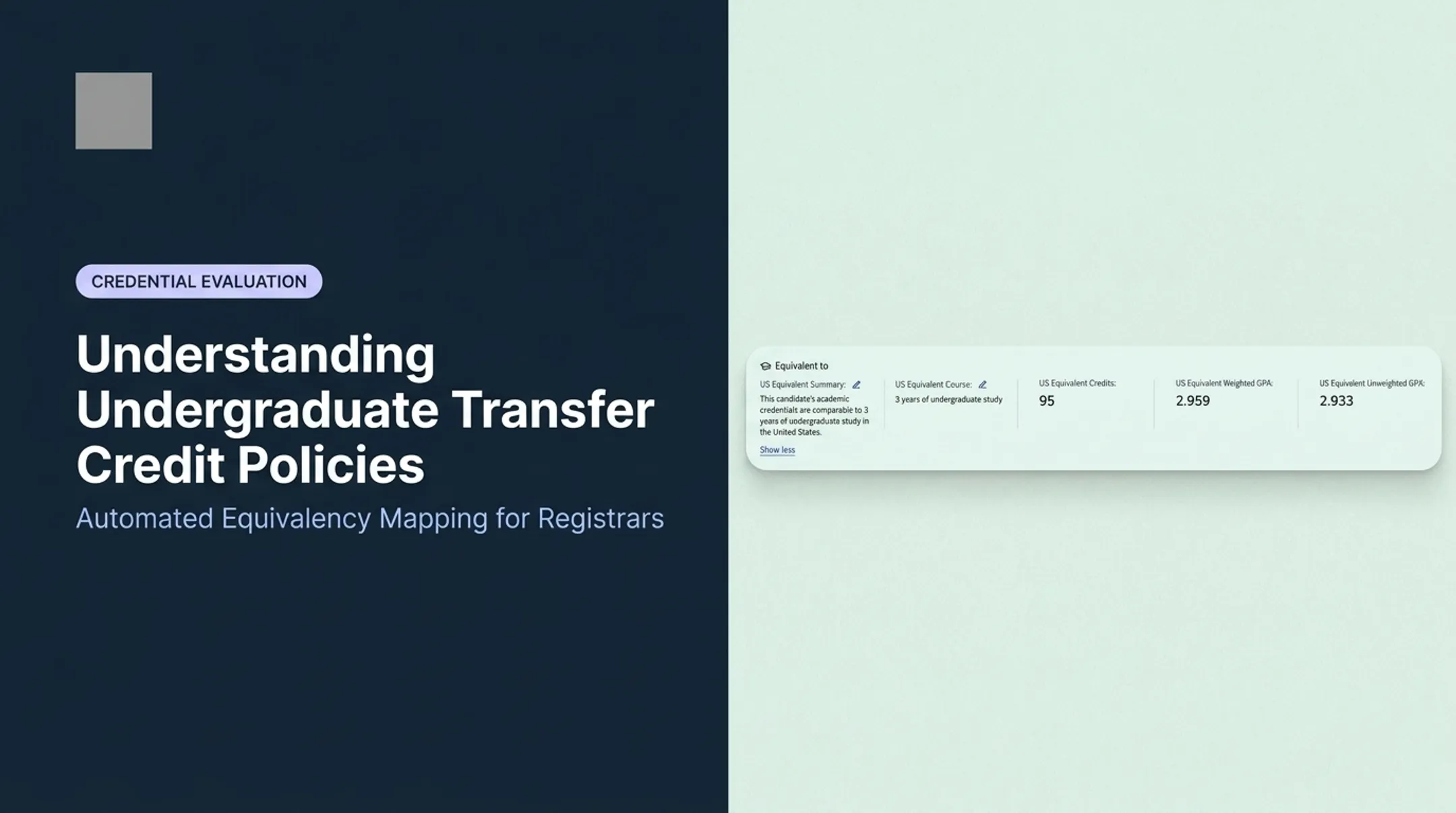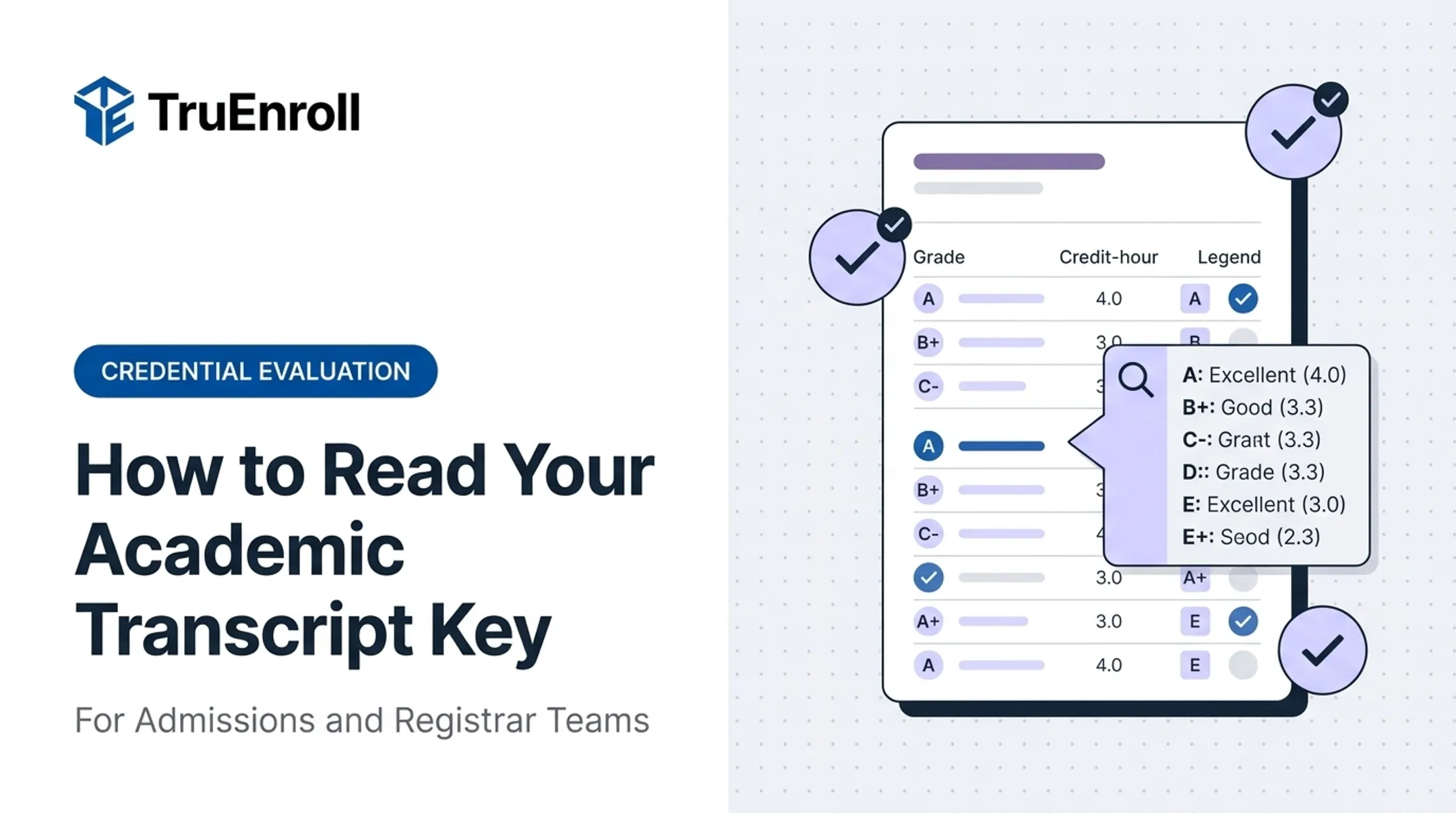

This guide is for U.S. admissions teams, credential evaluators, and employers who need to interpret education completed in India consistently. It's crucial to know that equivalency isn't a simple, one-size-fits-all conversion. The outcome depends on the programme's duration, the institution that awarded it, the specific curriculum, and the requirements of the organization receiving the records.
We'll break down how the evaluation process works, what factors and documents are most important, and where these evaluations are used. Understanding this process helps set clear expectations: a formal evaluation provides a vital comparison but doesn't automatically guarantee admission, a job offer, or a visa.
Key Takeaways
- A three-year Indian bachelor's degree may not always equal a four-year U.S. bachelor's degree, but acceptance depends on the evaluator, institution, and purpose.
- A credential evaluation translates an academic history into U.S.-comparable terms; it is not a direct path to a license, job, or visa.
- Course-by-course reports offer more detail than document-by-document reports and are often required for graduate school, transfer credits, or professional licensing.
- Always confirm the specific report requirements with the university, employer, or licensing board before ordering an evaluation.
- For higher-education teams, modern transcript-processing technology can standardize review workflows while preserving human verification and creating audit-ready records.
What Is Indian Bachelor's Degree Equivalency in the U.S.?
Foreign credential evaluation is a service that assesses an international degree against the framework of the U.S. education system. For an Indian graduate, an evaluator reviews the degree certificate, transcripts (mark sheets), and institution, then issues a report stating the U.S. academic equivalency.
So, what is an Indian bachelor's degree equivalent to in the U.S.? There is no single answer. Depending on the specifics of the degree and the evaluation methodology, it may be found comparable to:
- A U.S. bachelor's degree
- Three years of undergraduate study in the U.S.
- A different level or credit result based on curriculum, credits, and program type
Three separate concepts explain why results differ: recognition, equivalency, and eligibility.
- Recognition: Is the degree legitimate? Was it awarded by an Indian institution with authority to grant degrees under Indian law?
- Equivalency: How does the degree compare to a U.S. credential? That conclusion comes from the evaluation report after the academic record is analyzed.
- Eligibility: Does that comparison meet the bar set by a U.S. university, employer, or licensing board? Each organization sets its own standards.
Indian vs. U.S. Degree Structures
A primary point of confusion is program length. In India, many traditional bachelor's degrees—Bachelor of Arts (B.A.), Bachelor of Science (B.Sc.), and Bachelor of Commerce (B.Com.)—are three-year programs. Four-year programs are common in fields like engineering (B.E./B.Tech.).
India's University Grants Commission (UGC) framework also accommodates both three-year degrees (120 credits) and four-year honours degrees (160 credits).
In the U.S., a bachelor's degree is typically defined as the completion of a program requiring at least four years of full-time study, often totaling 120 semester credit hours. For example, a Bachelor of Arts at James Madison University requires 120 credit hours, with 41 dedicated to general education courses outside the major.
Duration isn't the only factor. Evaluators also weigh institutional recognition, program entry requirements, curriculum depth, and whether the degree grants access to postgraduate study (such as a master's program) in India.

How Indian Degree Equivalency Is Determined
Getting an Indian bachelor's degree evaluated in the U.S. follows a clear workflow. Applicants and admissions teams use the same core steps, though the report depth depends on the end use.
Step 1: Identify the Intended Use
Purpose drives how detailed the report must be. University admission, licensing, employment, and immigration do not ask for the same level of analysis.
- University admission: Often needs a course-level breakdown and grades to check graduate prerequisites
- Employment: May only need confirmation that the credential equals a U.S. bachelor's degree
- Immigration: Often must show the degree meets the education bar for a specific visa category
- Professional licensing: State boards in teaching, nursing, and engineering set strict course rules—for example, the California Commission on Teacher Credentialing requires a "detailed course-by-course" evaluation from an approved agency
Before starting, get the receiving organization's requirements in writing.
Step 2: Select the Appropriate Evaluation Report
Credential evaluators offer different types of reports. The two most common are:
- Document-by-Document (or General) Evaluation: Identifies the credential and states its U.S. equivalent. Often enough for employment or immigration when only degree-level equivalency matters.
- Course-by-Course Evaluation: Lists each course or subject, converts marks to a U.S. GPA, and assigns U.S. semester-credit equivalents. Usually required for admissions, transfer credit, and professional licensing.
Confirm which report type your target institution or agency accepts. Not all organizations accept reports from all evaluators.
Step 3: Verify and Interpret the Records
For an evaluation to be processed, you must provide official academic records. This typically includes:
- Degree Certificate (or Provisional Certificate if the final one is not yet issued)
- Official Transcripts or Statements of Marks (mark sheets) for all years of study
- English translations if the original documents are in another language
"Official" often means the documents must be sent directly from the issuing university to the evaluation agency. Some evaluators may accept documents from the applicant if they are in a sealed, unopened envelope from the institution. Always check the specific document submission rules for both the issuing university and the chosen evaluator.
For university teams, verification and interpretation are where backlogs form. TruEnroll helps admissions and registrar staff move this stage faster without giving up academic control:
- Extracts transcript data automatically
- Applies pre-configured academic policies
- Flags records that need review by a qualified evaluator
- Syncs verified data directly to the student information system (SIS)
The platform supports—rather than replaces—the final determination made by the institution's expert reviewers.

Where Indian Degree Equivalency Is Used
Credential evaluations show up in several parts of the U.S. education, hiring, immigration, and licensing system.
University and Graduate School Admissions
Admissions teams at U.S. universities use evaluations to interpret international academic records. A course-by-course report clarifies academic level, grades, and whether prerequisite coursework is complete for a given program.
For departments handling thousands of international applications, platforms like TruEnroll can automate GPA calculations and degree equivalency checks. That keeps decisions consistent and frees staff for holistic review.
Employment
Private employers have their own hiring standards. They may request an evaluation to confirm that an international candidate's education is comparable to the U.S. degree required for a position. A document-by-document evaluation is often sufficient for this purpose.
Immigration
For certain U.S. visa categories—especially employment-based paths like the H-1B—an applicant may need to show that a foreign degree equals a U.S. bachelor's degree.
Those evaluations are not binding. According to the USCIS policy manual, educational equivalency evaluations are "solely advisory"; the USCIS officer makes the final decision.
Regulated Professions
Licensure in teaching, nursing, engineering, or healthcare usually requires more than a standard credential evaluation. State boards set their own rules, which often include:
- Specific required coursework
- Supervised work experience
- Board exams (such as the NCLEX for nurses)
The evaluation supports the file; it does not replace board-specific requirements.
Key Factors, Common Issues, and Limits
Equivalency depends on several factors working together. Knowing them helps you set realistic expectations and avoid common pitfalls.
Key factors evaluators consider include:
- Degree Duration: The three-year versus four-year structure matters, but it is not the only factor.
- Institution Recognition: The evaluation confirms the awarding body is a recognized, degree-granting institution in India.
- Curriculum: The report weighs depth and breadth of coursework, including major subjects and general education components.
- Grades and Grading Scale: Indian marks, divisions (such as First Class or Second Class), and grade points need careful interpretation to convert into a U.S.-style 4.0 GPA.
- Documentation: Missing mark sheets, unofficial records, or unverified documents can delay or stop the evaluation.
- Receiving Organization Policy: The U.S. university, employer, or licensing board decides whether to accept the evaluation and credential.

Common Misconceptions to Avoid
- "An evaluation report guarantees acceptance." An evaluation is an expert opinion, not a final decision. The receiving institution makes the final call on admission, credit transfer, or hiring.
- "A master's degree will automatically make my three-year bachelor's equivalent to a U.S. bachelor's." Postgraduate study is a positive factor and will appear in the evaluation, but it does not always change how the underlying bachelor's is equated.
- "A degree from a top Indian university is automatically equivalent." Reputation counts, but the credential is still judged on duration, curriculum, and academic performance.
Admissions and credential teams see these same variables across high application volume. Automation can clear standard cases quickly, while qualified reviewers still handle edge cases, unrecognized institutions, and fraud flags so policy decisions stay consistent.
Conclusion
Determining an Indian bachelor's degree equivalency in the U.S. is a contextual comparison, not an automatic conversion. Factors like program duration, institutional recognition, curriculum, and academic records all play a role. The final outcome is heavily influenced by the evaluation methodology and, most importantly, the specific requirements of the university, employer, or licensing board receiving the application.
For applicants, the starting point is the receiving organization:
- Ask for their specific credential evaluation requirements
- Obtain the correct type of evaluation report
- Submit complete, verifiable academic records
For university admissions and registrar teams, secure and auditable transcript processing workflows improve consistency and review speed. Automating data extraction and policy application supports faster, more reliable decisions while keeping human expertise at the center of final judgment.
Frequently Asked Questions
What is a Bachelor's degree equivalent to in the USA?
An Indian bachelor's degree may be treated as a U.S. bachelor's degree, three years of undergraduate study, or another outcome. Results depend on duration, institution, evaluator, and purpose, so check the receiving organization's requirements.
Is Indian B.Ed. valid in the USA?
An Indian B.Ed. can be academically evaluated, but teaching eligibility is set by each state's licensing authority. That usually means a credential evaluation, state-mandated exams, and other professional requirements.
What is a Bachelor's degree in India?
A bachelor's degree in India is an undergraduate credential earned after a postsecondary program. B.A., B.Sc., and B.Com. degrees are often three years; engineering degrees (B.E./B.Tech) are typically four.
Do U.S. universities accept a three-year bachelor's degree from India?
Some U.S. universities and graduate programs accept a three-year Indian bachelor's degree; others require a four-year degree or additional study. Confirm the policy directly with each program.
What documents are needed to evaluate an Indian bachelor's degree in the U.S.?
You typically need the final or provisional degree certificate and official year-by-year transcripts or mark sheets. Documents often must come directly from the university, with certified English translations if the originals are not in English.
Is a credential evaluation required for employment or immigration in the U.S.?
Requirements vary. Some employers and immigration pathways, such as the H-1B visa, may require a credential evaluation. Follow the current instructions from the specific employer or government agency.