
That distinction trips up a lot of transfer applicants. Three separate questions need answers for every course you're considering:
- Does it transfer to USC at all?
- Does it transfer as a direct USC course equivalent, or just as an elective?
- Does it satisfy a specific major, General Education, writing, language, or prerequisite requirement?
This article walks through USC's articulation tools, how to research your own coursework, how credit actually gets applied, and what to do when a course or college isn't listed anywhere.
Key Takeaways
- Treat USC articulation agreements as institution-specific course maps, not a stand-in for major requirements
- Expect transfer credit as equivalent, comparable, or elective; those outcomes are not interchangeable
- Save official syllabi, transcripts, and graded work for any course that isn't clearly listed
- Final credit decisions come from USC's official evaluation and Transfer Credit Report, not planning tools
What Is a USC Articulation Agreement?
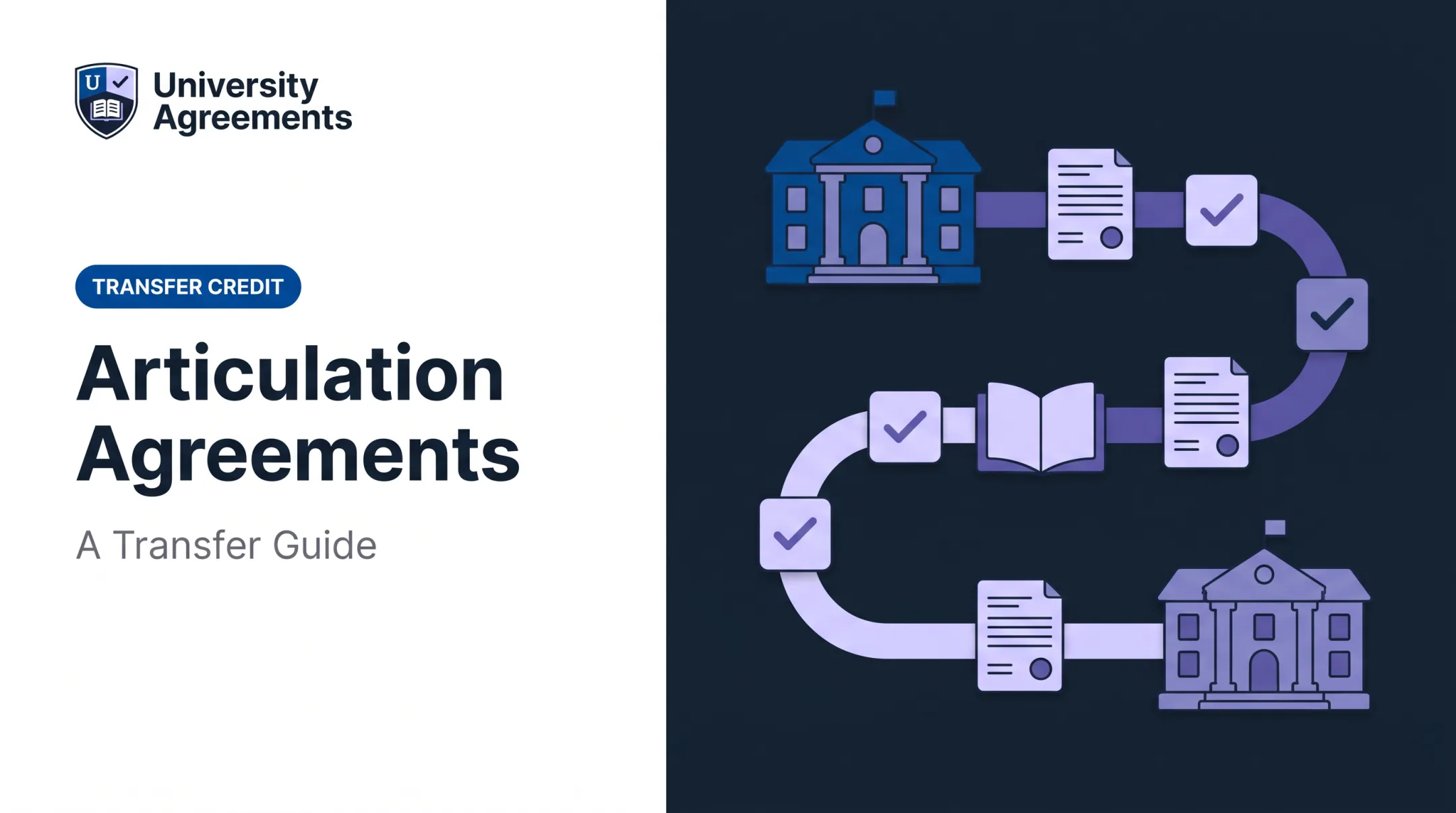
In USC's own terminology, an articulation agreement is a course-by-course resource that shows how classes from a particular institution may transfer. It covers possible USC course equivalencies, elective credit, and whether a course fulfills GE or other academic categories. USC maintains these agreements primarily with California community colleges.
Agreement vs. Articulation History
These two tools look similar but carry different weight.
An articulation agreement is a structured planning resource built for institutions where USC has established, documented articulation information. An articulation history, by contrast, records courses that transferred successfully for past students.
Histories are non-comprehensive by design and aren't a guarantee for future applicants, according to USC's glossary. USC does not maintain formal four-year-college agreements the way it does for community colleges, which is why histories exist for those schools instead.
Course Equivalent, Comparable, and Elective Credit
These three terms get used interchangeably by students, but USC treats them very differently:
| Term | What It Means | What It Does |
|---|---|---|
| Course equivalent | Closely matches a specific USC course | May satisfy a major prerequisite or specific degree requirement |
| Course comparable | Overlaps in subject matter, but isn't treated as the same course | May satisfy a requirement without replacing the exact USC class |
| Elective credit | Doesn't replace a required course | Adds to total units toward graduation |
A course equivalent matters most if you're trying to clear a specific major requirement before arriving. A comparable course might still help, but it won't show up as the exact USC class on your transcript. An elective, meanwhile, pads your unit count without moving you closer to finishing a required sequence.
None of this is a promise. An articulation agreement is a planning aid only. It does not guarantee admission, replace a degree audit, or stand in for USC's final official evaluation once you enroll.
How to Use USC's Articulation Tools Before You Transfer
Start with the exact institution where you completed the course. USC's agreements search is school-specific, so a similarly named branch campus or department won't give you accurate results.
Match the Tool to Your Major
USC's Transfer Planning Guide lets you select your intended major alongside your institution. The general agreements search does not offer that filter.
Compare the result against your program's:
- Lower-division requirements
- Prerequisites
- GE categories
- Writing and language requirements
A course can transfer to USC and still fail to satisfy the particular requirement your major needs.
Record These Details for Every Prospective Course
Keep a running log, not just a mental note, for every course you're banking on:
- Institution, campus, course title, number, units, and term taken
- The USC equivalent or requirement category shown in the tool
- Any conditions: minimum grades, lab components, repeat-course rules, online-delivery notes, or unit conversions
Check Dates Before You Enroll
Articulation information changes as curricula and GE requirements shift. Check the publication date on the page you're viewing, confirm it against current USC policy, and don't assume last year's screenshot still applies.
Build a written course plan with an academic advisor and keep a copy of the result page for your records.
If a course is missing from the list entirely, don't assume it won't transfer. That's a different problem with a different process, covered below.

How USC May Apply Your Transferred Coursework
Three separate questions matter here, and conflating them causes most of the confusion: Is the credit transferable? What type of credit does USC award? Does that credit actually move you toward your degree?
USC typically awards one of three credit types:
- Direct equivalent: Replaces a specified USC course when your program's rules allow it
- Subject or comparable credit: Documents related academic preparation without replacing the exact USC class
- Elective credit: Counts toward total units while a major, prerequisite, or GE requirement stays outstanding
Transferability and applicability still depend on academic level, course content, unit value, grade earned, repeat status, and whether the content is remedial.
Upper-Division Limits Matter
Lower-division coursework at your current school generally fulfills only lower-division requirements at USC. Departments can apply upper-division coursework completed before matriculation to major requirements on a case-by-case basis, but transfer courses generally cannot fulfill upper-division minor requirements.
A course that looks academically similar on paper may still need to meet USC's specific category definitions.
Residency rules add another layer. USC's general undergraduate transfer minimum is 64 units completed in residence, with higher thresholds for programs like Bachelor of Architecture, according to USC's undergraduate catalogue. Don't assume every accepted transfer unit reduces what you still owe USC directly.
Review Your Transfer Credit Report
Once you're admitted and have paid your deposit, USC generates a Transfer Credit Report (TCR) through Experience USC. This is your individual credit record, separate from any advisory articulation history. Review it carefully for:
- Missing coursework that should have transferred
- Credit categorized differently than the articulation tool suggested
- Courses showing as elective when you expected equivalent credit
If something looks wrong, that's a conversation for your advisor or Transfer Credit Services, not a guess.

What If Your Course or College Is Not Listed?
An absent course or institution doesn't prove your coursework is unusable. It usually just means USC hasn't conducted an individual review yet.
Build This Documentation Checklist
Gather these before you need them, not after an advisor asks:
- Official transcript showing the course, term, grade, and units
- Full course syllabus with learning objectives, readings, assignments, and assessments
- Lab schedule or experiment list if the course included a lab component
- Catalog description and graded assignments where available
- Certified translations for records not in English
Don't promise yourself a particular USC equivalency before the official review happens, and avoid enrolling in a course purely because its title resembles a USC class.
The Petition Process Has Real Limits
An articulation petition requests a change to how a course was evaluated. USC's current process sets eligibility, timing, and evidence rules, and petitions generally apply only after matriculation, not before. Ask your advisor targeted questions:
- Will this transfer as elective or subject credit?
- Can it satisfy a specific requirement?
- Is a syllabus review available before I enroll?
- What documentation does USC actually require?
A Note on the Technology Behind the Scenes
Universities processing thousands of transfer transcripts each cycle face a version of the same problem students do: matching unfamiliar coursework to institutional requirements accurately and quickly. Structured transcript processing and course-mapping workflows address that gap. They reduce manual re-entry while preserving registrar review, policy controls, and an audit trail.
TruEnroll is one example of a platform built for this, supporting transcript extraction, course and credential mapping, fraud screening, and secure synchronization with higher-education systems. It doesn't replace USC's official academic determination. It does show why institutions increasingly rely on verified data pipelines rather than manual spreadsheet comparisons when handling high transfer volumes.

Frequently Asked Questions
What is the USC articulation agreement?
It's an institution-specific USC resource showing how courses from a particular college may transfer, including possible equivalencies and elective credit. Final applicability to your degree still depends on USC's official review and your specific program's requirements.
What are the transfer credit requirements at USC, and how many credits can I transfer?
Check USC's current transfer-credit, residence, and graduation-unit policies directly, since cohort-specific rules have changed in recent catalog years. Credits USC accepts and credits that count toward your degree aren't automatically the same thing.
Will my courses or credits transfer to USC?
Check the relevant articulation agreement or history for your school first. Unlisted courses may need individual review, and transferability alone doesn't guarantee the course satisfies a major or GE requirement.
What is the USC transfer program?
Transfer admission is the process for applying to USC after completing college coursework elsewhere. Requirements vary depending on your academic background, intended program, and current USC admission policy, according to USC's transfer page.
Does USC accept transfer students, including one-year transfers?
Yes, USC considers transfer applicants under its published requirements, and there's no stated minimum number of transfer units required. Students with limited college coursework may see added weight placed on their high school record or test scores.
How hard is it to get into USC as a transfer, and what GPA is required?
Use USC's current official transfer profile and major-specific guidance rather than outdated third-party numbers, since GPA ranges shift by cycle and program. Competitive admission and credit articulation are evaluated separately.