
Treating an identity document or applicant account as genuine without checking its source and integrity is a gamble. The Department of Education reported that the College of Southern Nevada wrote off $7.4 million in Fall 2024 tied to fraudulent enrollments, and federal detection efforts flagged almost 150,000 suspect identities in current FAFSA forms, according to the Department of Education.
This article walks through what credential analysis actually does, how it differs from academic credential evaluation, and how institutions can combine automated checks with human review to keep fraud out without punishing legitimate applicants.
Key Takeaways
- Credential analysis checks whether an identity document appears authentic, unaltered, current, and consistent with authoritative data
- It's one layer of identity proofing, not a replacement for human review or data checks
- Identity credential analysis is distinct from academic credential evaluation, which judges educational meaning and equivalency
- Strong workflows route exceptions to trained staff instead of trusting an automated pass or fail
- Secure CRM and SIS integration preserves provenance and cuts manual data entry
What Is Credential Analysis for Identity Proofing?
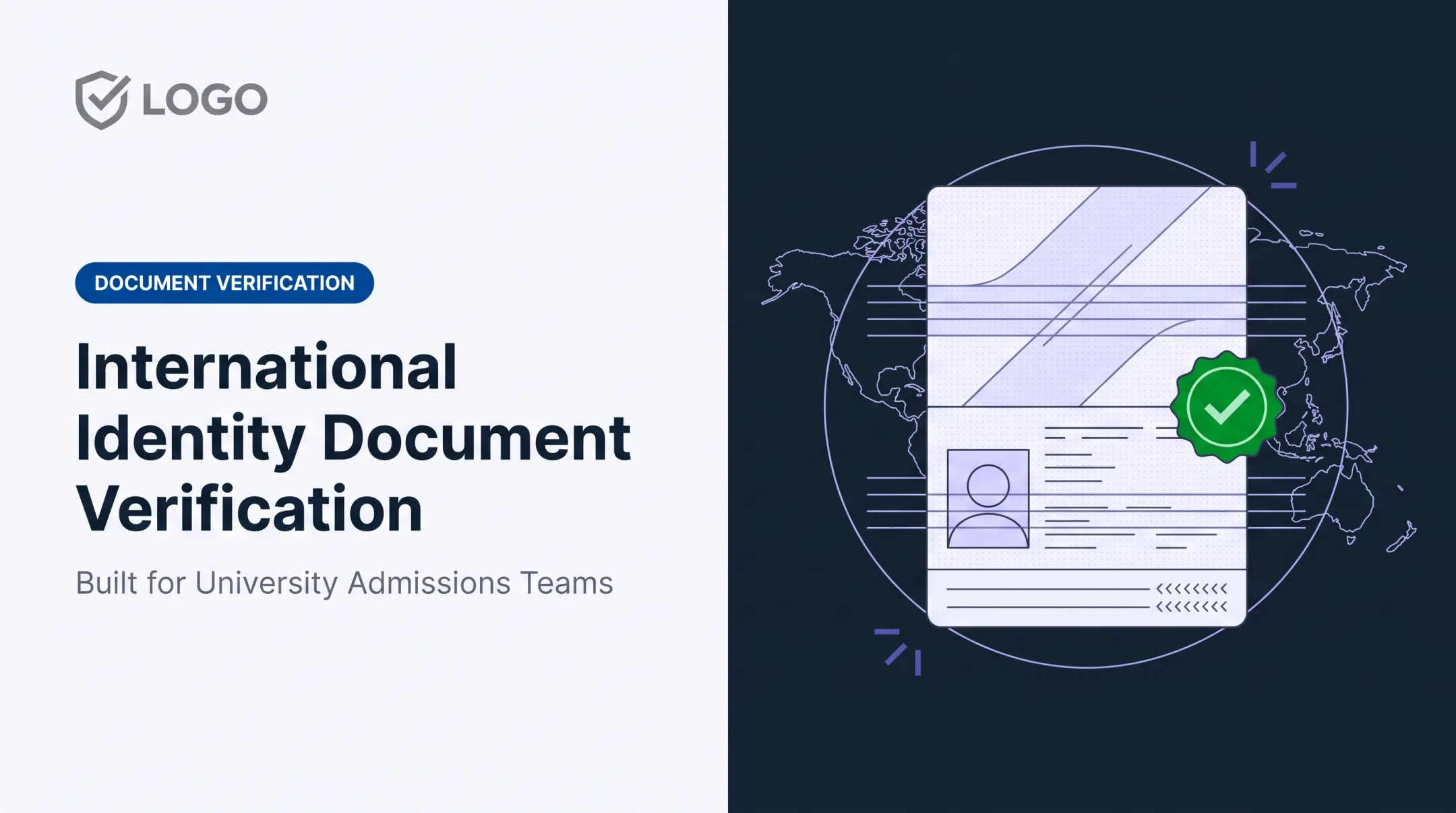
Credential analysis examines a government-issued identity document (or another accepted identity credential) along with its visual and machine-readable features. The goal is to assess whether the credential is genuine and belongs to the applicant presenting it.
It looks at the document itself. It doesn't evaluate what an applicant studied or earned.
Where It Fits in the Admissions Lifecycle
This check shows up at several points:
- Application creation and applicant portal access
- Transcript submission
- International student onboarding
- Re-enrollment after a gap in attendance
- High-risk changes to an existing student record
Four Concepts That Get Confused
These terms overlap but mean different things, and mixing them up leads to gaps in a verification program:
| Concept | What it actually does |
|---|---|
| Identity credential analysis | Checks the document itself and whether it matches the presenter |
| Identity proofing | Establishes overall confidence that an applicant is the real person they claim to be |
| Academic credential evaluation | Interprets transcripts, diplomas, grades, credits, and institutional equivalencies |
| Fraud detection | Flags suspicious patterns, alterations, or unrecognized institutions across both identity and academic records |
NIST's current guidance separates this further: evidence validation confirms the document is genuine, while identity verification confirms the applicant actually owns that evidence, according to NIST's digital identity guidelines.

What Signals Does a System Actually Check?
A credential-analysis tool might inspect:
- Document templates and visual security features
- Barcode or machine-readable zone data
- Image quality and expiration dates
- Whether printed fields match encoded ones
Not every vendor supports every signal, so confirm capabilities before you build a workflow around them.
A pass result is a confidence signal, not conclusive proof. Damaged documents, newly issued IDs, unfamiliar formats, and documents absent from reference databases all need an alternative verification path.
Why Credential Analysis Matters in Higher Education
Reliable identity proofing feeds directly into safer admissions decisions, lower impersonation risk, and stronger record integrity. AACRAO's 2026 research documents stolen and fabricated identities, AI-generated documents, and even staffed call centers impersonating learners in fraudulent applications, per AACRAO's fraud guidance.
Layered verification reduces that risk without forcing credentialed applicants through redundant manual steps every time. Done well, credential analysis supports:
- Better decisions: admissions and registrar teams get a documented basis for confirming identity
- Lower fraud exposure: altered, mismatched, or expired credentials get flagged before they reach a decision
- Record integrity: verified identity data links correctly to the right applicant, transcript, and student file
- Operational efficiency: fewer repetitive visual checks, less manual entry, no disconnected spreadsheets
- Auditability: field-level provenance, decision logs, and traceable escalation paths
- Fair processing: exception paths for applicants whose documents can't be read or matched automatically
The Risk of Leaning Too Hard on Automation
Automation isn't infallible. False positives reject genuine applicants. False negatives let fraudulent ones through. Biometric tools have shown measurable bias, too.
NIST's 2019 study of 189 facial-recognition algorithms found false-positive rates for Asian and African American faces that were 10 to 100 times higher than for Caucasian faces, depending on the algorithm. Unnecessary collection or retention of sensitive personal data adds legal exposure on top of that.

US institutions also operate under a patchwork of privacy, security, and accessibility requirements, from FERPA's rules on biometric records to state laws like Illinois's BIPA and accessibility obligations under the ADA. These obligations vary by institution type, applicant category, document type, and state, so confirm what applies to your program before you build it.
How Credential Analysis Works: A Step-by-Step Workflow
A good workflow connects identity evidence to a documented decision. A bare pass or fail result is not enough. Before implementation, validate your vendor's capabilities, security controls, and legal fit.
Step 1 – Define the Verification Objective
Decide what you need to establish: that the applicant controls an identity, that the document is genuine, that it matches an existing record, or that a high-risk account action is legitimate. Set the decision criteria, evidence requirements, escalation threshold, retention period, and responsible reviewer before you collect anything.
Step 2 – Collect and Secure the Credential
Capture the permitted document through a secure applicant workflow, with clear guidance on lighting, focus, framing, and glare. Require all necessary sides or pages. Address consent, data minimization, encryption, access controls, and vendor-processing terms up front.
Step 3 – Analyze the Document and Its Data
This step typically covers:
- Document-template recognition and security-feature inspection
- Barcode or MRZ parsing and tampering indicators
- Expiration status and consistency between visible and encoded fields
Know which checks run automatically, which depend on authoritative source data, and which need manual confirmation.
Step 4 – Compare the Credential With the Applicant Record
Compare verified identity details against application data, account information, or prior records. A name or date-of-birth mismatch isn't automatically fraud. Transliteration differences, legal name changes, and formatting inconsistencies happen often and should trigger review, not rejection.
Step 5 – Apply Risk Rules and Route Exceptions
Define clear outcomes:
- Verified: document and applicant match with no flags
- Verified with conditions: minor discrepancy resolved and documented
- Unable to verify: insufficient data, routed for alternative evidence
- Suspicious: signs of alteration or mismatch, escalated immediately
- Requires human review: automated confidence falls below threshold
Common mistakes here:
- Accepting an automated result without review
- Auto-rejecting unfamiliar international documents
- Failing to record why an exception was resolved the way it was
Step 6 – Record Provenance, Decide, and Review
Log the final decision, source evidence, reviewer action, timestamps, and any system changes in an audit-ready format.
Example: An applicant submits a passport that passes document checks but shows a name variation against the application. A reviewer checks the discrepancy, confirms a documented legal name change, notes the rationale, and allows the application to proceed, without confusing that identity decision with a separate academic eligibility question.
Close the loop by reviewing false-match rates, manual-review volume, applicant complaints, and confirmed fraud findings on a regular cadence.

How TruEnroll Can Help
TruEnroll is built for transcript processing, credential evaluation, credit articulation, and fraud detection, not as a replacement for every identity-document control in your stack. It's a complement to identity proofing, focused specifically on academic records.
What TruEnroll Actually Does
TruEnroll evaluates more than 70 fraud indicators across academic documents, including name consistency, institution identity, accreditation status, fonts, watermarks, overlays, and signatures. Every document gets an automated forensics audit for tampering and inconsistencies, and non-academic documents like ID cards are identified and excluded from further credential-evaluation processing.
Key capabilities that support an identity-proofing program:
- Fast forensic scans that clear documents in under 3 seconds, cutting manual verification latency
- Field-level provenance, with one-click coordinate mapping back to the original PDF for every extracted value
- Direct CRM and SIS sync with Slate, Salesforce, Banner, and PeopleSoft, removing manual entry and spreadsheet handoffs
- Broad language and format coverage, including 50+ languages and more than 150 pre-configured grading systems, confirmed against your specific use case before go-live
- Institutional accreditation checks, cross-referencing an issuing school against global accreditation indices to catch diploma mills
Security and Governance
TruEnroll states SOC 2 Type II, ISO 27001, and ISO 27701 certifications, cryptographically isolated tenant boundaries for student PII, AES-256 encryption at rest, and TLS 1.3 in transit. The company also states a policy against using institutional data to retrain public AI models, with 100% of document processing and storage kept on US cloud infrastructure. Confirm each of these claims against current documentation before relying on them in a compliance review.
The distinction worth repeating: TruEnroll's academic-record and transcript-fraud workflows should integrate with your identity-document verification, privacy, accessibility, and human-review controls, not substitute for them.
Conclusion
Credential analysis is a risk-control layer. It helps institutions build confidence in who an applicant is and whether the evidence they submitted can be trusted. Academic credential evaluation answers a different question entirely: what those educational records actually represent.
The strongest programs combine secure capture, document and data analysis, context-aware exception handling, human oversight, and provenance, reviewed against policy on an ongoing basis.
If you're leading admissions or registrar operations, map your current identity-proofing workflow. Define your escalation rules. Then ask whether your systems give you the speed, transparency, and audit trail that high-volume US admissions operations actually require.
Frequently Asked Questions
What is a credential analysis?
Credential analysis examines an identity document, including its security and machine-readable features, and related data to assess authenticity and consistency. It's distinct from academic credential evaluation, which judges educational records.
How is credential analysis different from identity proofing?
Credential analysis focuses narrowly on the presented identity document. Identity proofing is the broader process of establishing confidence that the applicant is the actual person associated with that claimed identity.
Is credential analysis the same as academic credential evaluation?
No. Credential analysis verifies identity-document authenticity. Academic credential evaluation interprets transcripts, diplomas, grades, credits, and institutional equivalencies, an entirely separate function.
What happens when an applicant's identity credential cannot be verified?
A controlled exception path provides clearer resubmission instructions, alternative accepted evidence, manual review, and applicant support. Documented resolution replaces automatic rejection.
Can credential analysis detect fraudulent transcripts?
Not on its own. Identity credential analysis doesn't authenticate academic records. Transcript fraud detection needs separate checks for alterations, inconsistent data, unrecognized institutions, and academic-policy anomalies.
How should institutions protect credential-analysis data?
Apply data minimization, encryption, and strict access controls, paired with defined retention limits, vendor due diligence, audit logs, and clear privacy notices. Confirm compliance with applicable US institutional and privacy requirements for your specific state and applicant population.