
An articulation agreement exists to prevent exactly that kind of surprise. It's a formal arrangement between institutions that spells out which credits, courses, or credentials carry weight at the receiving school. But these agreements aren't one-size-fits-all documents, and the rules shift by state, system, and even by major.
This guide is written for U.S. transfer students and the advisers, registrars, and admissions staff who support them. Because policies vary so widely, we'll define what articulation agreements actually do, walk through the major types, show you how to verify one before you enroll, and explain how institutions keep these rules accurate on the back end.
Key Takeaways
- An articulation agreement formally defines how coursework or credentials from one school apply at another.
- Credit transfer doesn't automatically mean admission, major acceptance, or finished degree requirements.
- Always confirm current equivalencies, grade and GPA rules, deadlines, and residency conditions with official sources.
- Statewide or systemwide agreements simplify transfer, but eligibility and protections still differ by pathway.
What Is an Articulation Agreement and What Does It Cover?
An articulation agreement is a formal arrangement between two or more educational institutions, systems, or programs. It spells out exactly how coursework, credits, credentials, or learning outcomes earned at a sending institution will apply at a receiving one.
These agreements rarely live in a single document. They usually involve:
- The sending institution (where credits were earned)
- The receiving institution, including its registrar and admissions office
- Academic departments that approve course-level equivalencies
- A published transfer guide or equivalency database students can search
What an Agreement Can Actually Promise
Articulation agreements generally provide one of three outcomes:
- Course-to-course equivalency: a specific course satisfies a named course requirement at the receiving school.
- Credit toward a broader requirement: general education, elective, or prerequisite credit, without replacing a specific course.
- Block transfer: a defined group of credits, often an entire associate degree, accepted together.
What It Doesn't Guarantee
An agreement is not a blanket promise. It typically does not guarantee admission to the institution, entry into a selective major, financial aid, housing, or completion of every remaining degree requirement. Those are separate decisions made by separate offices.
Here's a quick illustration. Say a student completes Introduction to Psychology at a community college. Depending on the receiving program, that single course could transfer as:
- A direct equivalent to the university's PSYC 101
- A general education social science credit
- A free elective with no major applicability
- Non-transferable credit, if the receiving program doesn't recognize the course
Same course, four different outcomes. That is why checking the current agreement matters more than assuming anything transfers automatically.
Types of Articulation Agreements and Transfer Pathways
The type of agreement determines how much certainty you actually have. Some map individual courses one by one. Others guarantee a whole block of credit or a structured path into a specific major.
Course-to-Course and Program-to-Program Agreements
Course-to-course agreements compare individual classes by learning outcomes, credit hours, level, and prerequisites. Rowan University's registrar, for example, distinguishes equivalent courses (which satisfy specific program requirements) from non-equivalent courses, which may only earn Rowan's elective credit.
Program-to-program (or major-to-major) agreements go further, aligning an entire associate pathway with a bachelor's curriculum so prerequisite sequencing stays intact, which is useful for fields like nursing or engineering where course order matters.
Block Transfer and Guaranteed Admission
Block-transfer agreements accept a defined credit group together, often tied to a completed associate degree. North Carolina's framework, for instance, grants a general education waiver to qualifying graduates, though major and institutional graduation requirements still apply separately.
Guaranteed, dual, and joint admission arrangements are a different animal entirely. George Mason University's agreement with Virginia's community colleges promises admission to qualifying students who complete an associate degree with a 2.85 GPA threshold, but selective majors can require more. Admission status and credit applicability are two separate promises, not one.
Statewide Pathways, Reverse Transfer, and Prior Learning
Statewide and systemwide agreements span many institutions at once, not just a single pair.
Reverse transfer works differently: it sends credits earned at a four-year school back to a community college so a student can finish an unfinished associate degree.
Prior learning assessment (PLA) is distinct again. It awards credit for college-level learning gained through work experience, military training, or industry credentials, independent of any bilateral agreement.
A policy that works in one state's public system shouldn't be assumed to apply anywhere else. Always verify locally.
How Credit Transfer Works in Practice
Credit evaluation follows a fairly predictable sequence, even though outcomes vary by school:
- Official transcripts are requested and received.
- Staff identify your target program and the agreement that applies.
- Courses are matched against current equivalencies.
- Grade and eligibility rules are applied.
- An official transfer-credit decision is issued.

Where the Credit Actually Lands
How a course transfers isn't the same as where it applies on your degree audit:
- A direct equivalency replaces a specific required course.
- A general education match satisfies a broader distribution requirement.
- An elective counts toward total credits but doesn't fulfill a major or prerequisite.
- Some courses transfer with no degree-applicable value at all.
Why Similar-Looking Courses Don't Always Match
Two courses with nearly identical titles can be treated completely differently. The joint AACRAO, ACE, and CHEA statement points to educational quality, content rigor, and applicability to the student's goals as the real deciding factors, not just a matching title.
Other common mismatches come from:
- Quarter-to-semester credit conversions (a quarter credit typically equals about 0.666 semester credits)
- Missing lab components or different academic calendars
- Repeated coursework or inconsistent grading scales
Before enrolling anywhere, verify:
- Minimum grade required
- Cumulative GPA thresholds
- Course completion dates
- Whether the agreement applies to your intended major
Equivalency databases change year to year, so save your documentation and get written confirmation from an advisor when something looks unclear.
How Students Can Use an Articulation Agreement: A Transfer Checklist
Start with the destination, not the courses. Identify your receiving institution, degree program, major, and intended start term before mapping anything else.
Follow this sequence:
- Find the authoritative agreement through the sending college's transfer office, the receiving school's transfer portal, or the state system website—skip third-party summaries.
- Build a course plan with an adviser, checking every planned course against the agreement, especially labs, math sequences, and foreign-language requirements.
- Confirm non-course requirements: application deadlines, minimum grades, GPA, good-standing rules, and separate major admission criteria.
- Keep records: the agreement's publication date, equivalency results, adviser approvals, syllabi, and transcripts.
- Request an official transfer-credit evaluation after admission and compare it against your degree audit.

Before you commit to a course, ask:
- Does this credit satisfy my major, or only count as an elective?
- How are repeated courses treated?
- Do grades transfer into my new GPA, or just the credit hours?
- If I change majors, does the agreement still apply?
The NC Comprehensive Articulation Agreement and Other Statewide Examples
North Carolina's Comprehensive Articulation Agreement (CAA) is one of the country's most cited statewide transfer frameworks, connecting the state's community college system with the UNC system. It was updated in October 2025, with the revised version taking effect for Spring 2026, so always check the current document rather than an older summary.
Per the 2025 CAA agreement, qualifying associate degree graduates with at least a 2.0 cumulative GPA receive:
- A general education waiver at the admitting UNC institution
- Transfer protection for CAA-listed courses completed with a C- or higher
- Consideration for junior-level standing
The waiver doesn't erase major-specific or institutional graduation requirements. Those still apply separately.
Other states use different mechanisms toward similar goals:
- Florida's statute 1007.23 grants Florida College System associate graduates upper-division admission protection at state universities, with exceptions for limited-access and audition-required programs
- California's ASSIST system publishes course-by-course equivalency data by academic year rather than a blanket admission guarantee
The common thread: state-level policies reduce uncertainty, but they rarely eliminate the need to check your specific program's grades, deadlines, and exceptions.
How Institutions Can Administer Agreements Accurately
Behind every student-facing transfer guide sits a registrar or admissions team managing a moving target: equivalencies that change yearly, transcripts in inconsistent formats, and exclusion rules that must align with approved policy every single time.
That data load is substantial. Institutions need to track course identifiers, credits, grades, terms, equivalency rules, effective dates, exceptions, and approval history, often across thousands of incoming transcripts per cycle. AACRAO's 2024 research found that manual data entry, paper transcripts, and unclear decision trails are common causes of evaluation delays.
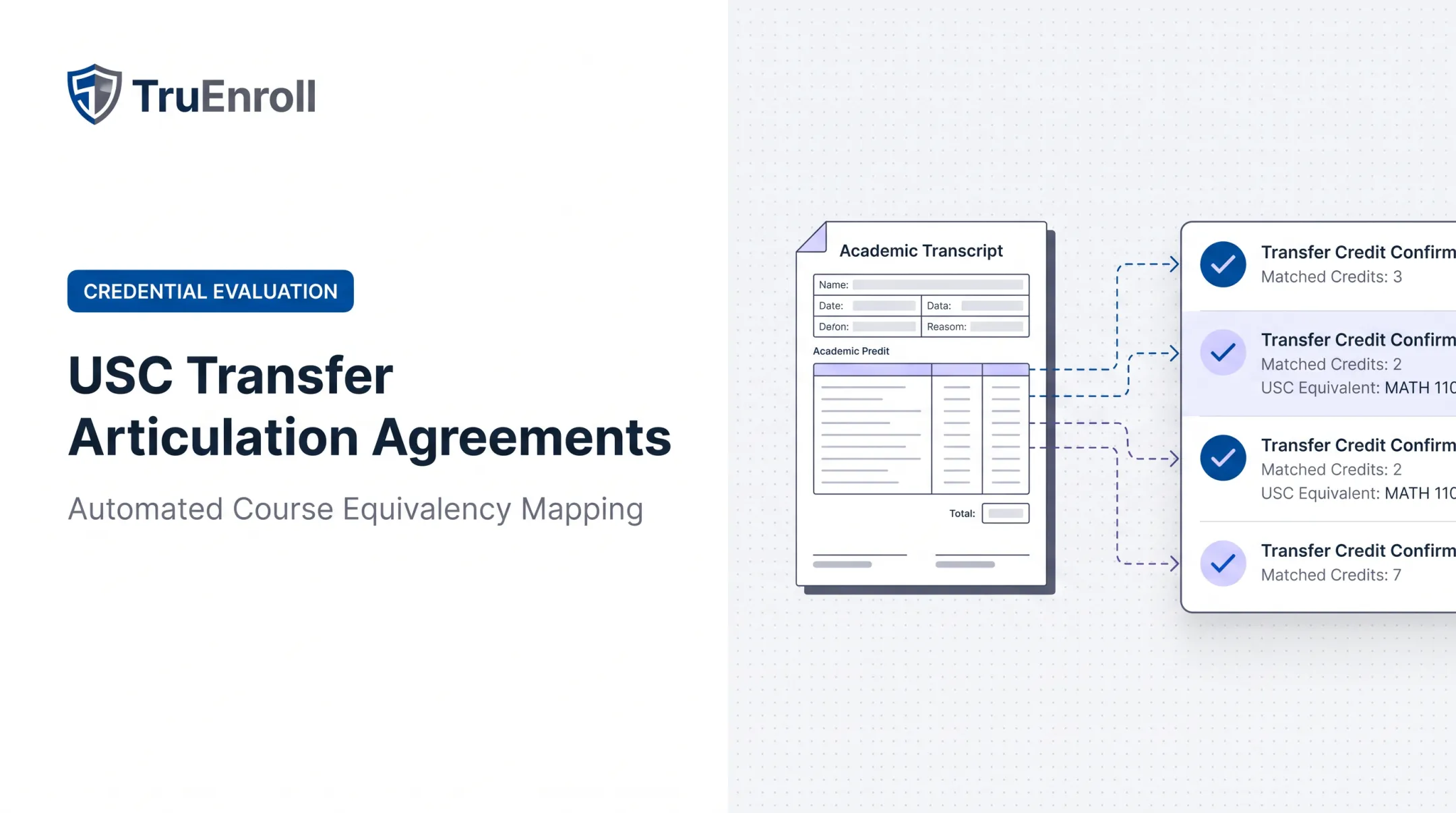
Platforms like TruEnroll are built for that operational load. TruEnroll maps incoming domestic coursework directly to program requirements using an AI-native extraction and evaluation engine. Specific capabilities include:
- Automated articulation that applies registrar-defined grade exclusions, repeated-course logic, and quarter-to-semester conversions
- Direct synchronization with CRM and SIS platforms, removing manual CSV exports
- Field-level provenance that lets staff click any extracted value back to its exact location on the original transcript
- One-click human verification for exceptions that need a registrar's judgment call
Institutions keep full control over policy configuration. TruEnroll enforces the rules a registrar defines; it does not set them. Faculty and admissions staff still own every equivalency decision, every exception, and every final communication to the student. The platform absorbs volume so staff can focus on judgment calls.
On the security side, TruEnroll holds SOC 2 Type II, ISO 27001, and ISO 27701 certifications, and runs on cryptographically isolated cloud boundaries with audit-ready data lineage for institutional compliance reviews.

Conclusion: Build the Transfer Plan Before You Enroll
An articulation agreement is a planning tool, not a blanket promise. It tells you what's possible, not what's guaranteed for your specific situation.
The safest approach stays consistent regardless of state or school:
- Choose your destination program first.
- Locate the current, official agreement.
- Confirm eligibility and course-level matches.
- Document every adviser conversation.
- Get an official transfer-credit evaluation in writing.
When policies are current, applied consistently, and communicated clearly, both students and institutions win. Students waste less time repeating coursework. Institutions spend less time untangling disputes after the fact.
Frequently Asked Questions
What is an articulation agreement?
It's a formal arrangement between institutions defining how coursework, credits, or credentials transfer. It may specify course equivalencies, block credit, program pathways, or admission conditions, often all four.
What is the NC Comprehensive Articulation Agreement (CAA)?
It's North Carolina's statewide framework connecting the community college system with the UNC system. Eligibility and benefits vary by pathway, so check the current official CAA document before assuming a provision applies to you.
Do articulation agreements guarantee admission to a four-year college?
Not always. Guaranteed, dual, and joint admission arrangements are distinct from simple credit-transfer agreements, and many still require a separate application plus major-specific criteria.
Do all credits transfer under an articulation agreement?
No. Credits may transfer as direct equivalents, general education, electives, or non-applicable credit. The outcome depends entirely on the agreement and your degree audit.
How can I find out whether my courses will transfer?
Check official transfer guides and equivalency databases first, then confirm with an advisor or transfer office. Get written confirmation before enrolling in anything uncertain.
Can an articulation agreement change after I start college?
Yes. Agreements and course mappings get revised periodically. Check effective dates, keep your own documentation, and ask the receiving institution how currently enrolled students are protected from changes.