
Introduction
Pull ten transcripts from ten different Indian institutions, and you might see ten different formats. One shows a percentage. Another shows CGPA on a 10-point scale. A third lists only A1, A2, and B1 grades. A fourth shows "First Division" with no number at all.
That variety is why admissions and evaluation teams struggle with Indian credentials: there is no universal formula that turns every CGPA or percentage into a U.S.-style 4.0 GPA. The board or university, the academic year, and the grading policy in force all change what a number means.
This guide covers school-board grading, higher-education scales, GPA terminology, and the real limits of equivalency tables—plus a practical process institutions can use to evaluate an Indian transcript with confidence.
Key Takeaways
- India runs on multiple grading systems across CBSE, ICSE, state boards, universities, and international curricula.
- GPA, SGPA, and CGPA depend on the academic period, course credits, and institutional rules, not one shared definition.
- Every equivalency decision should start with the original transcript's grading legend, not a generic conversion chart.
- Document the source, formula, and assumptions behind every conversion for audit purposes.
How India's Grading System Works Across Boards and Institutions
Indian academic records use five distinct notation types, often on the same document:
- Percentage grading – raw marks-based scores (for example, 78%)
- Letter-grade bands – categories like A1, B2, or O
- Grade points – numeric values tied to a scale, such as 8.5 on a 10-point system
- Divisions or classifications – First Division, Second Division, or Distinction
- Pass/fail notation – simple pass or fail status with no numeric detail
School-Board Grading: CBSE, ICSE, and State Boards
CBSE's current secondary curriculum assigns Class X (10th grade) students into grade bands A1 through D2 based on relative performance. Students are ranked and divided into groups rather than measured against fixed percentage cutoffs.
According to CBSE's 2026-27 secondary curriculum, this nine-point method applies specifically to Class X. It should not be confused with the fixed marks bands (A1 = 91-100, and so on) that the same document uses for Class IX (9th grade).
ICSE uses an entirely different structure. CISCE's regulations for the 2026 examination cycle rank subject results on a 1-through-9 scale, where 1 is the highest — not the A1-D2 labels CBSE uses.
State boards each maintain their own rules, and no single grade-band table applies across all of them. Always verify the current year's official documentation before assuming a grade's meaning.

Higher-Education Scales: 10-Point, 7-Point, and Legacy Systems
Indian universities show even more variation than school boards. The table below shows how percentage conversion and grade meaning change from one institution to the next:
| Institution | Scale Type | Notable Rule |
|---|---|---|
| UGC CBCS model (illustrative) | 10-point | O=10, A+=9, A=8, B+=7, down to F=0 |
| University of Mumbai (2017 circular) | 7-point and 10-point | Percentage = 7.1 × CGPA + 11 (local, historical) |
| University of Delhi (2019 ordinance) | Percentage/division | First Division = 60%+; Second = 50-59% |
| RGPV (2010 ordinance) | 10-point | Percentage = CGPA ÷ max CGPA × 100 |
No single formula in this table transfers to another institution. A CGPA of 8.5 at one university carries a completely different percentage equivalent than the same 8.5 at another.
Understanding Percentage, GPA, SGPA, and CGPA
A percentage is a raw, marks-based result: the direct output of an exam score. A grade point average converts performance into a standardized point value, then averages it across courses or terms.
These are two different measurement systems. One does not automatically translate into the other without a documented rule.
GPA vs. SGPA vs. CGPA
These three terms get used loosely, but they answer different questions:
- GPA generally refers to an average over some defined academic period. The term varies by institution.
- SGPA (Semester Grade Point Average) measures performance within a single semester.
- CGPA (Cumulative Grade Point Average) tracks performance across multiple semesters.
Under UGC's Choice Based Credit System guidelines, SGPA is the sum of each course's credits multiplied by its grade points, divided by total semester credits.
CGPA then weights each semester's SGPA by that semester's total credits, not a simple average of semester scores. If semester credit loads differ, an unweighted mean of SGPAs produces a different (and incorrect) result.
Factors that change interpretation:
- Credit hours assigned per course
- Courses excluded from GPA calculation (seminars, thesis work)
- Repeated or failed courses and how they're weighted
- Practical or lab components graded separately
- Pass/fail subjects excluded from point averages
Illustrative example (invented values, not an official rule):
A student completes Semester 1 with 24 credits and an SGPA of 8.0, then Semester 2 with 20 credits and an SGPA of 7.5.
CGPA = [(24 × 8.0) + (20 × 7.5)] ÷ 44 = 7.77
This hypothetical calculation shows the mechanics. It is not a formula any specific university has published.
Indian GPA Equivalency: Converting to a 4.0 Scale Carefully
A 10-point CGPA and a 4.0 GPA aren't two versions of the same measurement. They're different scales entirely, built on different grading philosophies, and treating them as automatically equivalent is where most conversion errors begin.
Four Approaches, Four Different Uses
- Linear conversion – applies a fixed ratio (like CGPA ÷ 10 × 4) across the board. Fast, but ignores institutional context entirely.
- Institution-specific conversion – uses the issuing university's own published grading legend. More accurate, but requires locating that document.
- Course-by-course evaluation – converts each course individually based on credits and grade points, then aggregates. Most precise for transfer credit decisions.
- Official credential evaluation – relies on a recognized evaluation organization's documented methodology for formal, high-stakes decisions.

What "4.0 GPA in India" Actually Means
This phrase gets searched often, but it's a category error. A 4.0 is a U.S.-style scale reference point, not an Indian grade, percentage, or fixed CGPA value. There is no single Indian number that universally equals 4.0.
Before applying any conversion formula, check current guidance from the receiving university, the relevant application system, or a recognized credential evaluation organization.
When no official conversion exists for a given institution, keep the original Indian result on file. Document the basis for any approximate equivalency clearly, rather than presenting an unverified number as fact.
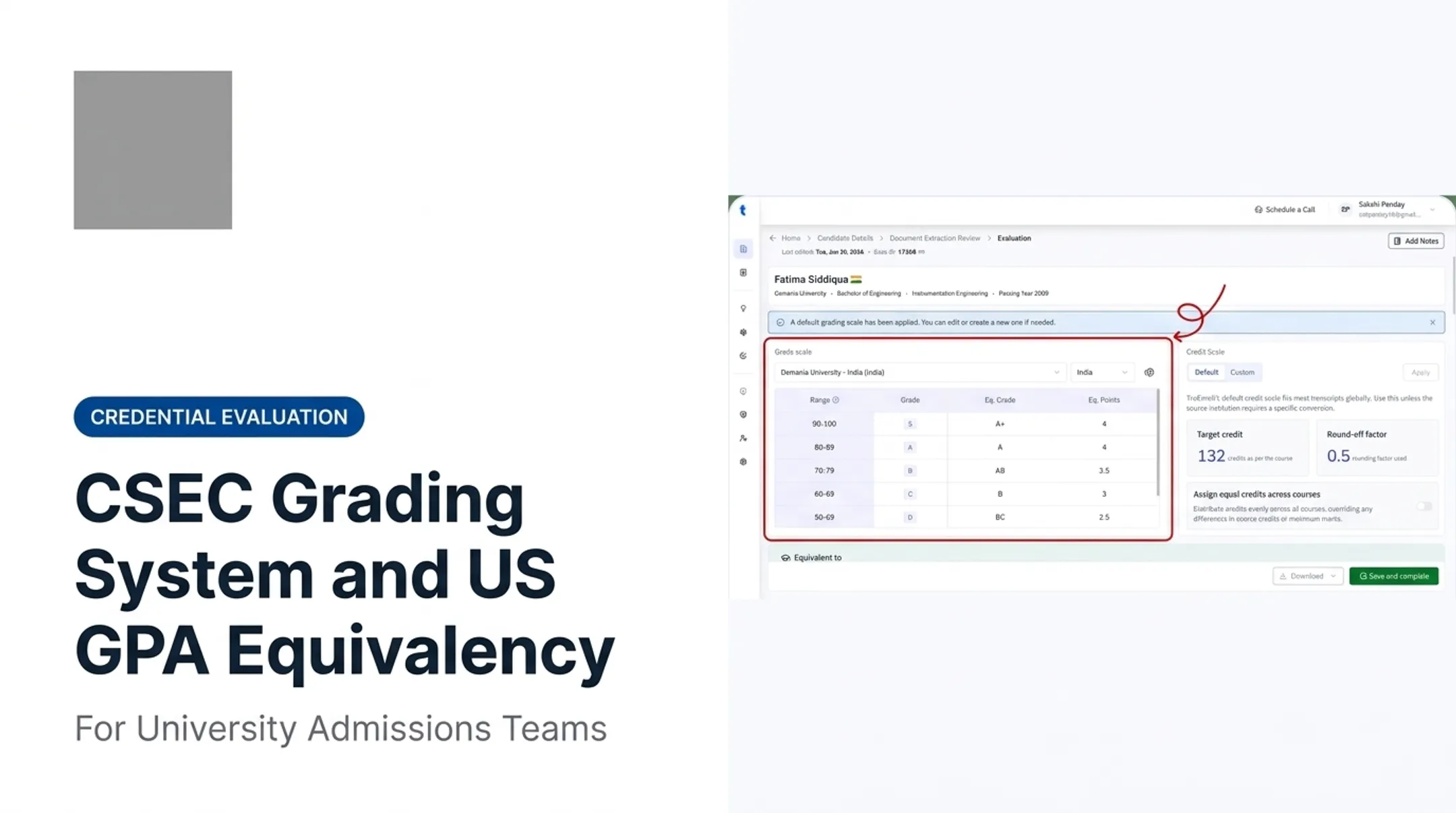
This is where automated evaluation tools help most. TruEnroll's Document Evaluation step applies the issuing institution's specific grading scale, drawn from a library of more than 150 pre-configured international grading systems, instead of one blanket formula. Every converted GPA traces back to its exact location on the source document.
A Practical Framework for Evaluating an Indian Transcript
Consistent evaluation starts with process, not shortcuts. Here's a five-step framework:
- Identify the issuing authority. Confirm the board or university, program, campus, qualification level, grading scheme, and the scheme year. Grading rules change over time even within the same institution.
- Locate the grading legend. Check the marksheet notes, back-page instructions, certificate supplement, or official policy document that accompanies the transcript.
- Reconcile the academic record. Cross-check course titles, credits, marks, grades, semester and cumulative results, pass status, repeats, withdrawals, and any transferred credits.
- Validate anything unusual. If a record looks ambiguous, contact the issuing institution or an authorized evaluation source directly. Don't infer meaning from a generic online table.
- Document the audit trail. Record the source consulted, formula applied, exceptions handled, the reviewer's name, and the final institutional determination.

Applied to a Bachelor of Engineering transcript from Osmania University in Telangana, TruEnroll's evaluation workflow runs the same checks end to end:
- Confirms the program, 2005 admission year, 2009 completion year, and four-year duration
- Maps course marks (for example, 89 out of 100 in Programming in C & C++) to U.S. credit and grade equivalents
- Keeps every field traceable to its exact coordinates on the original document
Common Mistakes When Comparing Indian Grades Internationally
Even experienced admissions staff fall into predictable traps when reviewing Indian transcripts.
- Applying a generic multiplier. "CGPA × 9.5" or "CGPA ÷ 10 × 4" without confirming the issuing university's grading policy.
- Assuming identical CGPAs mean identical achievement. Grade bands, course structures, and conversion formulas differ by institution, so two students with the same 8.5 CGPA may not have performed at the same level.
- Confusing screening estimates with formal evaluation. A rough conversion for initial review is not a formal credential equivalency for licensed professions, transfer credit, scholarships, or immigration.
- Overlooking letter-scale mismatches. AACRAO's 2025 white paper notes that at IIT Madras, "S" equals 10 points and "B" equals 8, while a UGC example labels 8 points as "A." Letters without institutional context misplace standing.
- Data-quality slips. OCR misreads, missing grading legends, inconsistent abbreviations, altered documents, and mixing up semester GPA with cumulative GPA all corrupt conversion accuracy.
High-volume admissions offices encounter these risks regularly. TruEnroll's transcript-processing workflow addresses them directly. It preserves field-level source traceability for every extracted number, applies registrar-defined policies for exclusions and repeats, and runs automated forensics that flag altered documents or unrecognized institutions before verified data reaches a CRM or SIS.
What Indian Grading Equivalency Means for Higher-Education Operations
Grading data serves different purposes depending on who uses it:
- Admissions teams — initial screening
- Registrars — transfer credit and progression decisions
- International student offices — scholarship eligibility and academic standing reviews
Treating all three as one task produces inconsistent outcomes.
A better operating model separates two functions:
- Automated extraction identifies grades, credits, scales, and inconsistencies at scale.
- Authorized staff review and approve the policy-sensitive decisions those findings inform.
This separation matters for governance too. Student records need:
- Privacy protection and controlled access
- Human verification on ambiguous cases
- Clear source provenance
- A documented escalation path when a credential does not fit standard rules
Institution-specific policy differences make this concrete. The University of Delhi's postgraduate ordinance sets First Division at 60% and above for the programs it covers, a threshold that does not apply to RGPV's separate CGPA-to-percentage formula.
Assuming one university's policy governs another's transcripts is the error a documented, registrar-approved policy engine is built to prevent. TruEnroll keeps registrar policy overrides fully human-in-the-loop, so automation handles volume while staff retain the final call.
Conclusion
India doesn't run one national GPA scale. It runs a family of board- and institution-specific systems, each with its own logic, and no shortcut formula captures all of them accurately.
The practical path forward:
- Preserve the original result exactly as issued
- Verify the official grading context behind it
- Apply the correct institutional policy
- Document whatever international equivalency you use
That documentation is what turns a rough estimate into a defensible, repeatable decision.
Frequently Asked Questions
What is the grading scale in India?
India uses multiple percentage, letter-grade, grade-point, and GPA/CGPA scales that vary by board and university. Read any result against that institution's own grading legend.
How are percentages converted to grades in India?
Conversion follows each board or university's grade bands, which may use fixed mark ranges or relative ranking. No single nationwide cutoff applies to every Indian credential.
What is a 4.0 GPA in India?
A 4.0 belongs to the U.S.-style GPA scale, not to one standard Indian grade. No Indian percentage or CGPA value automatically equals 4.0 across institutions.
What do A1, A2, B1, B2 mean in CBSE?
These CBSE letter grades mark relative performance bands on Class X (Grade 10) results. Exact bands follow the grading framework published for that examination year.
Is there one standard CGPA-to-GPA conversion formula for all Indian universities?
No. Each university may publish its own grading legend, so admissions and evaluation decisions should follow the receiving institution's policy, not a generic online calculator.
What documents should institutions review when evaluating an Indian transcript?
Start with the transcript or marksheet, its grading legend, and the degree or certificate. Add any transcript supplement or institutional regulations, plus a verification or evaluation report when your policy requires one.