
Introduction
A detailed evaluation report takes a messy pile of transcripts, mark sheets, or credentials and turns it into something a decision-maker can actually trust. It connects raw academic evidence to a clear admissions, transfer-credit, credential, or compliance outcome.
The hard part? Reports need enough depth for expert review, yet they still have to be clear, traceable, and fast enough to keep applicants from walking away.
Many admissions and registrar teams struggle with multi-week evaluation backlogs while trying to balance those two demands at once.
This article covers why detailed reports matter, what they should contain, how they get produced and reviewed, and what quality standards (including responsible AI use) look like in practice.
Key Takeaways
- Detailed reports link evidence to findings and make reasoning, exceptions, and limitations visible
- A one-page overview communicates results fast but should never replace access to underlying evidence
- Quality requires consistent criteria, policy alignment, human review, and secure data handling
- An auditable trail of changes and approvals protects institutions during appeals or compliance reviews
Why Detailed Evaluation Reports Matter
Credit-award decisions carry real weight for applicants and institutions alike. When evaluations are inconsistent, students lose credit they earned elsewhere, admissions teams repeat work, and registrars field appeals they can't fully explain.
The joint AACRAO, ACE, and CHEA position on transfer credit calls for standardized, equitable evaluation practices applied consistently across a receiving institution. Denials need a reasonable basis and a clear rationale, not just a lower number on a transcript.
Uncertainty about credit recognition is already a major pain point for transfer students. According to AACRAO's 2025 research, 82% of prospective transfer learners reported uncertainty about how their credit would be recognized at a potential institution.

A detailed report, paired with a clear overview, closes that gap.
A detailed report differs from a brief overview in one key way: the overview states the outcome; the detailed report preserves the evidence, calculations, assumptions, exceptions, and reasoning behind it.
Who Actually Uses These Reports
Different teams need different things from the same document:
- Admissions staff need a fast, defensible answer to attach to an application
- Registrars need the course-by-course math and policy application
- Faculty evaluators need the academic rationale behind equivalency calls
- Applicants need clarity on what transferred and why
- Compliance teams need an audit trail for internal or external review
- IT and security stakeholders need confidence that data handling meets institutional standards
Skip the detail, and you risk inconsistent decisions, duplicated manual work, and reports nobody can defend six months later when an applicant appeals.
What a Detailed Evaluation Report Should Contain
A report earns trust by showing its work. Start with the scope and evaluation question. Common questions include:
- Admission eligibility
- Academic equivalency
- Transfer-credit applicability
- Professional credential verification
- Fraud review
Each question demands different evidence.
Source and Identity
This section establishes what's actually being evaluated:
- Document type and issuing institution or authority
- Dates of study or award
- Student or candidate identifiers
- Original language and delivery method
- Information needed to confirm record authenticity
NACES professional standards require member agencies to clearly identify the institution, the credential or program as named on the official document, the award year or enrollment period, and the applicable field of study, at minimum.
Academic and Evidentiary Analysis
This section covers the core analysis:
- Institutions attended and programs completed
- Courses or activities, grades, and credits or units
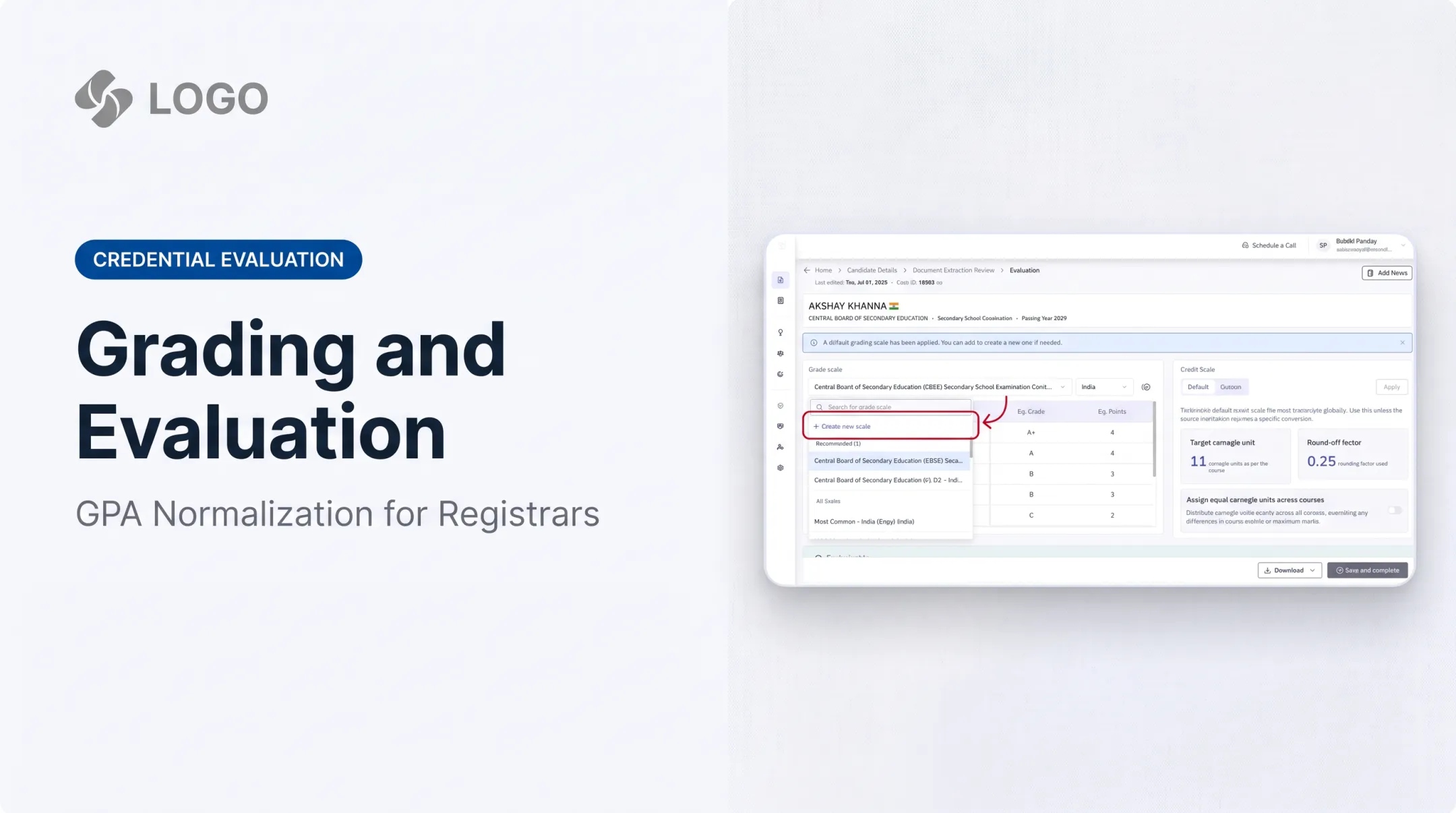
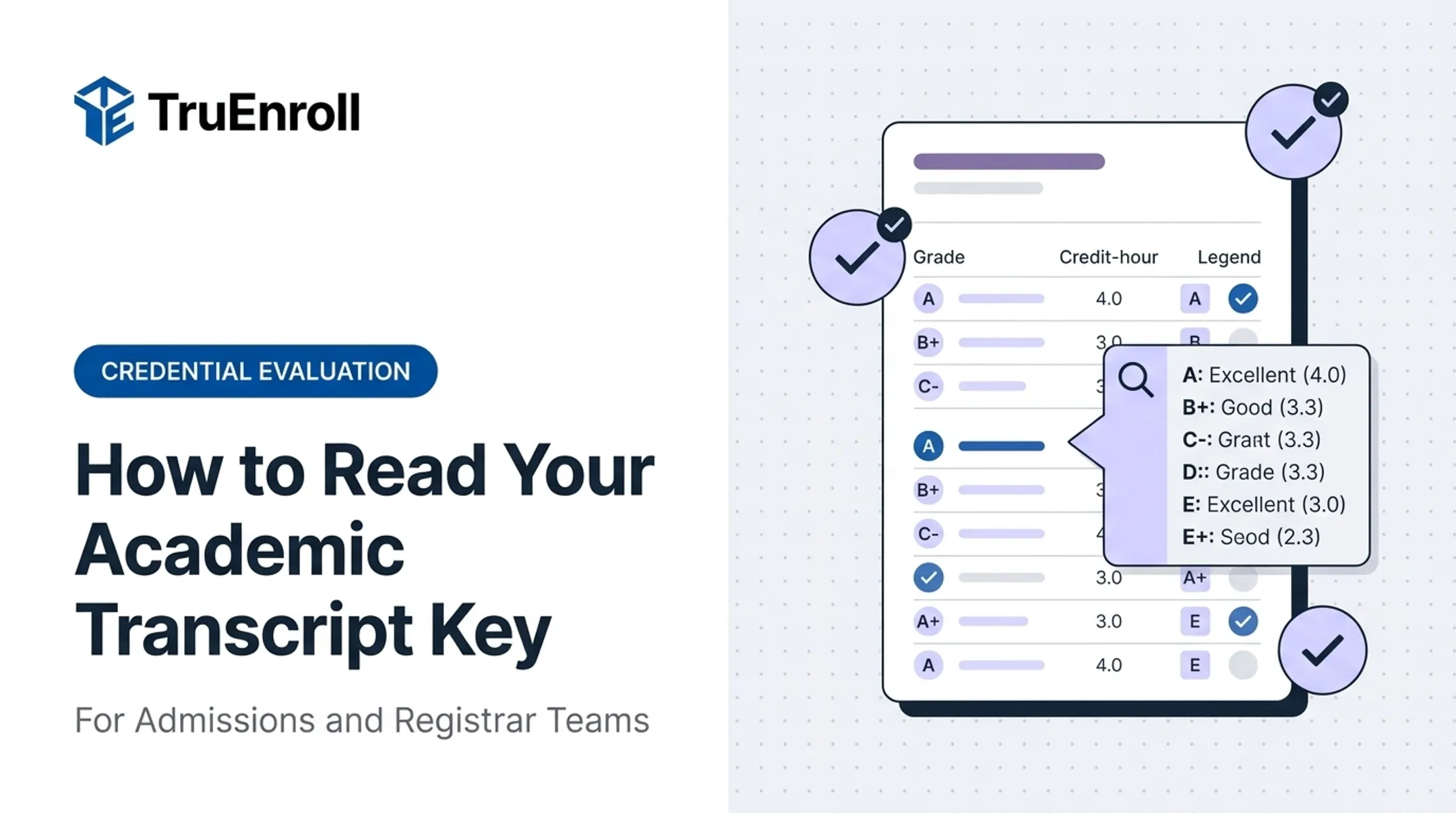
- Grading scales, conversions, exclusions, and repetitions
- Any gaps in the record
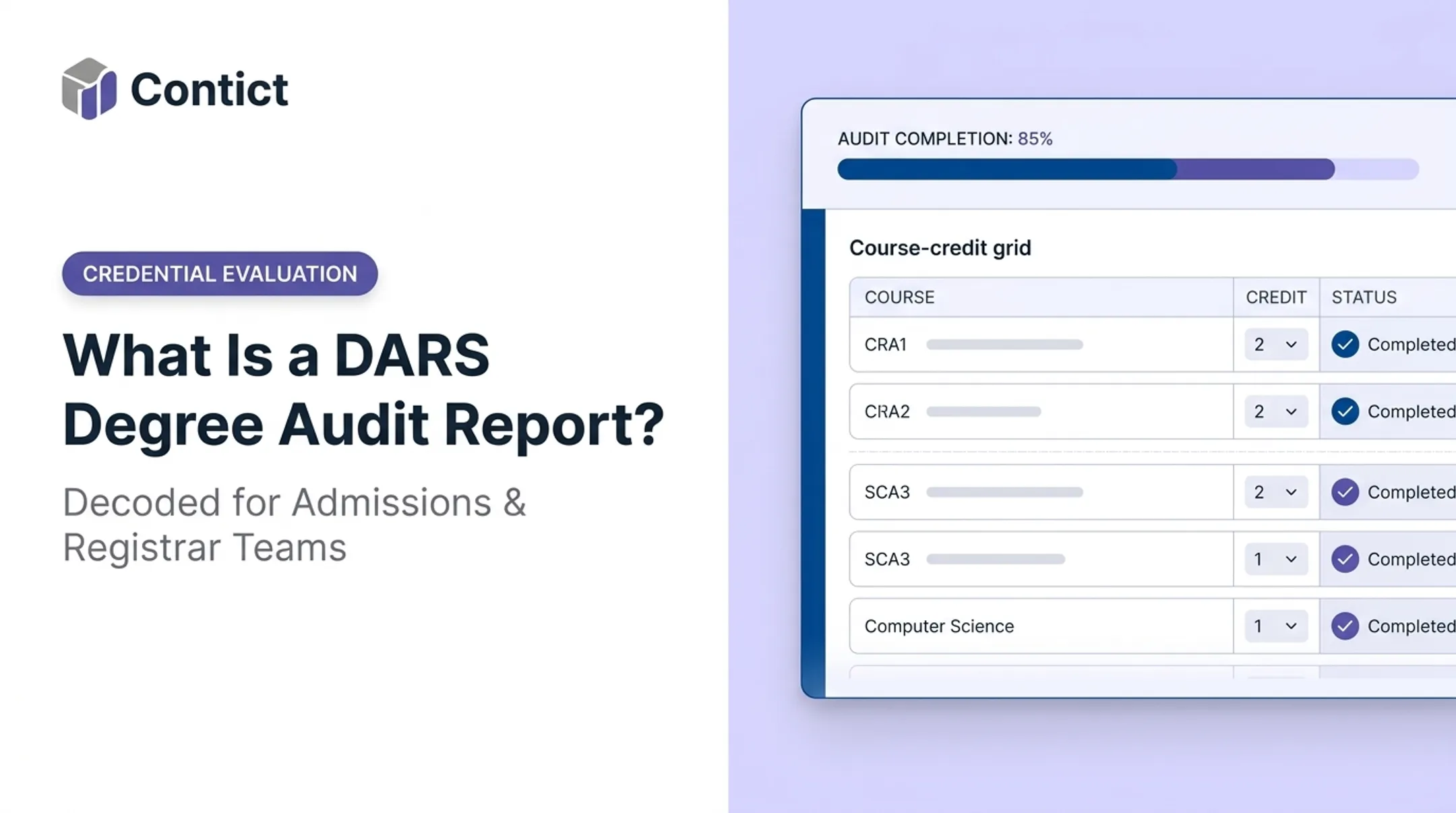
A course-by-course table (course name, credits, grade, converted equivalent, points) works better here than narrative paragraphs.
Methodology, Exceptions, and Conclusion
Every conclusion should trace back to a source field, policy, or standard, not just appear as a number. Document exceptions explicitly:
- Missing pages or unclear sections
- Inconsistent names across documents
- Unrecognized institutions or unclear grading systems
- Suspected alterations requiring further verification
The report should close with a result, any conditions attached, reviewer status, a date, and known limitations, stated plainly and without overstating certainty.
How Detailed Evaluation Reports Are Produced and Reviewed
Producing a defensible report is a multi-step workflow. The typical path runs:
- Intake and identity matching - confirming the document belongs to the right applicant
- Extraction - pulling structured data from unstructured documents
- Normalization - converting grades, credits, and terminology to a common scale
- Policy application - applying institutional rules for exclusions, repetitions, and conversions
- Exception handling - flagging anything ambiguous or inconsistent
- Human verification and approval - qualified review before release
- Delivery or synchronization - sending verified data to the systems that need it
Source quality varies widely. Records arrive in different languages, scripts, layouts, grading scales, and institutional terminology, which is where automated-only processing often fails.
A Two-Layer Review Model Works Best
Automated checks handle extraction accuracy, calculations, consistency, and routing at scale. Qualified human reviewers then step in for ambiguous, high-impact, or policy-sensitive findings. Both layers are required for defensible results.

Before release, teams should confirm:
- Field completeness and arithmetic/conversion accuracy
- No duplicate or conflicting records
- Policy compliance and reviewer sign-off
- Consistency with comparable past cases
- Version history showing source document, transformations, and approvals
- Privacy safeguards and recipient permissions are correctly set
- The overview accurately reflects the detailed findings underneath it
Quality Standards and Technology Considerations
Nine criteria tend to separate a trustworthy report from a rushed one: accuracy, completeness, consistency, explainability, timeliness, privacy, security, accessibility, and fitness for the intended decision.
Automation has a clear, limited role here. AI can process high volumes and surface patterns humans would miss. Configurable institutional rules, human escalation paths, and verification for uncertain or consequential findings still have to sit on top of it.
NIST's voluntary AI risk-management guidance recommends documenting who is accountable for AI-assisted decisions and defining when human oversight kicks in, not treating automation as a black box.
Visual provenance matters more than most teams realize. If a reviewer can't click a reported grade and jump straight to the exact spot on the source transcript, verifying that finding takes far longer than it should.
Protecting student data isn't optional. FERPA's disclosure rules require that outside parties handling education records operate under direct institutional control, follow use and redisclosure restrictions, and meet the same legitimate-interest standard as internal staff.
Where TruEnroll Fits
TruEnroll's evaluation engine was built around this exact workflow. It:
- Processes unstandardized domestic and international transcripts without manual templates
- Applies policy-based credit and grade handling for exclusions, repetitions, and unit conversions
- Flags fraud or inconsistency signals before a decision gets made
A typical case shows the model in action: a U.S.-equivalent GPA, recognized credits, 42 of 42 fields traced back to source coordinates, and a confidence score reviewers can act on, synced directly into Slate, Banner, or Salesforce.

Institutions evaluating any platform, TruEnroll included, should still validate accuracy, security controls, integration behavior, escalation procedures, and governance requirements for their own environment before deployment.
Conclusion
A detailed evaluation report is more than a tidy summary. It's a defensible chain running from source evidence to institutional decision, one that holds up when an applicant appeals or an auditor asks questions.
The practical standard includes:
- Clear scope and complete evidence
- Transparent methodology with visible exceptions
- Documented review and secure handling
- A concise overview that matches what's underneath it
If your current workflow can't produce that chain quickly, audit where the manual bottlenecks and traceability gaps actually sit, and whether automation can close them without weakening human accountability.
Frequently Asked Questions
What does "detailed analysis" mean?
It means systematically examining source information, context, evaluation criteria, discrepancies, and evidence before reaching a supported conclusion. It's the opposite of a snap judgment based on a single data point.
What is the difference between a detailed evaluation report and an overview?
An overview communicates the key result quickly : the GPA, the credit total, and the equivalency statement. The detailed report preserves the evidence, methodology, exceptions, and reasoning that produced that result.
What sections should be included in a detailed evaluation report?
At minimum: scope, source information, methodology, findings, discrepancies or limitations, conclusion, reviewer details, and supporting evidence. Missing any of these weakens the report's defensibility.
How can institutions ensure that evaluation reports are accurate?
Use standardized criteria, verify source documents, run automated consistency checks, and require qualified human review. Document corrections and run periodic quality audits across comparable cases.
Can AI create detailed evaluation reports?
AI can assist with extraction, normalization, comparison, and drafting. Human oversight, policy controls, exception handling, and final accountability for the decision still have to remain with qualified staff.
How should sensitive information in evaluation reports be protected?
Through role-based access, encryption, secure integrations, retention controls, audit logs, and clear privacy policies. Institutions also need to confirm compliance with FERPA and other applicable education and data-protection requirements.