
Many students assume transfer credit and degree credit mean the same thing. They don't. A course can transfer into an institution's accepted-credit ledger without ever satisfying a specific major, general education, or elective requirement. That gap confuses students and eats up advising-office time.
The stakes are real. Between 2004 and 2009, students transferring colleges lost an average of 43% of their earned credits, according to the GAO's 2017 report, roughly 13 credits, nearly a semester of tuition, gone.
This guide covers what belongs in a transfer credit policy, how institutions should manage evaluation workflows, and where technology fits into transcript review without replacing registrar judgment.
Key Takeaways
- Define eligible sources, grade minimums, equivalencies, credit caps, residency rules, and appeals in one written policy
- Transferable credit doesn't automatically satisfy degree, major, or gen-ed requirements
- Consistent documentation and plain-language communication prevent disputes and advising bottlenecks
- Review policies regularly against accreditation standards and curriculum changes
- Technology can speed evaluation but shouldn't replace registrar or faculty judgment
What Are Transfer Credit Policies?
A transfer credit policy is the rulebook an institution uses to decide whether outside coursework can count toward a student's record. Sources can include another college, an AP or IB exam, military training, or a prior learning assessment.
The policy sets which sources count, how many credits a student can bring in, and who makes the final call.
Transfer Credit vs. Degree Applicability
Transfer credit and degree applicability aren't the same thing, and conflating them is where most student complaints start. AACRAO's joint statement on the transfer and award of credit draws a clear line. Accepting a course as transferable is separate from counting it toward a specific major, general education category, or elective slot.
Key distinctions:
- Transfer credit – credit a receiving institution agrees to accept from another provider
- Course equivalency – a faculty-reviewed match between a transferred course and one offered on campus
- Institutional (residency) credit – coursework completed "in residence" at the degree-granting school
- Program applicability – whether accepted credit actually satisfies a declared requirement
Why Policies Vary So Much
No two institutions handle this the same way. A community college articulation agreement looks nothing like an international credential evaluation, and a state system's rules won't match a private university's departmental review process. Variables include accreditation type, state or system-level agreements, program sequencing, and how recently the coursework was completed.
These differences hit students directly in the wallet. A rejected course means retaking it, paying for it twice, and pushing back graduation. A published policy is the starting point, not the final answer. Transcripts with outdated coursework, foreign grading scales, or thin documentation almost always need individual review, no matter how detailed the manual is.
What Should a Comprehensive Transfer Credit Policy Include?
Simply stating "we accept transfer credit" is not a real policy. A thorough version spells out the following in writing.
Eligible Sources and Grading Standards
Specify where credit can originate:
- Regionally or nationally accredited institutions
- Community colleges and two-year programs
- International institutions and credential evaluation services
- Approved exam programs (AP, IB, CLEP)
- Military training and prior learning assessments
Then set the bar for acceptance. Minimum-grade rules differ sharply across institutions. Some schools accept C- or better for standard transfers but allow D grades from an already-completed degree, treating the degree itself as evidence of academic success.
There's no universal cutoff, so your policy needs to define pass/fail treatment, repeated coursework, and how incomplete or withdrawn classes count.
Equivalencies, Degree Applicability, and Limits
Someone has to decide whether a transferred course is a direct equivalent, satisfies general education, counts toward a major, or only earns elective credit. Spell out who:
- Registrar staff confirm the transcript and initial course match
- Academic departments judge subject-specific equivalency
- Program directors confirm major and prerequisite fit
- Advisors communicate the outcome and remaining requirements
Pair that with hard limits: how many credits can transfer by source or category, and how much coursework the student must complete in residence. Also address time limits. Does a ten-year-old biology course still count, and what happens when a program retires the course it would have matched?
Documentation, Exceptions, and Appeals
List exactly what's required:
- Official transcripts and grading-scale keys
- Course descriptions or syllabi
- Translations and accreditation evidence
- Exam score reports
Then build a fair exceptions process covering who can request a review, what evidence they need, expected response timeframes, and how the decision gets recorded.
Distinguish a one-time exception from a precedent-setting articulation rule. The latter should update the policy itself, not just one student's file. Be upfront about uncertainty, too: provisional evaluations, transfer caps, and elective-only credits need to be communicated before a student commits, not after.

How Should Institutions Manage the Transfer Credit Evaluation Process?
A clean policy on paper doesn't help if the evaluation workflow behind it is slow or inconsistent. Institutions need a mapped process: receipt of the official record, document validation, transcript extraction, review, articulation, degree-audit update, student notification, and final record-keeping.
Setting Realistic Service Standards
Turnaround benchmarks vary widely by institution and case complexity. There's no single industry standard, but published examples give a useful range:
| Institution | Timeframe | Trigger |
|---|---|---|
| Utah State University | 48 hours (routine) to 2-3 weeks (departmental review) | After admission file is complete |
| Austin Peay State University | 5-7 business days | Registrar processing |
| East Carolina University | 15 business days (standard); 30 days (international or 4+ transcripts) | After admission offer and official transcripts |
Build escalation paths for complex cases: international records, missing documentation, and suspected fraud each need their own track and timeline. Someone also needs ownership of policy version control, since articulation agreements, grading systems, and curricula change constantly.
Decision Consistency and Quality Control
Ambiguous coursework needs a repeatable decision framework, not case-by-case guesswork. Compare learning outcomes, contact hours, academic level, subject matter, and assessment methods against the target course.
Build quality checks that catch:
- Duplicate or excessive credit
- Mismatched course levels
- Repeated coursework and grade exclusions
- Unit-conversion errors, like quarter hours miscounted as semester hours
- Credit that can't actually apply to the student's declared program
Manual quarter-to-semester conversions alone can eat up 35-plus minutes per file when done by hand, which is exactly where many registrar offices now lean on software to catch what manual review misses at scale.
Students also need plain-language explanations of outcomes: accepted credits, rejected credits, elective-only classifications, remaining requirements, and how to appeal. Transfer students often feel out of the loop or get conflicting answers from different offices. A consistent written explanation at the point of decision closes that gap before it becomes a complaint.

How Can Technology Support Transfer Credit Policy Administration?
Registrar offices face growing pressure to process transcripts quickly without sacrificing accuracy. AACRAO's 2025 survey found that 25% of responding institutions were already using or implementing AI in academic operations, with transfer-credit evaluation and transcript processing ranking among the top applications mentioned.
What Automation Can Actually Handle
Transcript-processing technology extracts coursework, grades, units, dates, and institution details from both standard and nonstandard records, domestic and international, while flagging low-confidence fields for a human reviewer. It can apply institution-specific rules consistently:
- Grade exclusions and minimum-grade thresholds
- Repeated-course handling
- Quarter-to-semester or ECTS unit conversions
- Equivalency mapping to CIP and SCED codes
- Transfer limits and degree-applicability flags
TruEnroll is built around this kind of rules-based evaluation. Institutions can configure exclusions, repeated-course logic, credit ratios, and minimum grade-transfer thresholds.
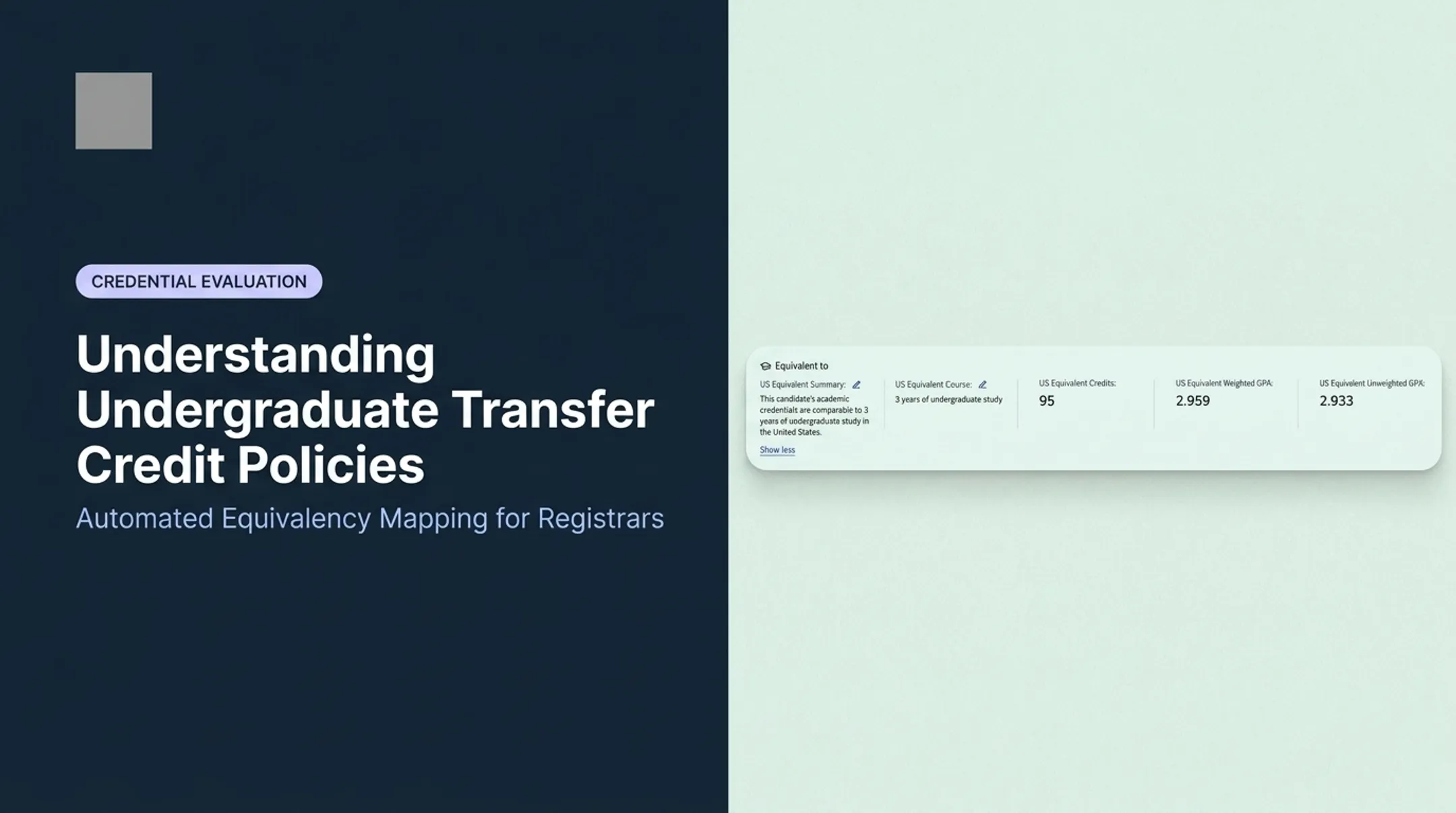
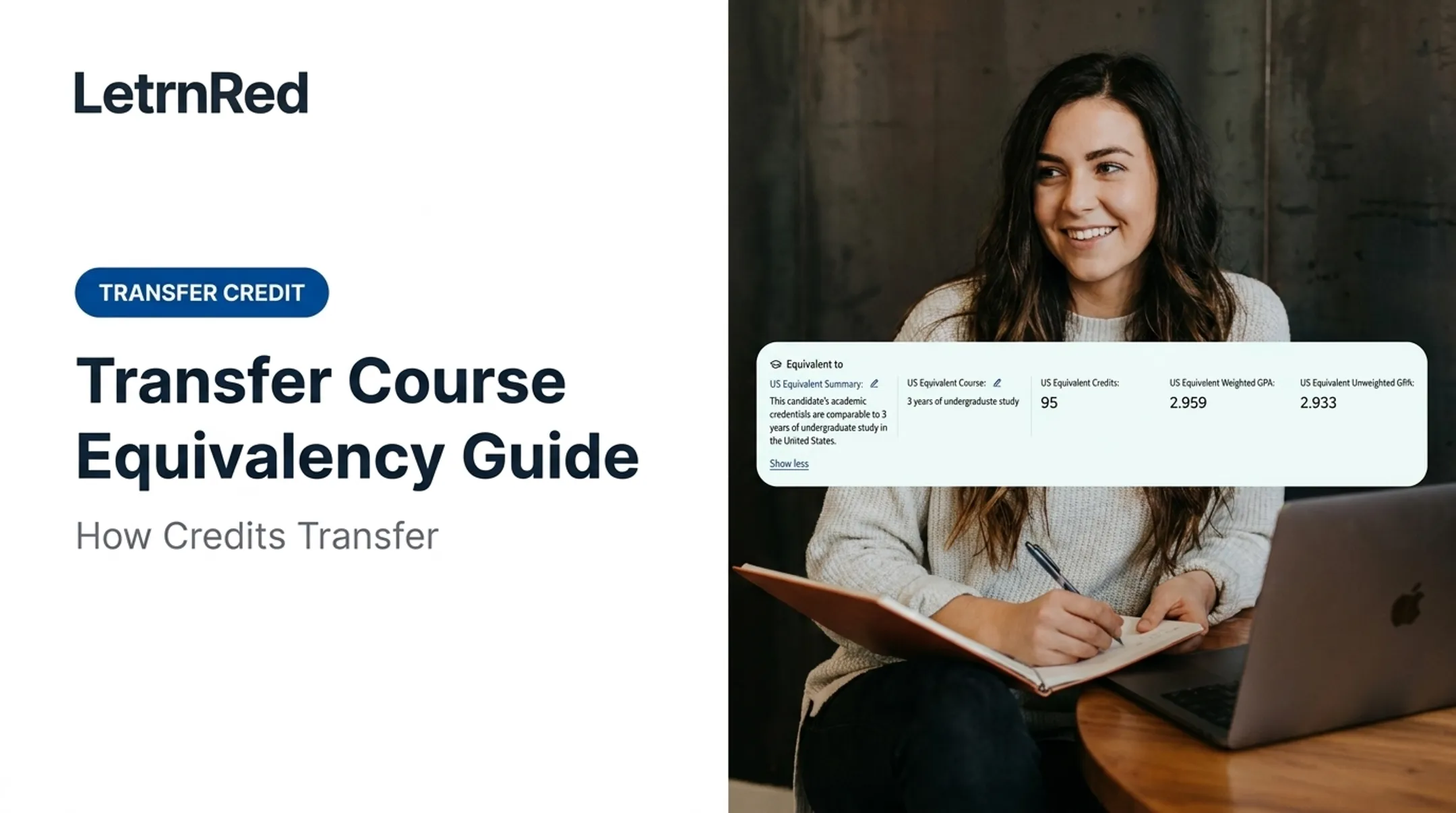
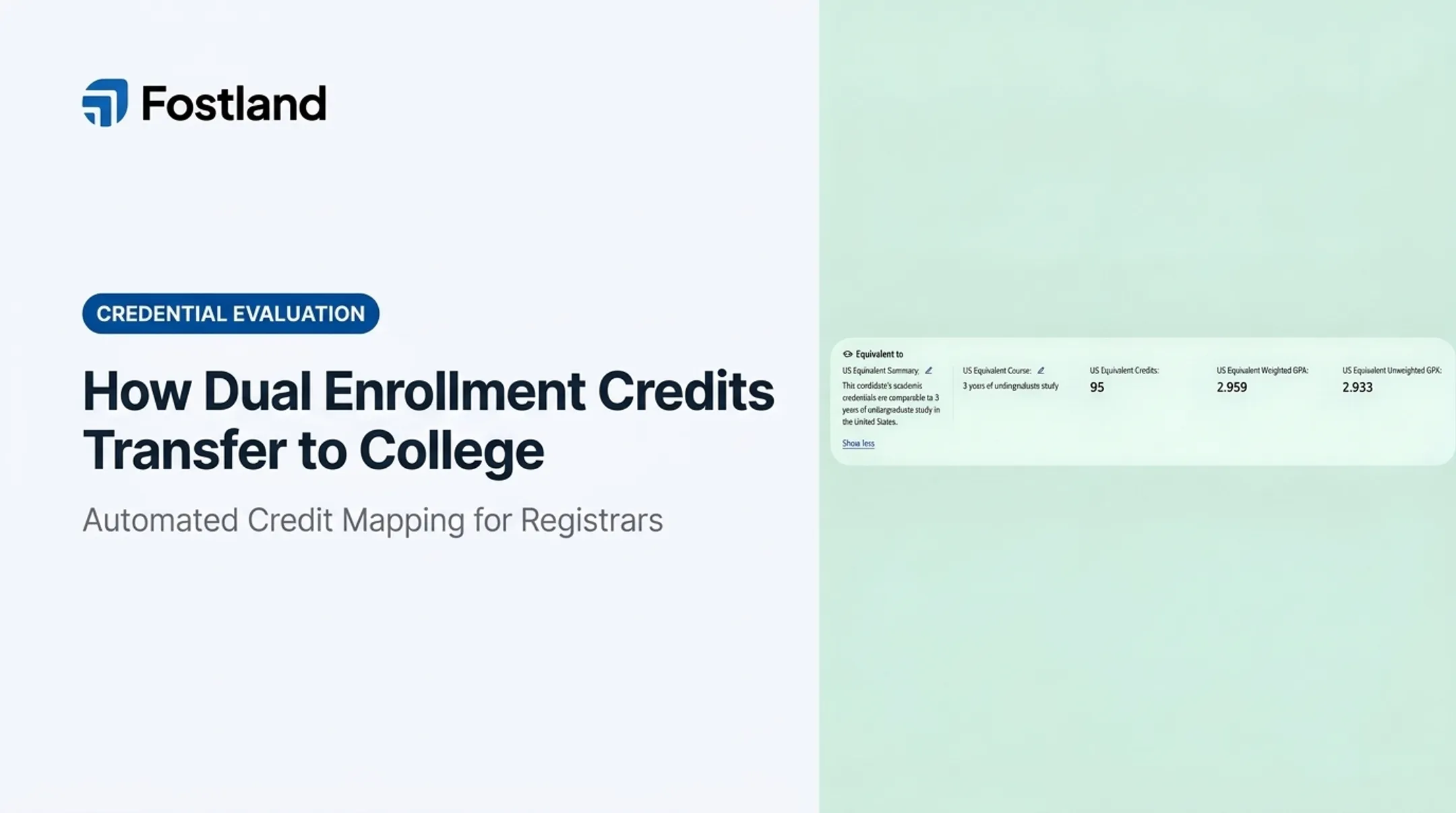
The platform then returns a US-equivalent GPA, credit total, and course-by-course equivalency for each applicant, with every field traced back to its exact location on the source document.

Security, Traceability, and System Integration
Any technology touching student records needs field-level source traceability, audit-ready logs, version control, and role-based access. FERPA requires institutions to restrict record access to staff with a legitimate educational interest, and that obligation doesn't disappear just because software handles the first pass.
Practical requirements include:
- Encryption at rest and in transit
- Role-based access limiting who can view which fields
- Direct integration with CRM and SIS platforms like Slate and Banner instead of manual CSV exports
- Documented retention and data-handling policies reviewed by campus security teams
TruEnroll supports this with SOC 2 Type II, ISO 27001, and ISO 27701 certifications, AES-256 encryption, and direct synchronization into CRM and SIS fields. None of this replaces registrar or faculty judgment on degree applicability. It just gets accurate, traceable data in front of the people making that call faster.
Frequently Asked Questions
How much is 1 credit hour at KU?
The cost depends on residency status, program, campus or delivery format, and current fees. Check KU's official tuition and fee schedule for this year's exact per-credit-hour rate.
What AP exam scores does KU accept for credit?
Accepted AP subjects, minimum scores, and awarded credit hours change periodically. Review KU's current official AP and exam-credit table before assuming a specific score qualifies.
How many KU credit hours is one AP exam worth?
Credit hours vary significantly by subject and score, ranging from 3 to 14 hours in KU's published table. Check the official equivalency chart for your specific exam rather than assuming a flat value.
Is a 70% equivalent to a 5 on the AP exam?
No. Classroom percentages and AP exam scores use entirely different grading systems and can't be reliably converted without an institution-specific equivalency rule.
Is a D+ a passing grade at KU?
Whether a D+ earns credit or satisfies a requirement depends on the course, program, and KU's current grading policy. Confirm with an advisor or KU's official academic regulations before relying on it.
Can I get into KU with a 2.5 GPA?
Admission depends on applicant type, academic history, transfer coursework, and KU's current criteria. A 2.5 GPA alone doesn't guarantee acceptance, so check KU's official admissions requirements for your specific pathway.