
This guide is designed for families, students, university admissions teams, registrars, and credential evaluators. We will break down Panama's school structure, explain common grading formats, and provide a clear framework for interpreting transcripts. Because grading practices can vary significantly, this article relies on official sources from Panama’s Ministry of Education (MEDUCA) and specific institutional examples, avoiding unverified or universal conversion rules.
Key Takeaways
- Panama's education path typically moves from preschool to primary, then pre-media and media, before higher education.
- A grade from Panama must be interpreted using the transcript's grading legend, pass mark, and institutional context.
- Reviewing a transcript for admissions and making an official credential-recognition decision are two separate processes.
- International institutions must verify grading scales, course history, and document authenticity before granting admission or credit.
Understanding the Structure of Panama’s Education System
Panama's Ministry of Education (MEDUCA) oversees the national school system. Private, bilingual, international, and technical schools may follow different frameworks.
Compulsory schooling falls under Educación Básica General (General Basic Education), which is free. Upper-secondary education follows and is also free, though not compulsory.
The official stages are:
- Educación Inicial (Early Education): Children up to age 3
- Preescolar (Preschool): Two years for ages 4–5; begins General Basic Education
- Primaria (Primary): Six years for ages 6–11; foundational subjects and annual report cards
- Premedia (Lower Secondary): Three years for ages 12–14; completes the 11-year compulsory General Basic Education framework
- Educación Media (Upper Secondary): Three years for ages 15–17; free but not part of compulsory basic education
At this level, students choose a specialized pathway—academic (Bachiller en Ciencias, Letras, or Comercio), technical, or vocational. The path determines the diploma awarded and shapes higher-education options.

Credential reviewers should separate grade level, completed program, and final diploma:
Diploma de Pre-Media: Completion of lower-secondary schoolDiploma de Educación MediaorDiploma de Bachiller: Upper-secondary completion credential required for university access
School Types, Language, Academic Calendar, and Daily Schedule
Panama’s schools include public, private, bilingual, and international options. School type often shapes curriculum, language, calendar, and how the transcript is formatted.
- Public vs. private: Public schools are government-funded and follow the national MEDUCA curriculum. Private schools charge tuition and may use MEDUCA, a U.S. or British model, or the International Baccalaureate (IB).
- Language of instruction: Spanish is used in the national system. Bilingual and international schools may mix Spanish, English, or another language—check the language listed for each subject on the transcript.
- Academic calendar: MEDUCA’s national calendar typically runs March to December. Many international schools instead follow an August to June calendar.
- Attendance gaps: An apparent gap or overlap on a transcript may only reflect a move between schools on different calendars.
- Daily schedule: There is no single school day. Some schools run morning or afternoon shifts (
jornada matutinaorjornada vespertina); others offer a full-day program with varied start, dismissal, and activity times.
How Grading Works in Panama
Panama does not have one universal grading system. Formats vary by institution, education level, and even program. You may encounter numeric marks, percentages, letters, or descriptive terms.
Reading a Grade in Context
To properly interpret a grade, you must look beyond the number or letter itself.
- Find the Grading Legend: The most important tool is the grading scale legend (
escala de calificación) printed directly on the transcript. This legend defines the maximum mark, the minimum passing mark, and the meaning of each grade. - Identify the Mark Type: Determine if the mark is a final course grade, a term grade, an exam result, or a conduct mark. Panamanian transcripts often show grades for multiple trimesters and a final grade.
- Check for Weighting and Credits: Look for information on credit hours (
créditos), contact hours, or weighting that might explain how the final grade was calculated.

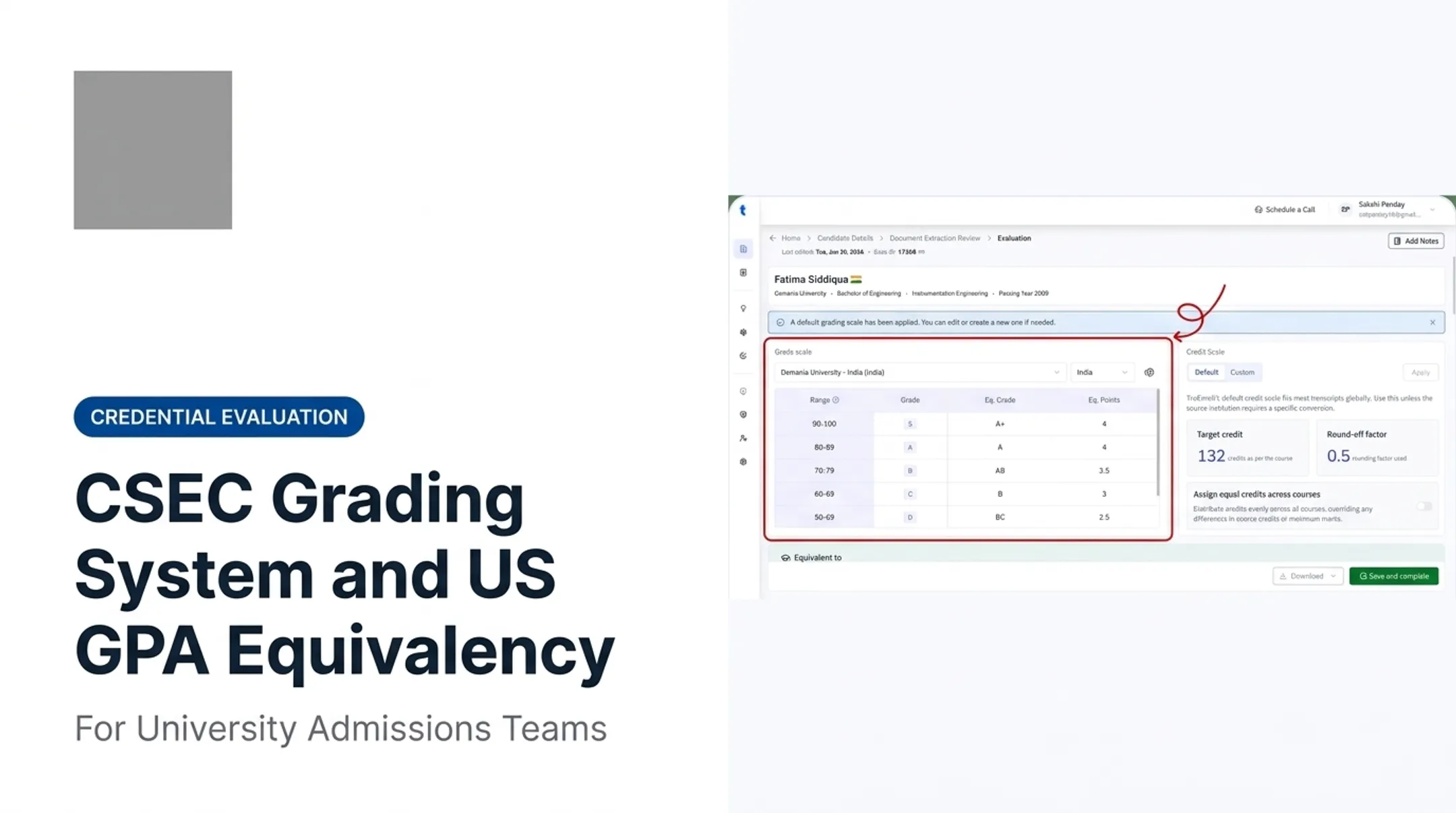
Directly converting a Panamanian grade to a U.S. GPA without this context is highly misleading. A "3.5" on a 5.0 scale means something very different if the passing mark is 3.0 versus 2.0.
Example of a Panamanian Grading Scale
While no single scale is universal, a numeric scale of 1.0 to 5.0 is common. One published interpretation appears in the NCAA's guide for student-athletes from Panama.
This table is an NCAA-specific equivalency for athletics eligibility, not an official conversion rule for university admissions.
Illustrative Example (Based on NCAA Eligibility Guidelines)
| Numeric Grade (Panama) | Potential Meaning | NCAA Quality Points (for athletic eligibility only) |
|---|---|---|
| 4.5 – 5.0 | Excellent | 4 (A) |
| 4.0 – 4.4 | Good | 3 (B) |
| 3.0 – 3.9 | Satisfactory | 2 (C) |
| 1.0 – 2.9 | Failed | 0 (F) |
Disclaimer: This table is for illustrative purposes only. The minimum passing grade is often 3.0, but this must be verified on the official transcript. Receiving institutions set their own evaluation policies.
Grading policies can also change between primary, secondary, and higher education. Never assume a grading scale from a high school diploma applies to a university transcript from Panama.
How to Evaluate a Panamanian Transcript or Academic Record
Admissions and credential evaluation teams need a clear sequence when reviewing a Panamanian transcript so decisions stay fair, consistent, and defensible.
A Practical Review Sequence
- Confirm Core Information: Verify the student’s full name, the institution’s name and location, the program of study, dates of attendance, and the credential awarded.
- Locate the Legend: Find the grading scale, minimum passing mark, and definitions of terms or abbreviations. Without a legend, you cannot evaluate the record accurately.
- Analyze Course History: Review course titles, grades, and credits. Note failed courses, repeated attempts, withdrawals (
RetiradoorR), and transfer credits. - Verify Authenticity: Check official signatures, seals, and stamps, and confirm the file arrived through a secure channel (for example, directly from the institution). For non-English documents, confirm whether an official translation is required and who provided it.

Remember that different academic calendars or curricula can create unusual course placements. A repeated subject might not be a failed attempt but a result of moving between a national and an international school. Likewise, a grade of "A" for "Aprobado" means "Passed," not an "A" letter grade.
Official Recognition vs. Internal Evaluation
Institutions usually separate three decisions:
- Admission Review: Determines whether an applicant is eligible for consideration.
- Credential Recognition: Establishes equivalency of a foreign diploma or degree (for example, whether a
Bachillerequates to a U.S. high school diploma). - Credit Articulation: Decides which courses transfer and apply toward a new program.
These processes often follow different policies and documentation rules.
For high-volume international transcript workflows, automation can reduce manual effort while leaving final judgment with admissions officers. TruEnroll extracts student identity, courses, credits, and grades from unstructured documents in more than 50 languages. It matches scales from a library of 150+ grading systems and flags issues such as a missing legend or possible tampering for human review.
That shift lets evaluators spend time on decisions instead of data entry, with more consistent outcomes and a complete audit trail.
From School Grades to Diplomas and Higher-Education Admission
Successful completion of Educación Media and the award of a Diploma de Bachiller is the standard pathway to university in Panama. That credential alone does not guarantee admission to a U.S. or other foreign university.
Receiving institutions typically request a standard document set:
- Official secondary school transcripts (
créditos de educación media) - The official diploma or completion certificate (
Diploma de Bachiller) - Course descriptions or syllabi
- Information on the grading scale
- Official translations of all non-English documents
- Authentication or an apostille, where required
Admissions teams evaluate curriculum content, academic level, final grades, and prerequisite subjects. Inconsistent names, missing dates, or unofficial photocopies can delay evaluation significantly.
Practical Checklist for Institutions and Families
For Families and Students
- Request official records from the issuing school early.
- Obtain a copy of the official grading legend alongside the transcript.
- Keep original copies of all report cards, transcripts, and diplomas.
- Check the translation requirements of the receiving institution before paying for a translation.
- Ask the new school or university how it handles grade placement and transfer credit.
For Admissions and Registrar Teams
- Document the source grading scale for every evaluation.
- Record all institutional assumptions made during the evaluation.
- Distinguish between verified original grades and calculated GPA conversions.
- Maintain a clear audit trail linking the evaluation back to the source document.
- Route ambiguous cases—such as transcripts with no legend or conflicting information—to a senior evaluator for review.
When in doubt, always ask the issuing institution or the applicant for clarification.
(This information is current as of its publication date. Always consult official sources for the most up-to-date requirements.)
Frequently Asked Questions
How good is education in Panama?
Quality varies by school type, location, and resources. 2022 PISA results place Panama below OECD averages in core subjects, though many public and private schools still deliver strong education.
How long is a school day in Panama?
Schedules vary widely. Many schools use five-hour morning or afternoon shifts; private and international schools often run a full day, about 8:00 a.m. to 3:00 p.m. Confirm times with the institution.
What grading scale is used in Panama?
There is no single national grading scale. Secondary and higher education often use 1.0 to 5.0, though percentages and letters also appear. Always check the grading legend on the official transcript.
How are grades in Panama converted to US grades?
There is no official universal conversion table. A qualified evaluator at the receiving institution or a credential evaluation service must assess the original scale, pass mark, curriculum, and institutional policies.
Are Panamanian diplomas and transcripts recognized internationally?
Recognition depends on the receiving country, institution, and program. An upper-secondary Diploma de Bachiller is generally considered for university admission when documentation, translation, and authentication requirements are met.