
Introduction
Transferring to NC State means answering two different questions, and mixing them up is where most students get tripped up. The first: will your course receive transfer credit at all? The second: will that credit satisfy a specific requirement in your intended major?
A course can clear the first hurdle and completely miss the second. You might transfer in with 60 credit hours and still need several more semesters because none of those hours matched a degree requirement.
This guide walks through NC State's current transfer-credit policies, equivalency tools, catalog language, and advising resources. It also covers a practical process for checking equivalencies, gathering documentation, understanding GPA treatment, and handling courses that don't have a direct match.
Key Takeaways
- A course can transfer to NC State without fulfilling a major, minor, general education, or prerequisite requirement.
- Always confirm results using NC State's current official resources, not screenshots, forums, or another school's decision.
- Request a department or advisor review whenever an online equivalency result looks incomplete or unclear.
- Final credit decisions hinge on institution accreditation, course content, grade, credit hours, course age, and documentation.
- Keep syllabi, course descriptions, and transcripts on hand in case a formal review is needed later.
What NCSU Course Equivalency and Transfer Credit Mean
At NC State, "course equivalency" is the process of comparing a course you completed elsewhere against an NC State course or credit category. The result determines whether, and how, that work shows up on your academic record.
NC State sorts outside coursework into four categories:
| Category | What it means | Example notation |
|---|---|---|
| Direct equivalency | Matches a specific NC State catalog course | A named course like MA 141 |
| Subject elective | Matches the discipline but not one exact course | MA 2**, CSC *** |
| GEP shell | No direct match, but satisfies a General Education Program category | HI 2GEP, ANT 3GEPG |
| General transfer elective | Transfers, but has no corresponding NC State discipline | TR *** |
A general transfer elective and a GEP shell are not interchangeable. One satisfies general education; the other only counts toward your total hours.
Transferability vs. Applicability
This is the distinction that catches people off guard. A course can be transferable, meaning NC State accepts it and adds the hours to your total, without being applicable to the specific requirement you need filled.
Say you transfer in a statistics course as a subject elective. It adds to your credit hours. But if your major requires a specific statistics course with particular learning outcomes, that elective might not satisfy the prerequisite at all. You'd still need to take the required course.
What Affects the Evaluation
Several factors shape how a course gets evaluated:
- The sending institution's accreditation and recognition
- Course level, subject area, and stated learning outcomes
- Credit-hour system (semester versus quarter)
- Grade earned and whether you actually completed the course
- Course age and whether you've repeated it elsewhere
An equivalency result also isn't a blanket guarantee across every program. One department might accept a course for a major requirement; another might only grant elective credit for that exact same course. Program-level rules and advisor review ultimately control how credit applies.
How to Check NCSU Course Equivalencies Before You Transfer
Checking before you enroll in a course elsewhere saves you from an unpleasant surprise later. Here's the workflow:

- Identify the exact course - sending institution, course code, title, and credit hours.
- Search the equivalency tool by institution and course number.
- Record the result, including any conditions tied to grade, term, or course version.
- Compare it against your intended major's published curriculum to see if the result actually fills a requirement.
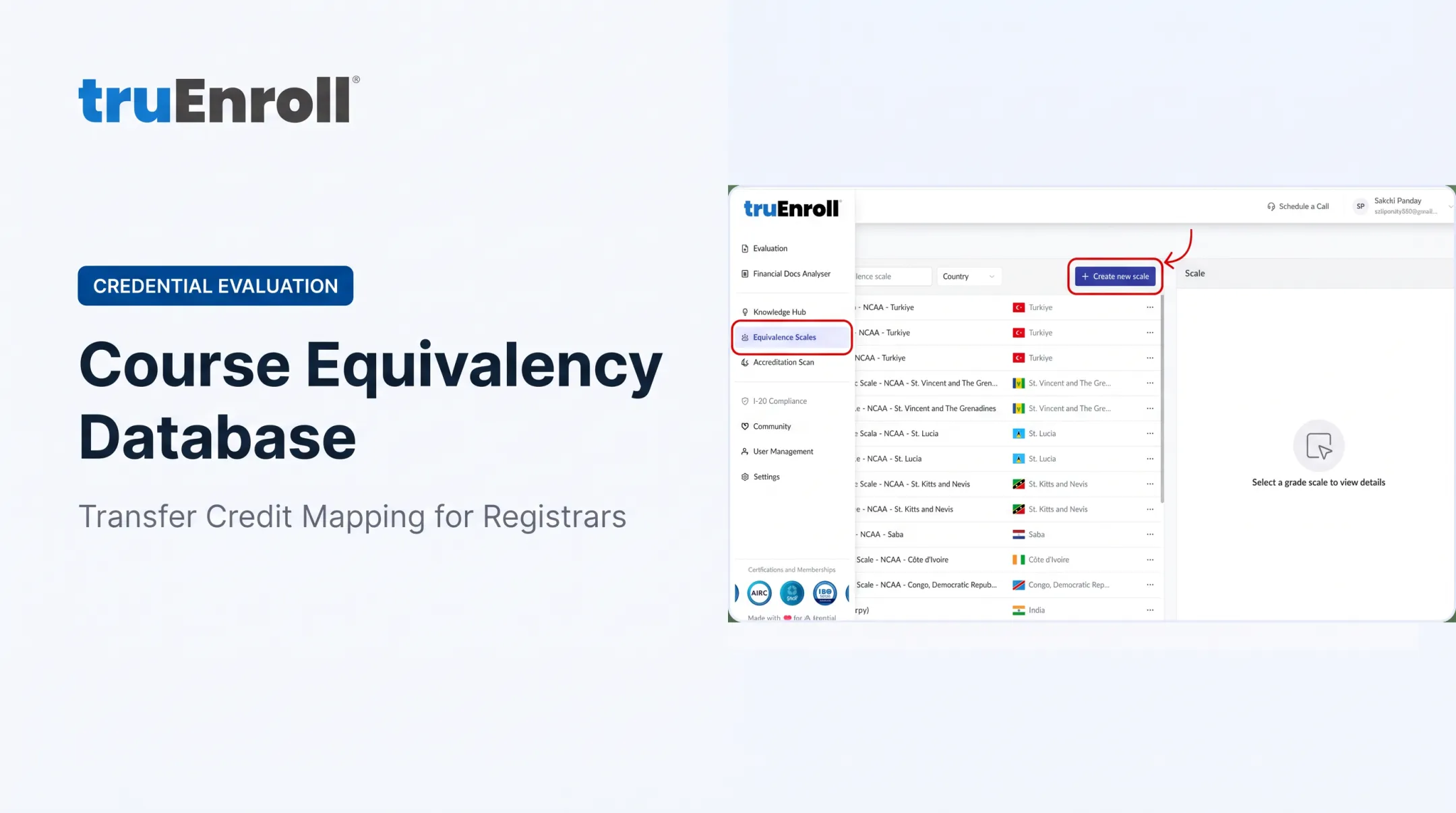
NC State's transfer equivalency database lets you search by "Courses Taken at Other Institution" or browse "NC State Courses" directly. Filters cover department, active versus historical equivalencies, and institution location.
Reading a Result Carefully
A listed equivalency isn't automatically the whole story. Watch for:
- A named NC State course: the clearest result, but still check whether it fulfills your specific requirement.
- An elective notation (like
***): transfers, but doesn't match a specific course. - No match found: not necessarily a rejection. It often just means the course hasn't been evaluated yet.
- Restrictions: tied to a minimum grade, a specific term, or an older course version that has since changed.
Don't stop at the course title. Pull the actual course description and learning outcomes, then compare them against NC State's catalog entry. Lab hours, contact hours, prerequisites, and course level all matter here. Two courses with nearly identical names can cover very different material.
When a Course Isn't Listed
If your course doesn't appear in the database:
- Save the syllabus, course description, and any grading or assignment breakdowns.
- Contact the appropriate NC State transfer-credit or advising office.
- Ask whether a formal departmental review is available for your specific course.
Keep a simple record for every course you're checking:
- Institution name and course code
- Course title and credit hours
- Term completed and grade earned
- Equivalency result and any conditions
- The specific NC State requirement you hope it fills
Equivalency databases and degree curricula both change over time. Verify your results against the current catalog and admissions or registrar guidance before signing up for more coursework based on an old search.
How NC State Evaluates and Applies Transfer Credit
Once you're admitted and your transcripts arrive, evaluation moves through a few stages: transcript receipt, review of institutional and course information, assignment of transferable credit, and posting of that credit to your academic record.
Several offices share this work:
| Office | Role |
|---|---|
| Undergraduate Admissions | Receives transcripts, evaluates in consultation with college deans |
| Registration and Records | Oversees evaluation, partners with departments on equivalencies |
| Enrollment Management and Services | Maintains the transfer policy, coordinates equivalencies with colleges |
| Academic departments/colleges | Decide whether credit fulfills a specific degree requirement |
The office that evaluates your transcript isn't always the one deciding how credit applies to your degree plan. That split is why the same transferred course can satisfy different requirements in different majors, or count only as elective hours depending on your program.
Timing and Grade Minimums
According to NC State's transfer policy, preliminary evaluation is generally completed within 15 business days after you're admitted and your required transcripts arrive. That window extends to 30 business days for international credit or files with four or more transcripts.
The policy also sets a content-alignment threshold of roughly 70% between your course and the NC State equivalent, though disciplinary accreditation standards can adjust that figure.
One discrepancy worth flagging: the 2025 transfer policy states a C- minimum grade, while the 2026-2027 catalog describes a C minimum. Confirm the current standard with your admissions or advising contact rather than relying on either figure alone.

GPA Treatment
Ordinary transfer credit adds hours to your record but does not factor into your NC State institutional GPA. Only the letter grade is displayed, shown with a transfer prefix (a B+ appears as TB+, for example). Select joint or exchange programs are an exception, where the grade and hours do count toward GPA.
Special Cases
A few situations usually need closer review:
- International coursework, which requires documentation and departmental review
- Quarter-system credit, converted individually with no blanket formula
- Pass/fail or satisfactory/unsatisfactory grading
- Repeated courses or unusually structured credit hours
- Older coursework with no stated expiration, but no guarantee it fits a current curriculum
Once your credit posts, check your Transfer Credit Report and Degree Audit in MyPack Portal. That view shows how evaluated credit actually populates your program and is a more reliable reference than a pre-transfer database search.
Preparing Documents and Resolving Unclear Equivalencies
Gathering the right paperwork upfront speeds up review and avoids back-and-forth delays. You may need:
- Official transcripts from every institution attended
- Detailed course descriptions and complete syllabi
- Reading lists, lab details, and assessment breakdowns
- Grading or credit-hour explanations
- Certified English translations for non-English documents
International course evaluations typically require a course-by-course credential evaluation (commonly through WES or ECE) plus syllabi showing the university, course number, term, weekly topics, and textbooks used.
To build a strong review request, identify the exact NC State requirement you're trying to satisfy. Then attach evidence mapping your course's topics, contact hours, assessments, and learning outcomes to that requirement, not just a title match.
Common Outcomes and What They Mean
| Outcome | What it usually means |
|---|---|
| No equivalent found | Needs individual evaluation, not necessarily a denial |
| Partial credit | Some content matched; may need a supplemental course |
| Insufficient grade | Grade fell below the current minimum standard |
| Missing lab component | Lecture matched, but lab hours didn't |
| Elective-only credit | Hours count toward total, not a specific requirement |
Don't assume an informal advisor comment, a similar course title, or another university's transfer decision guarantees the same result at NC State. Each evaluation stands on its own documentation.
A note for institutions managing this at scale: reviewing syllabi and transcripts one file at a time doesn't hold up well across thousands of applicants.
Platforms like TruEnroll help higher-education teams automate transcript data extraction, apply policy-based credit articulation rules, and keep document provenance intact. Edge cases still route to human reviewers, and NC State's own staff retain final evaluation authority over every credit decision.

Planning Your Transfer Path and Avoiding Credit Surprises
Check equivalencies before you register for courses elsewhere, especially for prerequisites, sequential courses, and classes with few alternatives. A mismatch in a required sequence can push your graduation timeline back a full semester.
Compare your transfer plan against your intended NC State curriculum:
- Total hours required for the degree
- Prerequisite sequencing and upper-level course requirements
- Residency rules (NC State requires at least 25% of graduation hours, plus 30 of your last 45 hours, through NC State coursework)
- Expected graduation timing given your remaining requirements
A general equivalency database won't answer every question. Ask both admissions or transfer-credit staff and your intended academic department directly: their answers can differ, and both matter.
For uncertain courses, run through this quick decision framework:
- Does the course transfer at all?
- What credit category does it receive?
- Does your department accept it for the specific requirement you need?
- How does it actually appear in your degree audit once posted?
Keep a written record of every official response, and recheck your plan whenever the catalog, your major, or your transfer institution's offerings change.
Frequently Asked Questions
How hard is it to get into NC State as a transfer student?
Transfer admission depends on your academic history, intended program, program capacity, and current admissions criteria. Check NC State's official transfer admissions data rather than relying on an unverified acceptance rate.
Do transfer credits affect GPA at NC State?
Transfer hours and GPA treatment are separate questions. Ordinary transfer credit typically adds to your hours without affecting your institutional GPA, but confirm the current policy with NC State's registrar or transfer-credit office.
What does transfer equivalency mean at NC State?
Equivalency identifies how a course from another institution may be recorded at NC State, whether as a direct match, an elective, or a general education credit. An equivalent course won't necessarily fulfill every degree requirement automatically.
What is the acceptance rate for in-state transfer applicants to NC State?
Overall transfer figures, such as the 43% rate reported in Admissions Fast Facts for fall 2026, don't break out by residency. Check NC State's latest institutional research pages, since rates shift by college, applicant pool, and cycle.