
Introduction: What Grading and Evaluation Mean in Higher Education
Every admissions cycle brings a stack of transcripts that don't match. One shows a letter grade, another a percentage, a third a number out of 10 that carries an entirely different meaning at the issuing school.
Many admissions teams struggle to reconcile these records against their own grading scale.
International enrollment makes this harder each year. The U.S. hosted 1,177,766 international students in the 2024/25 academic year, a 5% increase, according to IIE's Open Doors report. Each student arrives with a transcript built for a different system.
Grading assigns a result: an A, a 92%, an 8 out of 10. Evaluation does something different. It interprets that result inside its original institutional, national, and academic context.
This guide covers GPA and credit interpretation, international transcripts, special grades, and evaluation workflows built to scale with application volume.
Key Takeaways
- A grade records performance but rarely reveals what a student actually learned or how it compares internationally
- Accurate evaluation weighs grading scale, passing threshold, credits, policies, and academic level together
- Direct numeric conversions misfire when scales differ in direction, range, or rigor
- Technology speeds up evaluation, but human review and source traceability still matter for high-stakes decisions
What Grading and Evaluation Mean in Higher Education
Grading, Assessment, and Credential Evaluation Aren't the Same Thing
These three terms get used interchangeably, but they describe different functions:
- Grading assigns a letter, number, or descriptor to summarize performance in a course, exam, or assignment
- Assessment gathers evidence of learning during or after instruction to improve teaching and outcomes
- Credential evaluation interprets a completed academic record for a receiving institution's purpose, such as admissions or transfer credit
A registrar's office might handle grading. A provost's office might run assessment. An admissions team handles credential evaluation. Confusing the three leads to the wrong team making the wrong call.
Why One Grade Rarely Tells the Whole Story
A single A can mean different things in different classrooms. Some instructors grade almost entirely on exam performance. Others fold in attendance, participation, and effort.
One course might rank students against each other; another holds everyone to a fixed standard. Both paths can produce the same letter for very different levels of mastery.
That's before you factor in grading curves, assignment weighting, and institutional norms, which vary even within a single university.
From Classroom to Admissions Decision
Grading and evaluation feed directly into institutional decisions:
- Admissions review: confirming an applicant meets minimum GPA or coursework thresholds
- Transfer credit: deciding which completed courses count toward a new degree
- Academic progression and scholarships: verifying a student maintains required standing
- Professional licensing and international student processing: confirming a record meets a regulator's or program's criteria
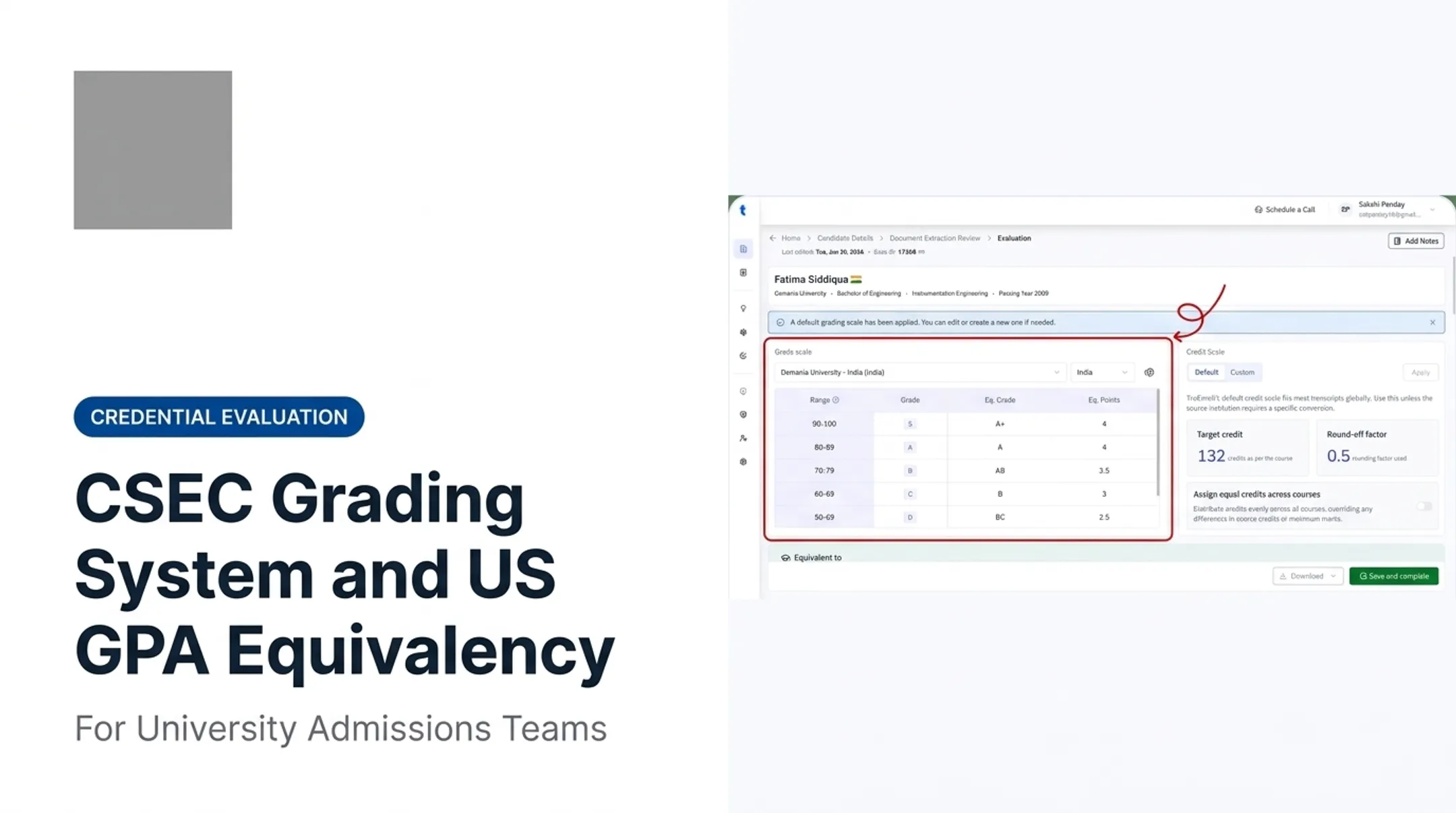
TruEnroll's evaluation workflow, for example, converts a foreign transcript into U.S.-equivalent grades, credits, GPA, and a degree statement that an admissions committee can act on directly, rather than starting from a raw scan.
How Grade and Credential Evaluation Works
Evaluation isn't a single step. It's a sequence, and skipping any part of it introduces risk.
The Evaluation Sequence
- Collect official records directly from the applicant or issuing institution
- Authenticate the documents, checking seals, formatting, and signatures for signs of tampering
- Extract course and grade data, including course titles, credits, marks, and completion status
- Identify the applicable grading scale based on country, institution, and academic level
- Apply institutional rules covering exclusions, repeats, and credit weighting
- Conduct human review on flagged or low-confidence items
- Produce a report or synchronized record for the receiving system

Evaluators examine course titles, grades, credits, academic level, program duration, completion status, and institutional identity together. Reviewing a grade in isolation, without knowing the program or institution behind it, produces unreliable conclusions.
GPA and Credit Weighting
GPA calculations generally follow this structure:
GPA = (Sum of grade points × course credits) ÷ (Sum of credits attempted)
The formula looks simple, but what counts in the numerator and denominator depends entirely on institutional policy.
A course-evaluation example from TruEnroll's platform shows how this plays out at the course level: Introduction to Computing recorded as 4 credits with a B+ worth 13.2 points, and Data Structures as 3 credits with an A worth 12.0 points. Each course contributes proportionally to its credit weight, not equally.
Always confirm the receiving institution's exact calculation rules before finalizing a GPA. They differ more than most people expect.
When There's No Cumulative GPA
Some transcripts don't include a cumulative GPA at all, particularly outside the U.S. In those cases, evaluators work from course-level results, credit values, grading-scale context, and a documented methodology to reconstruct an equivalent figure.
Handling the Edge Cases
Policy-sensitive situations require explicit rules, not improvisation:
- Repeated courses and grade replacement
- Excluded grades (seminars, thesis components, pass/fail results)
- Transfer coursework from a prior institution
- Withdrawals, incompletes, and failures for non-attendance
- Non-credit coursework that shouldn't enter a GPA calculation
TruEnroll's platform applies these rules automatically once configured, including repeated-course handling, exclusions, credit ratios, and minimum grade-transfer thresholds set by the receiving institution.
One review example recorded an Osmania University Bachelor of Engineering, completed in 2009 over a four-year program, with institution and program details verified in the same pass.
Audit-Ready Evidence Matters
A defensible evaluation needs source-document references, field-level provenance, exception flags, and reviewer notes. It also needs a clear line between what an automated system extracted and what a human reviewer confirmed.
TruEnroll's workflow links every extracted field back to its exact location on the original document and flags low-confidence fields in red before an evaluator finalizes anything.
Why Context Matters in Global Grade Interpretation
Converting a percentage or numerical grade straight into a U.S. GPA sounds simple. It isn't. Countries differ in passing thresholds, grade distributions, and even the direction of the scale.
A Snapshot of Different Grading Systems
| System | Scale | Direction |
|---|---|---|
| U.S. (institutional example) | 4.0 scale, A = 4.0 to F = 0.0 | Higher is better |
| United Kingdom | Honours classes: 1st, 2:1, 2:2, 3rd | Ordinal ranking, not a GPA |
| Germany | 1 to 5 | Inverted: lower numbers mean stronger performance |
| India (UGC 10-point) | O = 10 down to F = 0 | Higher is better, but implementation varies by institution |
| Italy | Course exams out of 30; final degree marks out of 110 | Higher is better, two different denominators |
These examples illustrate the range of systems evaluators encounter. Always verify a specific country's current grading practices against authoritative sources before applying them, since local policy changes.
Same Symbol, Different Meaning
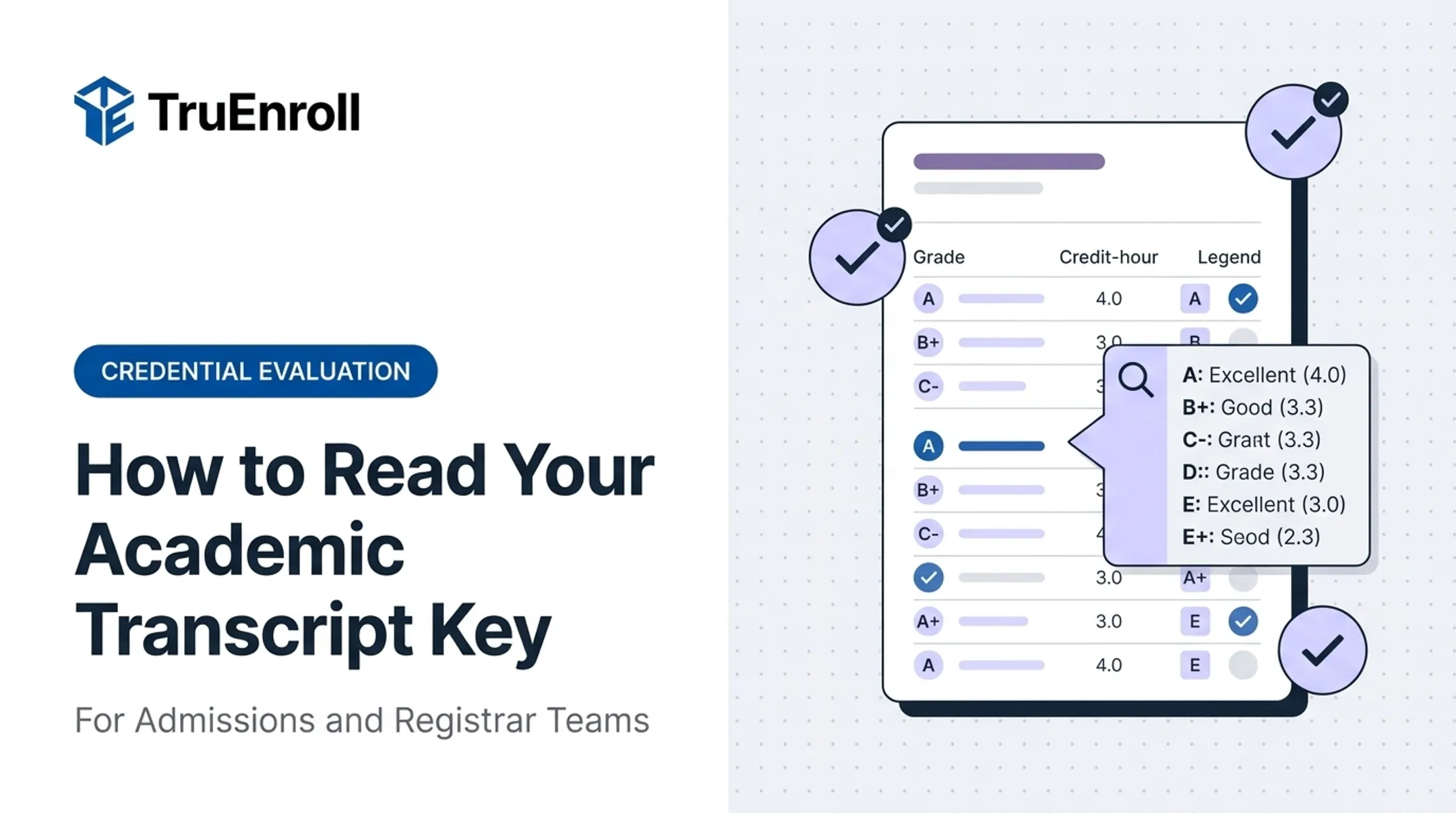
A plus or minus grade, or a raw percentage, doesn't carry a fixed meaning across institutions. AACRAO's grading guidance notes that evaluators need to understand what a grade means in its original system, its distribution, and whether students are judged against a fixed standard or against each other.
India offers a clear illustration. AACRAO's India paper documents that IIT Madras labels a grade of 8 as "B" on its own scale, while the same numerical grade equals "A" under India's UGC scale. Reading the letter alone would understate that student's standing.

A Quick Checklist Before Accepting a Converted Grade
- Who issued the original record?
- What grading scale did they use?
- What does this grade mean locally, including its passing threshold?
- How were credits weighted in the original system?
- What methodology supports the conversion applied here?
The goal of evaluation is to translate achievement into terms a receiving institution understands, not to mechanically alter or downgrade the original record.
Technology and Operational Best Practices for Grading and Evaluation
Consistency at scale depends on a standardized evaluation workflow:
- Standardize intake and extract transcript fields
- Identify the applicable grading system
- Apply repeat and exclusion rules
- Route exceptions with a clear escalation path
- Retain a reviewable record of every decision
Where AI Fits, and Where It Doesn't
AACRAO's AI survey found transfer-credit evaluation and transcript processing among the most frequently mentioned AI applications in open-ended institutional responses. Responsible use of that technology typically includes:
- Multimodal document processing for unstructured and non-standard layouts
- Multilingual recognition across non-Latin scripts
- Fraud and inconsistency flagging before a grade enters an evaluation
- Policy-rule enforcement for exclusions, repeats, and credit ratios
- Human verification for ambiguous or low-confidence cases
TruEnroll applies this model directly to transcript workflows. Its zero-template processing handles unstandardized domestic and international documents, including skewed scans and smartphone uploads, without per-school configuration. The platform supports more than 150 pre-configured global grading systems and over 70 languages. It enforces registrar policy automatically and links every extracted data point back to its source location on the original document for one-click verification.
On the security side, TruEnroll holds SOC 2 Type II, ISO 27001, and ISO 27701 certifications. The platform isolates student data cryptographically within dedicated tenant boundaries and never uses transcript data to train or fine-tune public AI models.
Implementation Guidance
- Define evaluation policies before automating anything
- Document exceptions so edge cases aren't handled ad hoc
- Test automation against representative historical records
- Establish approval thresholds for when human review is mandatory
- Monitor accuracy on an ongoing basis, not just at rollout
- Maintain a human escalation path for high-stakes or ambiguous decisions

Frequently Asked Questions
What is a grade evaluation?
Grade evaluation is the process of interpreting a student's grades within the original grading scale, course credits, institutional policies, and the requirements of the receiving institution. It goes beyond reading the grade itself.
How are letter grades (A, A+) and percentage scores (e.g., 92%) interpreted?
Interpretation depends on the issuing institution's grading policy, grade boundaries, and plus/minus conventions. The same percentage can represent a course result, an exam score, or a final transcript grade, each requiring different context.
What is the difference between grading and evaluation?
Grading assigns a performance result, such as a letter or number. Evaluation analyzes that result in context to determine equivalency, credit, admission, or progression decisions.
How is GPA calculated from grades and credits?
GPA generally weights grade points by course credits or units. Institutions apply different rules for repeated courses, transfer coursework, pass/fail grades, and excluded classes, so the formula alone doesn't tell the whole story.
Why can't international grades be converted using a simple formula?
Grading scales differ in passing thresholds, grade distributions, descriptors, rigor, and even scale direction. Some systems rank higher numbers as stronger performance; others do the opposite. Accurate evaluation requires contextual research, not a purely mathematical conversion.