
Introduction
A single altered transcript can undo years of institutional trust. Admissions offices use these records to make enrollment decisions, registrars rely on them for transfer credit, employers check them before hiring, and licensing boards depend on them to protect the public.
The stakes are real. At the University of Missouri-Kansas City, admissions staff discovered multiple applications using the same transcript with only the student's or school's name changed—identical courses, grades, and GPA repeated across files (AACRAO, 2026).
Not every irregularity signals fraud. An outdated logo or unfamiliar grading scale might simply reflect an older format or an international system.
This guide walks through a step-by-step, lawful verification process: one that protects the original record, checks academic details, confirms authenticity independently, and documents every decision.
Key Takeaways
- Cross-check identity, dates, courses, credits, GPA, signatures, and delivery method together—never rely on one clue alone.
- Formatting quirks, odd wording, or missing metadata are investigation prompts, not proof of fraud.
- Confirm records through the registrar or an authorized delivery platform, not contact details printed on the document itself.
- Build an escalation process that protects privacy and gives applicants room to explain discrepancies.
- Pair automated screening with human review and a documented audit trail.
What You Need to Check an Academic Transcript
Reliable transcript review needs three things: the document itself, trusted reference information from the institution, and a controlled process for recording what you find. A polished, official-looking PDF proves nothing on its own.

Tools and Indicators Required
Before reviewing anything, gather:
- The submitted transcript in its original file format (not a screenshot or re-typed copy)
- Applicant consent documentation, where required
- The institution's official website and registrar contact information
- Recognized U.S. accreditation resources
- Any secure transcript-delivery record or confirmation
Then compare these document-level fields against known institutional patterns:
- Institution name, address, and student identifiers
- Attendance dates, program title, and degree awarded
- Course codes, credits, grading scale, and term sequence
- Cumulative totals, issue date, and registrar details
- Signatures, seals, watermarks, QR codes, and document numbering
Digital records add another layer: file properties, embedded links, verification-token status, and delivery provenance. Ordinary software metadata, such as a "last modified" timestamp from a routine save, is not conclusive evidence of tampering on its own. It only shows you where to look closer.
Preconditions and Setup
Set up a controlled review environment first:
- Preserve the original file and work from a copy for annotations and comparisons.
- Log who viewed the transcript and when.
- Limit transcript access to authorized personnel only.
You also need a reference baseline for legitimate variation. Institutions merge, rebrand, and change registrar systems. International grading conventions look nothing like a standard U.S. 4.0 scale, and older paper transcripts predate today's digital signatures.
None of these differences prove fraud on their own. Check the institution's documented history before you flag anything.
Methods to Check an Academic Transcript
No single method authenticates a transcript. Use these three together: internal consistency review, independent issuer verification, and secure digital or automated review.
Method 1: Review the Transcript for Internal Consistency
Check whether the identity fields, chronology, and academic data actually make sense together.
Steps:
- Compare student name, ID, program, dates, and degree title across every page and related application document.
- Check whether term order, credit totals, grading scale, repeated courses, and degree requirements line up logically.
- Record anomalies with page references—then seek an explanation before assuming fraud.
Pros: Fast and effective for triage. Cons: Cannot authenticate the source; may misfire on nonstandard or international formats.
Method 2: Verify the Issuer and Academic Record Independently
Confirm the institution exists, holds appropriate recognition, and can verify the student's record through a channel you found yourself—not one printed on the transcript.
Steps:
- Locate the registrar independently, rather than using a phone number or QR code from the submitted document.
- Follow the institution's documented verification process, respecting consent and privacy requirements.
- Compare the response against the submitted record and preserve the result for the files.
Pros: Stronger evidence than appearance checks alone. Cons: Slower; depends on consent and institutional responsiveness.
Method 3: Use Secure Digital and Automated Review Workflows
Automated review examines provenance, alterations, and rule-based inconsistencies at scale—while keeping a human reviewer in the loop.
This is where platforms like TruEnroll fit into higher-education workflows. TruEnroll runs an automated forensics audit on every submitted document, checking more than 70 fraud indicators alongside institution and accreditation checks, including:
- Font inconsistencies and pixelation artifacts
- Logo placement and watermark patterns
- Document overlays and signature matching
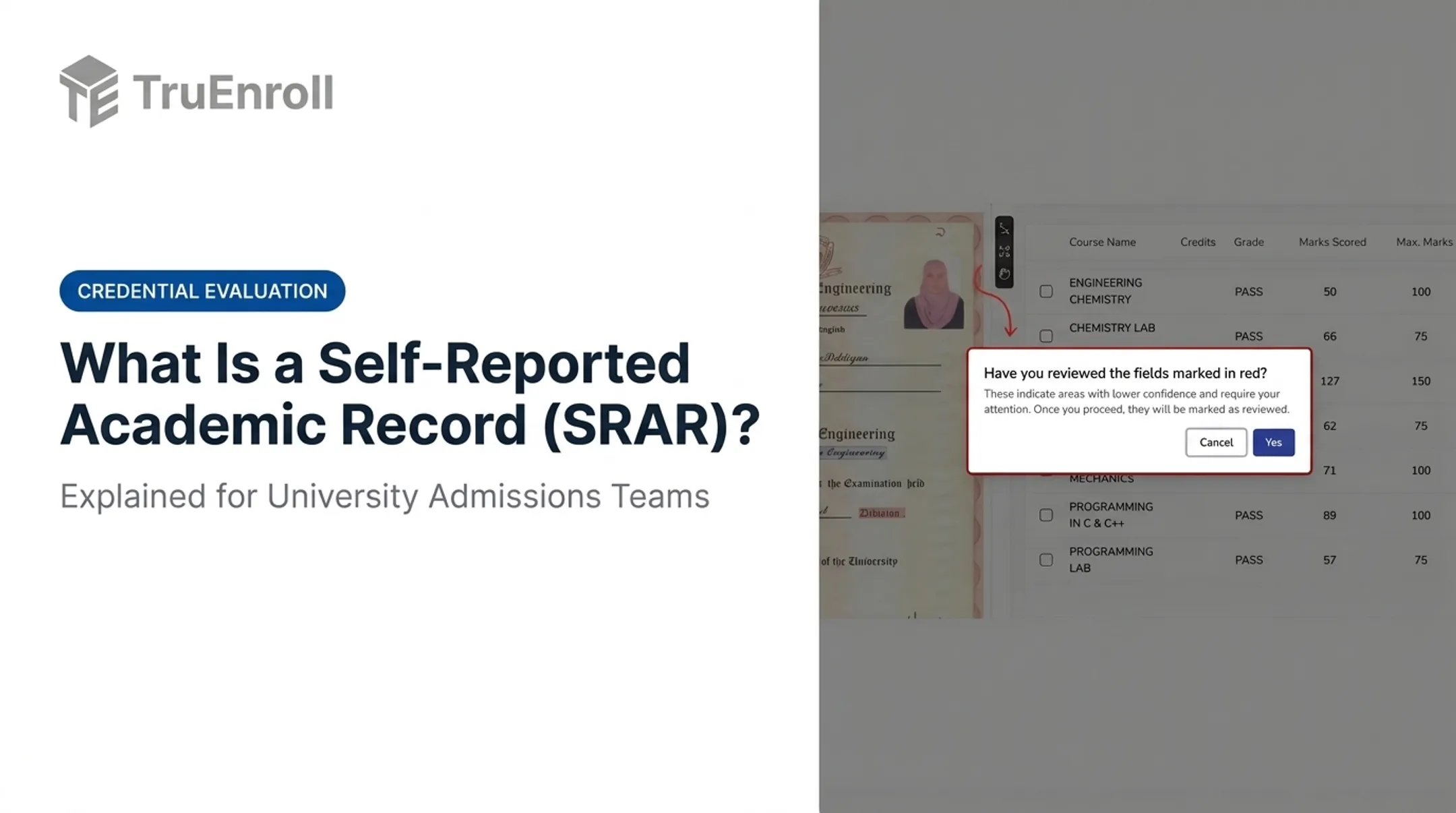
Each extracted field links back to its exact coordinates on the source PDF. A reviewer can verify any data point in one click instead of re-reading the whole file.
Steps:
- Receive records through a controlled channel and preserve the original file and access history.
- Compare extracted fields against institutional rules and grading conventions; route uncertain cases to human review.
- Verify material findings with the issuing institution and retain reviewer notes for audit purposes.

Pros: Improves consistency and speed at scale. Cons: Can misread poor scans or flag unfamiliar but legitimate academic systems. Automation supports registrar verification; it does not replace it.
How to Interpret the Results
Findings aren't binary. The right response depends on how many discrepancies you found, how independent they are, and how serious they are, not on a single suspicious detail.
Normal or Acceptable
A clean result typically shows:
- Consistent chronology
- Coherent credits and GPA
- A verifiable institution
- Expected security features
- Confirmation from an issuer-controlled source
Document the verification source, date, reviewer name, and consent basis before closing the file.
Minor Issues
These warrant a closer look, not a denial:
- Scan artifacts or outdated logos
- Small layout differences between transcript versions
- Unusual but explainable grading systems
- Name changes or transfer-credit presentation quirks
- Incomplete metadata
Request clarification or a clearer official copy. Check archived institutional references. Let the applicant or registrar explain before taking adverse action.
Out-of-Spec or High-Risk Findings
Escalate when you see:
- An institution or program that can't be substantiated
- Issuer contact details routing to an unauthorized party
- Materially conflicting attendance or award dates
- Impossible academic calculations
- Altered fields or failed secure verification
- A registrar response that contradicts the submitted record
Preserve evidence, limit access, and pause the affected decision where policy allows. Refer the matter to compliance or legal personnel, and avoid labeling anyone a fraud before the review is complete.
For consent and disclosure rules, most institutions rely on FERPA guidance from the U.S. Department of Education. Employers using third-party background-check services should also review FTC guidance on background checks before taking adverse employment action.
Accreditation status can be checked through the Department of Education's DAPIP database, though the agency itself notes this data isn't independently audited. Treat it as a starting point, not a final answer.
Common Errors and Safety Best Practices
Most bad outcomes trace back to the same handful of mistakes:
- Treating visual appearance as proof of authenticity
- Relying on contact details supplied by the applicant instead of independent sources
- Using unrecognized accreditation lists
- Ignoring international grading conventions
- Accepting automated flags without human review
Handle student data carefully. Use approved systems, minimize copied data, restrict access, and avoid uploading transcripts to unapproved public AI tools or file-conversion sites. Set clear retention and deletion rules.
Escalate consistently. Compare like cases against the same criteria. Give applicants a channel for clarification. Keep document authenticity separate from admissions merit. A legitimate discrepancy doesn't automatically mean a weak application.
TruEnroll is built around the same controls: student PII stays cryptographically isolated within U.S. infrastructure, role-based access limits exposure, and an immutable audit trail logs every calculation and reviewer decision.
The platform is SOC 2 Type II certified (with ISO 27001 and ISO 27701). That gives registrars audit-ready documentation for accrediting bodies when a file is questioned.
Conclusion
Spotting a fake academic transcript takes more than checking fonts, seals, or QR codes. Reliable conclusions come from combining internal consistency checks with independent issuer verification—every time, not just when something feels off.
Safe review protects both the institution and legitimate applicants:
- Preserve evidence
- Respect privacy
- Account for legitimate format variation
- Escalate uncertain cases the same way every time
Higher-education teams processing thousands of transcripts a season can't manually re-verify every field by hand. Controlled automation, like TruEnroll's forensics audit and human-in-the-loop review queues, helps manage that volume. But registrar-authorized confirmation and accountable human judgment remain the final word.
Frequently Asked Questions
What are the most common signs of a fake academic transcript?
Inconsistent identity or academic data, impossible dates or GPA calculations, suspicious issuer contact details, and altered security features. No single sign proves fraud. Independent verification is still required.
Can formatting differences prove that a transcript is fake?
No. Formatting differences often reflect institutional redesigns, older records, international conventions, or accessibility versions. Confirm with the issuing institution before drawing conclusions.
How can an institution verify an academic transcript with the issuing university?
Locate the registrar through the institution's official website, not contact details printed on the transcript. Follow its documented consent and verification process, then compare the response with the submitted record.
How is US accreditation status confirmed for an institution?
Use the Department of Education's DAPIP database or CHEA's institution search. Accreditation checks confirm the institution's status; they don't verify a specific student's transcript.
What should an institution do if it suspects a transcript is fake?
Preserve evidence, restrict access, verify independently, and give the applicant a chance to clarify. Document the escalation and consult compliance or legal personnel before any final decision.
Can software detect fake academic transcripts?
Software can flag inconsistencies, extract fields, and preserve provenance at scale. It still needs human review and issuer-controlled verification to reach a reliable, defensible conclusion.