
The stakes go beyond one transcript. Students who transferred between US institutions during 2004-2009 lost an average of 43% of their earned credits, according to GAO's 2017 report on higher education transfer challenges. Much of that loss traces back to evaluation processes that can't clearly separate whether a course is transferable, equivalent, or applicable to a degree.
This guide covers how a course equivalency database supports admissions evaluators, registrars, transfer-credit teams, and advisers handling transfer, international, dual-enrollment, readmission, and internal-change cases. We'll walk through its structure, the evaluation workflow, governance expectations, and where human review stays essential.
Key Takeaways
- A course equivalency database maps sending coursework to receiving courses or credit categories.
- Transferability, equivalency, applicability, and residency are four separate decisions.
- Course titles alone rarely settle a match; content, outcomes, credits, labs, format, and catalog year matter.
- Database results inform decisions but never replace policy, departmental review, or appeals.
What Is a Course Equivalency Database?
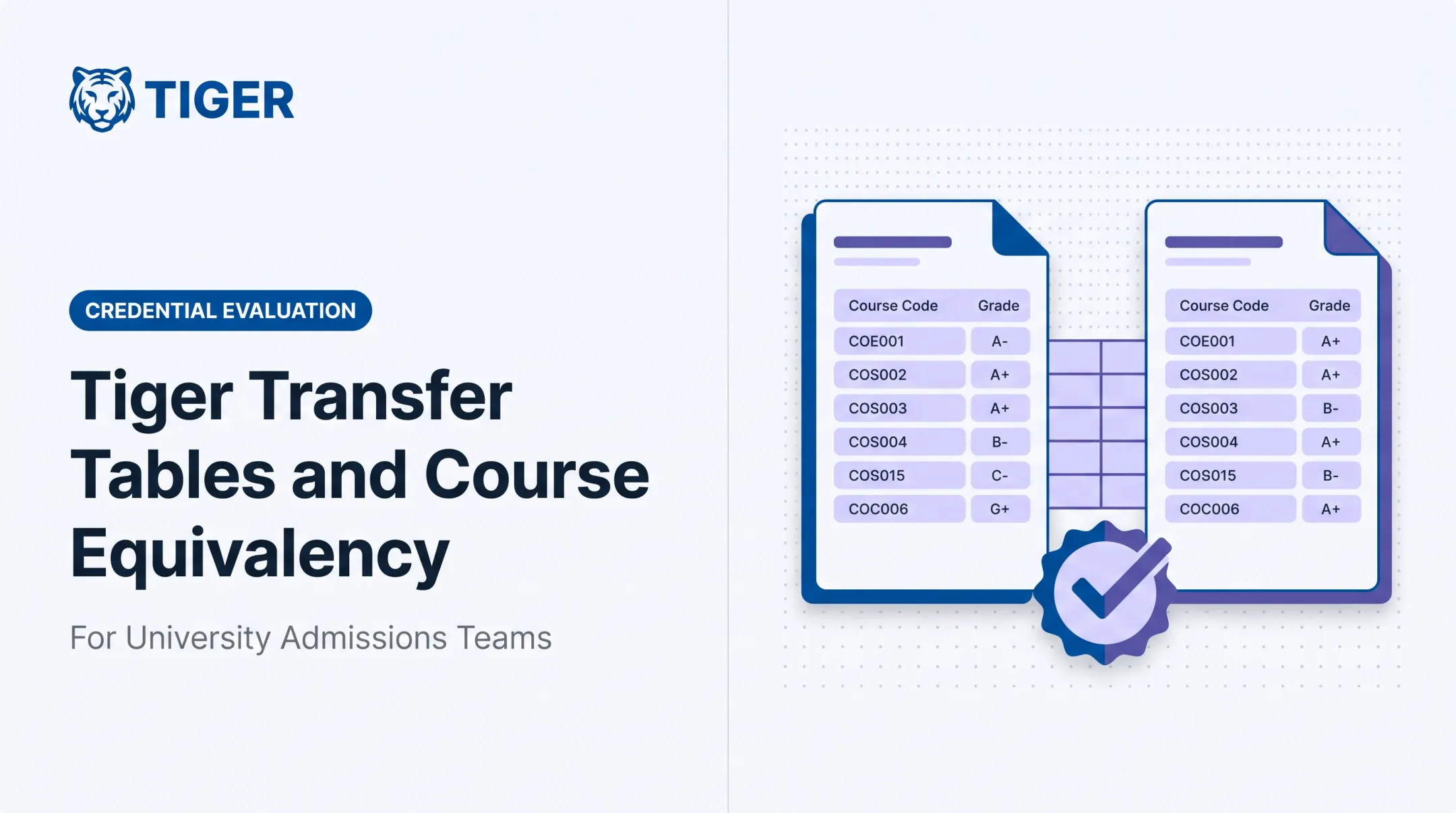
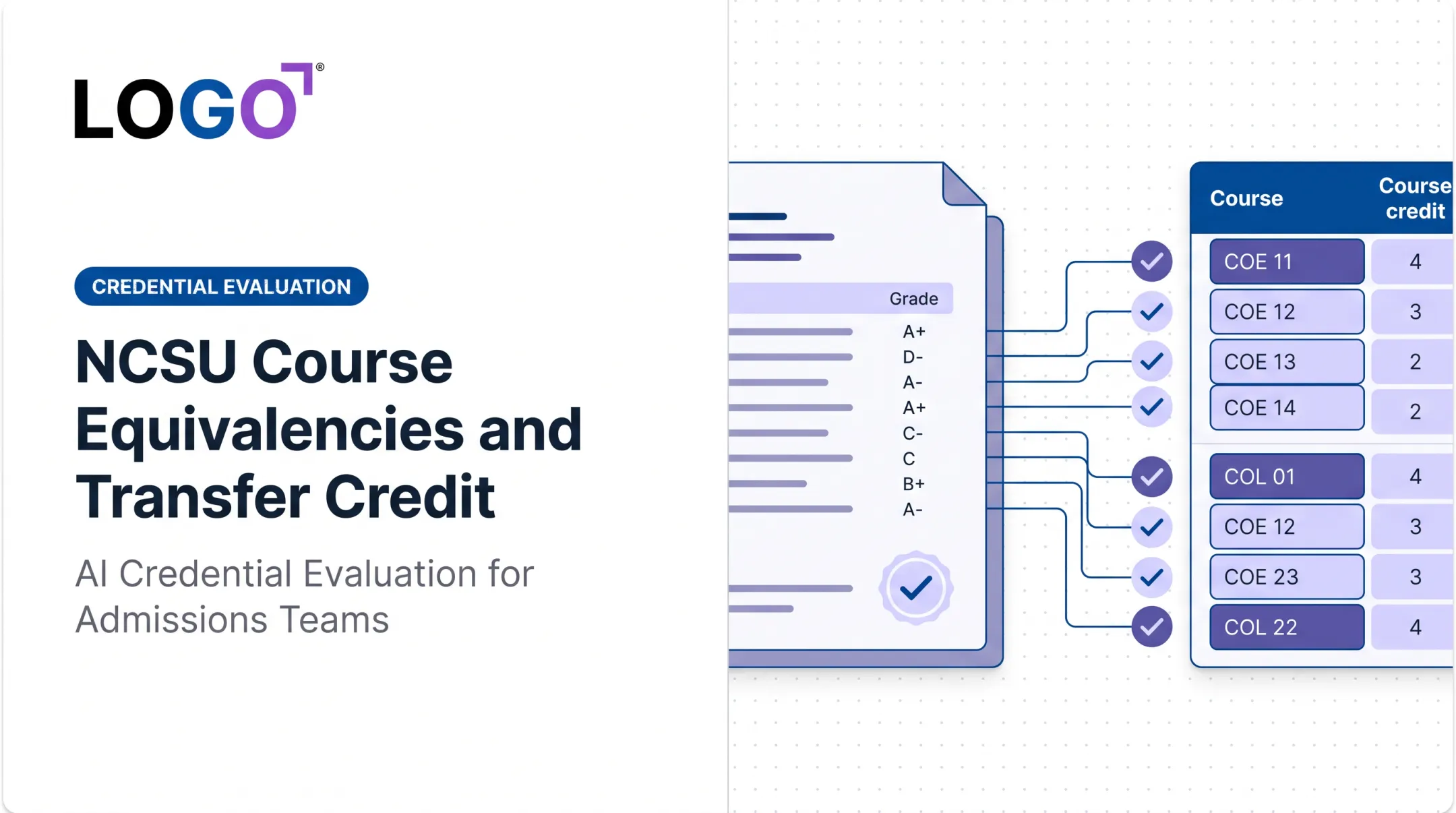
A course equivalency database is a searchable, institution-managed repository of evaluated course relationships, their outcomes, any attached conditions, and the evidence behind each decision. Rather than a static lookup table, it is a working record that evaluators, registrars, advisers, department reviewers, degree-audit staff, and sometimes students (through approved self-service tools) consult every day.
Results from a database typically fall into one of several outcome types:
- Direct equivalency: the course matches a specific receiving-institution course in content and credit hours.
- Subject or departmental credit: recognized within a discipline without a one-to-one course match.
- General elective credit: counted toward graduation without satisfying a specific requirement.
- Partial, pending-review, or no-credit outcomes: flagged for further evaluation or denied under current policy.
Four Decisions That Get Confused
Institutions and students often treat these as one decision. They aren't:
| Decision | What it answers |
|---|---|
| Transferability | Will the institution accept this credit at all? |
| Equivalency | Does it match a specific course or subject category? |
| Applicability | Does it satisfy a major, prerequisite, or gen-ed requirement? |
| Residency | Does it meet limits on credits earned at the receiving institution? |
A course can clear one hurdle and fail another. An introductory biology course with no lab component might transfer as general elective credit at one university, or count as a direct equivalent at another where the lecture content matches exactly.
At a third institution it may receive no credit if the program requires lab work for science-major applicability. Same course, three outcomes, depending on catalog year, program rules, and lab content.
How Does a Course Equivalency Database Work?
The workflow runs from transcript receipt to a published, reviewable record. Before evaluation starts, institutions typically collect:
- Sending institution and course code/title
- Credit value, grade, and completion date
- Catalog year and delivery format
- Lab component details and the intended receiving program
Gathering Evidence and Comparing Content
Evaluators then pull supporting evidence: official transcripts, course descriptions, syllabi, learning outcomes, contact hours, assessment methods, and accreditation information. International records add grading scales and credential documentation to the mix.
The comparison stage checks subject matter, academic level, learning outcomes, credit-hour conversion, lab or clinical requirements, and course recency. AACRAO's best-practices guide recommends roughly 70% content overlap as a general benchmark, unless accreditation or discipline-specific rules call for something stricter.

Once a match is confirmed, evaluators record conditions: minimum grades, expiration dates, repeat rules, or major-specific limitations.
Where Automation Fits
A mature workflow routes incomplete, conflicting, outdated, international, or fraud-flagged records to qualified human reviewers rather than auto-approving them. AACRAO's 2024 paper on automation notes that electronic data exchange can speed evaluation, but it stops short of recommending autonomous academic decisions.
TruEnroll is one example of a platform built around that boundary. It uses zero-template extraction to pull transcript data in as little as three seconds, maps coursework to CIP and SCED codes, converts quarter credits to semester hours, and normalizes grading scales across more than 150 international systems.
Low-confidence extractions get flagged for human review before anything syncs to a CRM or SIS like Slate, Banner, or Salesforce. The platform supports the evaluation; academic decisions stay with registrars and department reviewers.
What Information Should a Course Equivalency Database Contain?
Every equivalency entry needs enough detail to be defensible years later, not just today. Core fields generally group into five categories:
- Sending side: institution name, campus/division, accreditation status, country or state, institutional identifiers
- Sending course: code, title, subject, description, academic level, credit value, grading basis, delivery format, lab/clinical hours
- Receiving side: equivalent course or credit category, equivalent credits, subject code, prerequisite relationship, degree requirement mapping, applicable programs
- Conditions: minimum grade, repeat-course treatment, pass/fail treatment, time limits, effective term, catalog year
- Decision metadata: status, evaluator/approving department, review date, supporting documents, confidence or exception indicators, appeal history
Why Catalog Year Changes Everything
Courses get renamed. Curricula shift. Grading systems change. A mapping approved in 2020 may no longer reflect what a course covers in 2026.
Without an effective-date field tied to catalog year, a database can quietly serve outdated decisions. Each result should link back to its evidence: the syllabus, catalog page, transcript location, or articulation agreement that justified it.
That evidence trail matters even more for international coursework. Foreign credit systems, translated titles, and unfamiliar grading scales often need credential evaluation before any course-level comparison is possible.
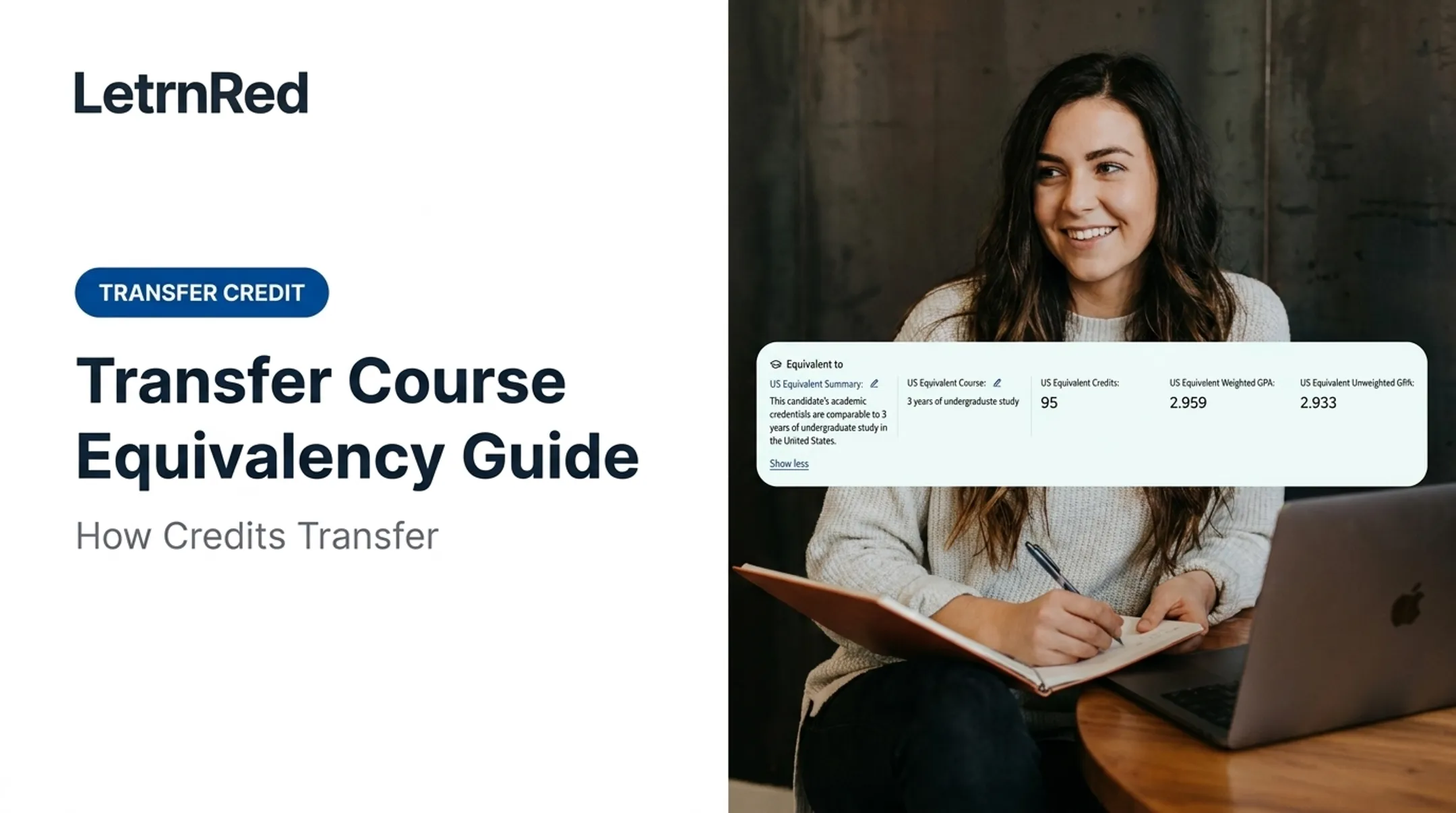
TruEnroll's course-level output shows the format in practice. A record for CSC148, Introduction to Computer Science, from the University of Toronto carries 0.5 credits, a grade of A, and resolves to 95 U.S.-equivalent credits at 96% confidence, with one grade-table variation surfaced for reviewer visibility rather than auto-approved. Those fields are what separate a direct equivalent, elective credit, and a case still waiting on a human decision.

How Institutions Govern and Maintain the Database
The receiving institution owns its equivalency decisions. That means clearly defining which offices or departments can create, approve, revise, expire, or override a record.
Governance and Maintenance Controls
Strong governance typically includes:
- Role-based access separating who evaluates from who approves
- Version history on every mapping
- Documented exceptions, not undocumented workarounds
- Periodic review of high-impact mappings (the ones feeding major degree requirements)
Maintenance triggers matter just as much. Each of these events demands a review cycle:
- New or renamed courses
- Curriculum changes
- Discontinued courses
- Updated transfer agreements
- Grading-policy changes
Institutions validate outputs through sampling, duplicate detection, conflict checks, and reviewer feedback compared against current catalogs.
Security, Compliance, and Where Automation Helps
Transcript and student data carry real compliance weight under FERPA. Expect least-privilege access, encryption, secure integrations, audit logs, and vendor due diligence as baseline requirements, not nice-to-haves.
This is where a platform like TruEnroll supports institutional oversight instead of replacing it. It maintains field-level traceability back to original PDF coordinates, supports human-in-the-loop override on every policy exception, and flags credential anomalies or tampering before a decision gets made.

It's built around SOC 2 Type II, ISO 27001, and ISO 27701 controls. Institutions should still verify current certification status and security documentation directly before publication or procurement sign-off.
Database matches aren't final when:
- Documentation is incomplete or conflicting
- Course content has changed since the mapping was approved
- The course affects licensure or graduation eligibility
- Institutional policy requires departmental sign-off
A Practical Implementation Checklist
- Define decision categories (direct, elective, pending, denied)
- Standardize fields across sending and receiving data
- Migrate and clean legacy equivalency records
- Establish clear approval ownership by department
- Connect the database to CRM, SIS, and degree-audit systems
- Train staff on exceptions and escalation paths
- Publish a visible appeal process for students and advisers
Conclusion
A course equivalency database is a governed academic knowledge base, not a simple lookup table or a guarantee that credits will satisfy a degree. It needs reliable source data, transparent matching criteria, catalog-year control, documented approvals, and secure integrations to stay useful over time.
Done well, it gives institutions more consistent transfer decisions, clearer advising conversations, fewer manual searches, and stronger audit trails. It also moves students faster from transcript receipt to enrollment planning, without skipping the human review that academic decisions still require.
Frequently Asked Questions
What does course equivalency mean?
Course equivalency is the receiving institution's comparison of completed coursework against its own course or credit categories. It's separate from degree applicability, which determines whether that credit actually satisfies a specific requirement.
How many times can you retake a course at Rutgers?
Retake limits are institution- and policy-specific, so check Rutgers' current published policy directly. Confirm program-level rules, grade-replacement treatment, and how retakes affect transfer-credit evaluation before assuming a general limit applies.
What does non-course equivalency mean?
Non-course equivalency typically refers to credit or recognition that doesn't match a specific receiving-institution course, such as subject, elective, or experiential credit. The exact definition and criteria depend on each institution's published policy.
Does a course equivalency database guarantee that credits will count toward a degree?
No. A database result can confirm that a course transferred or matched a category, but it doesn't automatically establish applicability to a major, prerequisite, or general-education requirement. A degree audit makes that determination separately.
What information is needed to add a course to an equivalency database?
At minimum: the official transcript, course code and title, credit value, syllabus or description, learning outcomes, grading information, lab details, and the catalog year. Program-specific requirements may call for additional documentation.