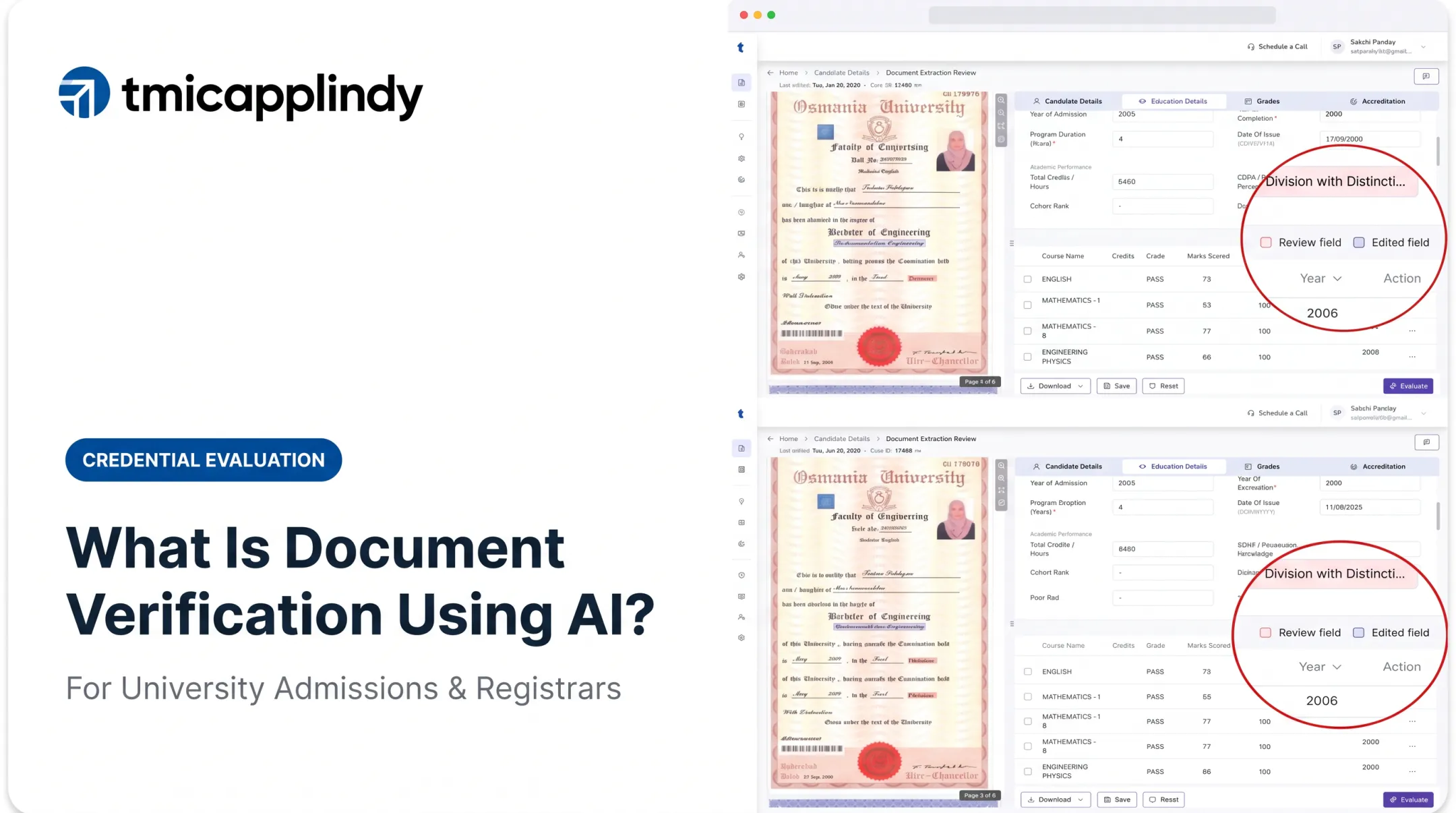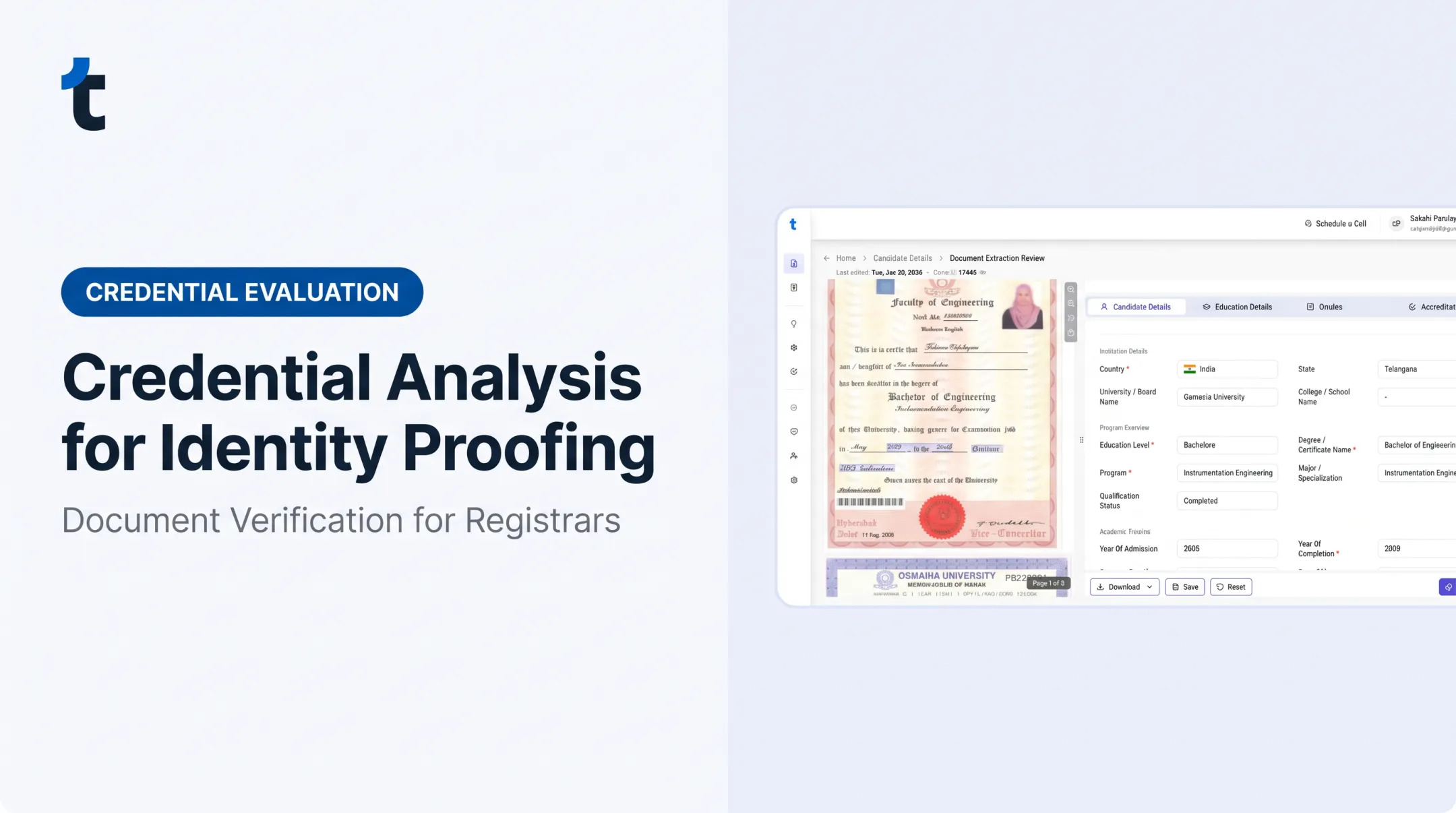

International enrollment reached 1,177,766 students in 2024/25, up 5% year over year, according to IIE's Open Doors report. That volume strains manual review. Unfamiliar document formats, inconsistent names across records, and altered scans can slow decisions or let fraudulent credentials slip through.
This guide separates identity document verification from academic credential evaluation and apostille legalization, then walks through the verification process, the fraud risks involved, and what institutions should look for when implementing a solution.
Key Takeaways
- Identity document verification confirms a document is genuine, unaltered, and linked to the person presenting it
- Strong verification layers data extraction, authenticity analysis, identity matching, and human review
- Admissions teams should assess language coverage, fraud detection, privacy safeguards, and SIS/CRM integration before selecting a vendor
- A failed check should trigger remediation, not an automatic fraud determination
Understanding International Identity Document Verification
International identity document verification is the structured process of confirming that a document issued by a foreign authority is authentic, currently valid, unaltered, and actually belongs to the person submitting it. It's a narrower task than people assume, and it's often confused with three related but distinct processes.
Identity Verification vs. Document Authentication vs. Credential Evaluation
- Identity verification establishes whether the applicant is who they claim to be
- Document authentication or legalization (including an apostille) confirms whether a document or signature is recognized for use in another jurisdiction, nothing more
- Credential evaluation determines the academic level, institutional status, grading scale, and transferable credit represented by an academic record
An apostille certifies a signature, seal, or stamp. It does not prove the document holder is the person standing in front of your admissions office. Likewise, a verified passport confirms identity, not whether a diploma on university letterhead reflects a recognized credential.
Institutions that conflate these steps leave gaps in both identity assurance and credential integrity.
Documents and Data Points That Matter
Common document types include:
- Passports and national identity cards
- Residence permits and visas
- Refugee or Convention travel documents
- Birth certificates and government-issued professional licenses
Reviewers should check:
- Full name, date and place of birth, and nationality
- Document number, issue and expiry dates
- Photograph and issuing authority
- MRZ or barcode data
- Consistency across every submitted record
The required assurance level isn't fixed. A routine application review needs less scrutiny than a transfer-credit decision, a professional licensing pathway, or access to sensitive student information systems.
International Verification Challenges and Fraud Risks
Document variation is the first operational headache. Different countries use different layouts, security features, date formats, and naming conventions. A reviewer trained on U.S. and European documents may have no frame of reference for a Vietnamese identity card or an Ethiopian birth certificate.
Script diversity compounds the problem. Arabic, Cyrillic, Chinese, and dozens of other non-Latin scripts appear across applicant pools, and transliteration practices vary even within a single country. Institutions should confirm a verification system's actual, documented language coverage rather than relying on an unverified marketing number.
Common Fraud Indicators
Reviewers and automated systems typically look for:
- Altered names, dates, or photographs
- Inconsistent fonts or manipulated scans
- Mismatched MRZ or barcode data
- Issuing authorities or institutions that cannot be confirmed
- Expired documents submitted as current
Remote submission introduces its own threats: screenshots, edited images, replayed video, and synthetic identities. None of these are automatic proof of fraud on their own. They're indicators that warrant closer review, which is exactly why a defined escalation path matters.
Why Database Checks Fall Short
Foreign government databases are frequently unavailable, restricted, or legally inaccessible to U.S. institutions. That's not a gap you can patch with more aggressive querying.
ICAO's own standard acknowledges this limitation at the chip level. Passive authentication confirms a passport chip's contents are unchanged, but it does not prevent exact copying of that chip's data, according to ICAO's passive authentication standard.
Document-based checks, biometric comparison, NFC reading, and human review need to work together rather than as one standalone control.
Privacy obligations add another layer. FERPA governs education records for enrolled students, CCPA generally excludes nonprofit institutions, and GDPR can apply when an institution recruits applicants located in the EU. None of these frameworks blankets every applicant interaction, so institutions need to map which rules apply to which stage of the pipeline rather than assuming one universal standard.
How the International Identity Document Verification Process Works
A sound verification workflow follows a consistent sequence, regardless of the document's country of origin.
- Consent and capture – Collect applicant consent and the document image, limited to the minimum information needed for the admissions or enrollment purpose at hand
- Automated extraction – Pull data from the visual zone, MRZ, and barcodes, with defined handling for low-quality images, glare, cropped scans, and handwritten fields
- Validation and authenticity checks – Confirm format recognition, expiry status, consistency between visible and machine-readable data, and plausibility of the issuing authority
- Identity matching – Compare the document against applicant-provided information, institutional records, and, where proportionate and legally permitted, a live selfie
- NFC or chip verification – Read embedded chip data on eligible e-passports and ID cards as an additional control, not a replacement for the earlier steps

This sequence reflects a distinction NIST draws in its identity guidelines: validating that evidence is authentic is separate from verifying that the person presenting it owns it. NIST's identity guidelines treat those as distinct controls. Skipping either half leaves a real gap.
Every case should resolve to one of four outcomes:
| Outcome | Meaning |
|---|---|
| Pass | Evidence meets the institution's defined requirements |
| Review | Information is incomplete, conflicting, or needs trained human judgment |
| Fail/Reject | Submission doesn't meet policy after reasonable remediation |
| Escalate | Higher-risk case requires compliance, registrar, or legal review |
Field-level provenance, decision timestamps, and reviewer notes matter here. They let an institution explain how a decision was reached without hoarding personal data it no longer needs.
Best Practices for Higher-Education Institutions
Start with a written, risk-based policy. Define which documents are acceptable per applicant type, when a secondary document is required, and how long records stay on file.
From there, build an intake process that handles real-world name complexity:
- Translated or transliterated names
- Multiple surnames and diacritics
- Former legal names
- Differences between legal and preferred names
Use layered verification rather than one pass/fail signal:
- Validate the document's structure and machine-readable data
- Compare results against applicant and institutional records
- Add biometric, NFC, or manual review only where risk and legal context require it

Route anything ambiguous to trained reviewers with clear reason codes.
Protect sensitive data with encryption, access controls, vendor due diligence, and documented retention limits. When evaluating vendors, weigh:
- Country and language coverage
- Fraud-detection depth and explainability
- Audit logs and SIS/CRM integration
- Independent security certifications such as SOC 2 or ISO 27001
Pilot the workflow against your actual applicant population before full rollout. Review results with admissions, registrar, IT, and privacy stakeholders together.
Selecting a Solution: Vendor Evaluation and TruEnroll's Role
Identity verification and academic-record processing are two stops on the same pipeline. Once an applicant's identity and supporting documents clear review, transcript and credential data move into evaluation, articulation, and admissions decisioning. Disconnecting these steps is how institutions end up re-keying the same applicant data three times across three systems.
This is the layer where TruEnroll operates. Its platform supports international transcript processing, credential evaluation, transfer-credit articulation, and academic policy enforcement at the volumes international admissions pipelines actually see.
TruEnroll's forensics engine runs an automated authenticity audit on uploaded documents, checking for tampering, manipulation, and internal inconsistency. Field-level provenance ties every extracted data point back to its source location on the original file.
On the governance side, TruEnroll holds SOC 2 Type II, ISO 27001, and ISO 27701 certifications, runs on cryptographically isolated cloud tenant boundaries, and does not use institutional data to train public AI models. Verified records sync directly into Slate, Banner, or Salesforce through native integrations or a Partner API, cutting out CSV exports and duplicate entry.

One caveat worth stating plainly: TruEnroll is an adjacent workflow layer, not a replacement for government authentication, immigration review, or institutional judgment. Confirm the exact identity-document, biometric, and NFC capabilities any vendor offers before relying on them for a specific use case.
When comparing solutions, ask vendors:
- How do you update document libraries as new formats and fraud patterns appear?
- What happens when a document type isn't supported?
- What integration options exist for SSO, webhooks, and SIS/CRM sync?
- How accessible is the capture experience across mobile, low-bandwidth, and multilingual conditions?
Institutions that want to connect credential review, fraud detection, and admissions-system synchronization into a single workflow can request a live demo to see how TruEnroll fits an existing admissions stack.
Frequently Asked Questions
How do employers verify international degrees?
Employers typically confirm the issuing institution, award, dates, and accreditation through the institution directly, a credential evaluation service, or an approved verification provider. This is separate from identity-document verification, which confirms the applicant, not the degree.
How long does VFS take to verify documents?
Processing times vary by visa program, destination country, document type, and whether additional checks are required. Check the relevant VFS center and consular authority for current timelines, since no single figure applies across programs.
Can I get rejected in document verification?
Yes. An application can be declined or paused when documents are missing, expired, unreadable, inconsistent, or flagged as suspicious. Follow the institution's remediation or appeal instructions rather than assuming a failed check proves fraud.
What documents are commonly used for international identity verification?
Passports, national identity cards, residence permits, visas, and refugee or Convention travel documents are the most common. Acceptable documents ultimately depend on the institution and the specific use case.
What is the difference between identity document verification and credential evaluation?
Identity verification confirms who the applicant is and whether their ID is genuine. Credential evaluation separately assesses an academic record's authenticity, level, equivalency, and transferable credit.