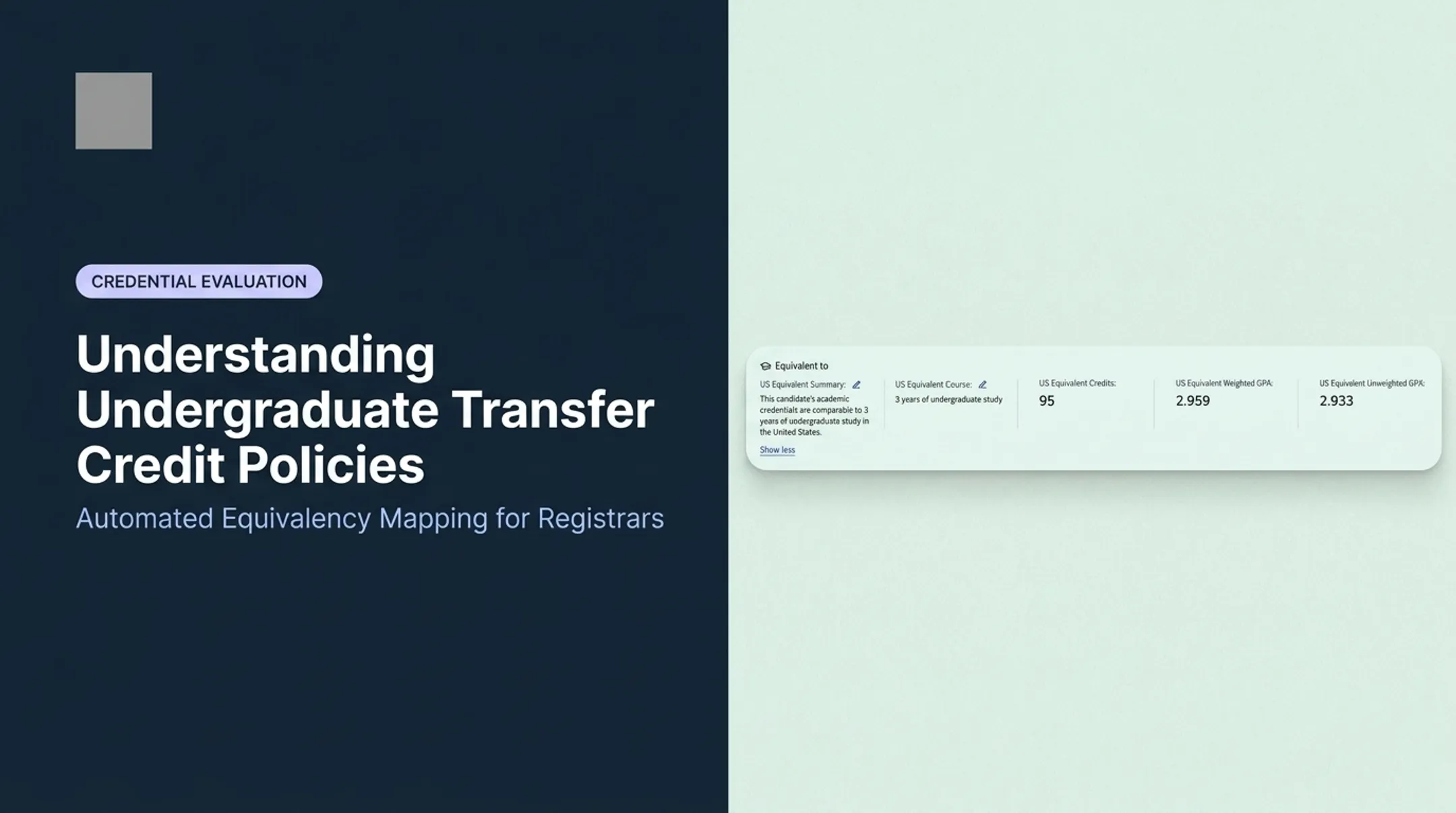

This is different from financial credit evaluation, which assesses a borrower's creditworthiness using income, debt, and payment history. This article focuses entirely on the academic side: how colleges and universities evaluate transcripts for admissions, transfer, credential recognition, and degree-progress decisions.
Credit evaluation touches nearly every student who transfers schools, applies from abroad, or brings in prior coursework. Getting it wrong has real costs. The U.S. Government Accountability Office found that students who transferred between 2004 and 2009 lost an average of 43% of their credits in the process — a historical figure, but a telling one.
Key Takeaways
- Credit evaluation assesses the scope, level, and content of learning, not just credit counts or grades.
- Receiving institutions apply their own policies; there is no universal transfer standard.
- Automated tools accelerate review, but exceptions still need human judgment.
- Accepting credits and applying them to a degree are separate decisions.
What Is a Credit-Based Evaluation System?
In higher education, a credit-based evaluation system reviews the amount, level, content, and relevance of academic learning represented by a transcript. The review goes beyond grade matching alone. Evaluators typically weigh:
- Credit hours or units completed
- Course level (introductory, intermediate, advanced)
- Subject area and how closely it aligns with target program requirements
- Learning outcomes described in a syllabus or catalog
- Contact or instructional hours
- Grades and grading scale used by the issuing institution
- Institutional status (accreditation, recognition)
- The receiving institution's own transfer and articulation policies
One Credit Isn't One Credit Everywhere
Credits function as a shared unit of measurement, but they aren't identical across countries or even across U.S. institutions.
Under 34 CFR 600.2, the federal definition treats one semester credit hour as roughly one hour of classroom instruction plus a minimum of two hours of outside coursework each week, for about 15 weeks. Equivalent work through labs, internships, or other formats also qualifies.
That's a baseline, not a universal formula. Institutions still set their own credit-hour policies within it.
Credit Evaluation, Equivalency, Articulation, and Transfer Aren't the Same Thing
These terms get used interchangeably, but they describe different steps:
- Credit evaluation – determining what a course or credential represents academically
- Credit equivalency – matching that learning to a comparable course or requirement
- Credit articulation – the formal agreement or rule connecting a course to a specific degree requirement
- Credit transfer – the institution's actual decision to accept and apply the credit
A single completed statistics course, for example, might be evaluated as equivalent to a specific department requirement at one school, count only as a general elective at another, and be rejected outright by a third. The evaluation is a recommendation grounded in policy, not a guarantee every college applies it the same way.
Grades and credits also answer different questions. Credits describe the amount and scope of learning. Grades and other evidence establish performance and whether a student meets minimum thresholds for transfer under institutional policy.
How Does a Credit-Based Evaluation System Work?
A credit-based evaluation system moves each transcript from intake to a documented credit decision. Handled manually, every stage introduces delay, inconsistency, or missing rationale.
The Core Workflow
- Document verification – Confirm authenticity, completeness, and whether the record is usable as-is
- Data extraction – Capture course titles, credits, grades, and terms as structured fields
- Course review – Assess subject matter and level against the receiving institution’s requirements
- Credit conversion – Translate foreign or nonstandard units into a comparable U.S. credit framework
- Equivalency matching – Map accepted coursework to specific degree requirements
- Policy checks – Apply rules on minimum grades, residency limits, and repeat-course handling
- Human review – Route ambiguous or high-risk cases to an evaluator
- Final reporting – Record the outcome, applied rules, and rationale
Domestic and international records rarely line up one-to-one. Evaluators must reconcile different academic calendars, grading scales, credit units, languages, and institutional structures, especially at peak volume.
Conversion Is Illustrative, Not Universal
Credit conversion (step 4) is where many manual reviews stall, because unit systems are not globally interchangeable.
A 2013 NAFSA conference training handout offers a clear illustration: a British transcript with 470 CATS points might be divided by four, or 235 ECTS credits divided by two, to approximate 120 U.S. semester credit hours. That math reflects one training example built on assumed full-time loads. It is not a universal rule for every country or program.

In practice, platforms like TruEnroll apply default conversion logic from the issuing country, program length, and typical pathway, then allow a configurable round-off factor when edge cases appear.
Exceptions evaluators regularly encounter:
- Incomplete or unclear institution names
- Duplicate or repeated coursework
- Pass/fail grading with no numeric equivalent
- Nontraditional learning (portfolios, competency-based credit)
- Examination credit (AP, CLEP, IB)
- Documents with signs of alteration
Those exceptions are why the workflow ends in documentation, not just a credit total. A defensible decision needs a reviewable record: source document, extracted fields, applied rules, evaluator notes, and the rationale for the final credit outcome. Without that trail, appeals and audits have nothing reliable to test.
Where Is Credit-Based Evaluation Used?
Credit-based evaluation shows up across the student lifecycle, not just at the admissions gate.
At entry and re-entry:
- Undergraduate transfer admissions
- Graduate admissions
- International credential evaluation
- Readmission after a break in enrollment
After credits are on the record:
- Internal curriculum or catalog changes
- Prior learning assessment
- Examination credit (AP, IB, CLEP)
- Professional or regulatory credential review
Admissions teams use evaluations to decide eligibility and initial placement. Registrars and academic departments then apply those same credits toward general education, major, elective, or residency requirements, which is where accepted credit sometimes stops counting as applicable credit.
| Factor | Domestic Transfer | International Credential Evaluation |
|---|---|---|
| Primary comparison | Prior courses vs. articulation agreements | Foreign qualification vs. U.S. equivalents |
| Common evidence | U.S. transcript, catalog descriptions | Marksheets, degree certificates, translated records |
| Main challenge | Whether accepted credit applies to the target major | Document verification and unfamiliar grading conventions |
Students benefit most when the process is transparent, with a clear pre-application or post-admission explanation of how prior learning may count. Final applicability still depends on the institution, program, and policy in force at enrollment.
What Are the Benefits and Challenges of a Credit-Based Evaluation System?
Done well, a credit-based evaluation system delivers real operational gains:
- More consistent decisions across evaluators
- Clearer transfer outcomes for students
- Faster admissions turnaround
- Better use of skilled evaluator time
- Stronger documentation for appeals or audits
Standardized rules reduce reliance on individual judgment calls while keeping expert review available for unusual or high-risk records that genuinely need a human eye.
Where Things Go Wrong
Operational challenges are common and well documented:
- Inconsistent institutional policies across departments
- Outdated articulation agreements
- Incomplete documentation
- Unfamiliar grading systems
- Ambiguous course content
- Conflicting departmental interpretations of the same equivalency
A 2024 AACRAO report illustrates the stakes with a real learner scenario. A student named Juanita had her community-college courses assessed individually against her new major; several became unassigned electives instead of direct equivalents.
When she learned a required course wouldn't transfer as expected, the university's own equivalent section was already full and only offered in fall, pushing her enrollment back a full year.
That's the core risk of treating credit counts alone as sufficient evidence: accepting credits without confirming academic level, subject relevance, or minimum-grade requirements creates problems downstream, not at the point of decision.

Fairness and Governance
Institutions should:
- Apply criteria consistently across applicants
- Document every exception made
- Provide a clear appeal or second-review path
- Monitor outcomes for unexplained gaps across student groups or source institutions
Delays compound these problems. Every day an evaluation sits in a backlog is a day a student might enroll elsewhere instead.
How Can Technology Support Credit-Based Evaluation?
Modern evaluation platforms take on the repetitive, error-prone steps in credit-based evaluation so staff can focus on judgment calls.
What automation typically covers:
- Extracting transcript data across varied formats and languages
- Recognizing and converting academic units (quarter to semester, ECTS, CATS)
- Matching courses to institutional equivalency rules
- Routing uncertain or flagged records for human verification
TruEnroll's platform reflects this approach directly. It processes transcripts in 50-plus languages without a template for each institution, applies more than 150 pre-configured global grading scales, and normalizes credit hours for quarter, ECTS, and CATS systems in under three seconds.
Every extracted field links back to its exact location on the source PDF, giving registrars a traceable record instead of a black-box result. In one internal example, a document evaluation returned 42 courses, a 3.71 U.S.-equivalent GPA, and 42 of 42 fields fully traced to source.

What to Verify Beyond the Automation Layer
Speed and accuracy claims mean little without the controls behind them:
- Configurable institutional policies for grade exclusions, repeat courses, and unit conversions
- Human-in-the-loop review for flagged or low-confidence cases
- Audit-ready data lineage from raw document to final record
- Role-based access and secure handling of student PII
- Integration with existing CRM or SIS platforms (Slate, Banner, and similar systems)
TruEnroll lists SOC 2 Type II, ISO 27001, and ISO 27701 certifications as part of its security posture. Those are worth confirming when comparing vendors, but certifications alone do not cover every obligation your registrar's office carries.
A Practical Vendor-Evaluation Checklist
Before adopting any credit-evaluation platform, ask about:
- Documented accuracy rates and how they're tested
- Exception-handling procedures for unusual records
- Explainability of every equivalency decision
- Integration options with your current CRM/SIS
- Data retention and deletion policies
- Model governance (does student data train public AI models?)
- Accessibility for staff with varying technical skill levels
- Implementation support and timeline
- Measurable service-level expectations (uptime, response time)
Frequently Asked Questions
What are the 5 Cs of credit evaluation?
The "5 Cs" (character, capacity, capital, collateral, and conditions) are financial-lending terms used by banks to assess borrowers. They don't apply to academic credit evaluation, which instead considers course content, level, credits, and institutional policy.
How many hours are 3 credits?
It depends on the institution's credit-hour policy. Under the federal classroom illustration in 34 CFR 600.2, three semester credits are about three hours of instruction plus at least six hours of outside work each week for roughly 15 weeks. Labs, practica, and independent study may use different formulas.
What does credit-based mean?
In academics, "credit-based" means evaluating learning through credit units alongside course content, level, and grades, not credits alone. This is distinct from credit-based lending, which assesses financial risk rather than academic achievement.
What does the UGC 10-point grading system mean?
It's an Indian higher-education grading framework issued by the University Grants Commission, ranging from "O" (Outstanding, 10 points) to "F" (Fail, 0 points). Evaluators should check the issuing institution's specific grading legend, since usage varies, and confirm the current official UGC framework before converting grades.
How does a credit-based evaluation system work?
It starts with transcript receipt and document verification, then moves through credit conversion and course-by-course matching. Policy checks and exception handling lead to a final documented decision with supporting rationale.
What is the difference between credit evaluation and credit transfer?
Credit evaluation determines what prior learning represents academically. Credit transfer is the institution's separate decision to accept that learning and apply it toward a specific degree or program.