The Registrar’s Blueprint to Verify Academic Credentials: Standards, Workflows, and Automated Intake


Admissions offices and registrar teams face unprecedented operational friction during peak application cycles. As applicant volume expands across transfer, international, and non-traditional student populations, credential analysts are tasked with validating diverse documentation formats—ranging from certified electronic exchange PDFs and physical registrar-sealed envelopes to scanned foreign mark sheets and division certificates.
Institutional Governance Notice: This operational framework is written specifically for university registrars, credential analysts, and enrollment operations teams in establishing institutional verification policies and automated intake systems. It does not provide individual student diploma lookups, pre-employment screening services, or personal record request portals.
When credential teams rely on manual verification methods—making outbound verification phone calls, manually validating individual PDF certificates, and hand-entering verified records into student information systems—file completion stalls. Establishing an automated, policy-governed workflow allows campuses to systematically verify academic credentials with audit-ready accuracy while eliminating enrollment bottlenecks.
What It Means to Verify Academic Credentials in Higher Education
In higher education administration, academic verification is the procedural and technical validation that an applicant’s official academic record originates from an accredited institution, maintains an unbroken chain of custody, contains unaltered coursework and conferral milestones, and satisfies institutional transfer and matriculation standards.
Unlike corporate human resources screening, which typically checks a binary "graduated/did not graduate" flag, university admissions teams must verify academic credentials at the course, credit, and prerequisite level. Evaluators must authenticate:
Document Authenticity: Validating cryptographic certificates, Public Key Infrastructure (PKI) signatures, or physical paper security pantographs.
Institutional Status: Confirming that the issuing institution holds recognized regional, national, or ministerial accreditation.
Ledger Integrity: Auditing term-by-term enrollments, grade distributions, earned credits, repeated course rules, and explicit degree conferral statements.
Thoroughly verifying academic credentials protects university accreditation standing (such as SACSCOC, MSCHE, or HLC compliance) and ensures academic preparedness across incoming cohorts.
The 4-Pillar Document Verification Process in Admissions Intake
A defensible document verification process requires an end-to-end institutional workflow across four sequential checkpoints:

1. Chain of Custody & Secure Transmission Channels
The credential must transit directly between the issuing institution (or its authorized agent) and the receiving university without student interception.
Certified Electronic Delivery: Direct ingestion via Electronic Data Interchange (EDI), PESC XML formats, or trusted exchange networks (such as the Parchment Exchange, National Student Clearinghouse, and SPEEDE).
Physical Postal Intake: Tamper-evident envelopes sent directly from the issuing registrar, sealed with registrar signature tape, embossed stamps, or chemical heat-reactive security seals. Opened envelopes presented by applicants are classified as unofficial.
2. Cryptographic Validation and Security Paper Inspection
Admissions evaluators must inspect document-level security features to confirm the file has not been altered:
Digital Records: Electronic PDFs must contain an active, unrevoked digital signature backed by the Adobe Approved Trust List (AATL) or Certified Document Services (CDS). The public key certificate must verify that the file has not been modified since signing.
Physical Paper Records: Evaluators check for green or blue "void" pantograph backgrounds that activate upon photocopying, microprinted border text, thermochromic reactive inks, and watermark patterns embedded in the paper stock.
3. Institutional Authority and Accreditation Checks
Confirming the legitimacy of the sending school prevents unaccredited institutions and diploma mills from bypassing admissions standards:
Domestic Records: Evaluators cross-reference the US Department of Education Database of Accredited Postsecondary Institutions and Programs (DAPIP) and the Council for Higher Education Accreditation (CHEA) directory.
International Records: Evaluators cross-reference national ministries of education, the International Association of Universities (IAU) World Higher Education Database (WHED), and AACRAO EDGE guidelines.
4. Ledger Reconciliation and Degree Verification
The final phase focuses on substantive degree verification and coursework reconciliation:
Conferral Milestones: Verifying the explicit degree awarded (e.g., Bachelor of Science in Mechanical Engineering), conferral date, and honors designations.
Ledger Auditing: Checking for internal discrepancies, such as unexplained term calendar gaps, font inconsistencies across grade columns, non-standard course codes, or retroactive grade alterations.
Evaluating Operational Models: In-House Manual vs. Verification Agencies vs. Automated Intake
When evaluating how to manage credential verification volume, institutions typically weigh three operational models:

While contracting an external credential verification service or traditional degree verification services can provide short-term relief during staffing shortages, outsourced agencies introduce operational silos. Third-party bureaus deliver static PDF summaries that staff must still read and manually type into campus records. Modern admissions operations bring evaluation in-house by pairing internal articulation policies with automated intake software.
Institutional SOP: How to Verify Credentials Under Peak Application Surges
During November–January freshman deadlines and July–August transfer intake, manual file audits collapse under volume. Following a standardized standard operating procedure ensures speed without compromising security:

Automated Cryptographic Pre-Screening: Inbound PDF documents are checked at receipt for valid AATL digital certificates, unrevoked PKI chains, and secure delivery endpoints. Files failing certificate validation are automatically flagged before entering the review queue.
Database Triangulation: For domestic institutions, query electronic exchange clearinghouses to cross-reference reported degree conferrals against official clearinghouse records.
Forensic Anomaly Detection: Check files for signs of digital tampering: mismatched font kerning in grade columns, PDF metadata indicating consumer editing software (e.g., Photoshop or Illustrator), and vector misalignments along ledger lines.
Exception-Based Queue Routing: Clean records (typically 80–90% of submissions) flow directly into automated articulation and SIS ingestion, while suspicious documents route to senior credential analysts with specific anomaly flags pre-highlighted.
The Technical Engine: Direct SIS Writeback into Slate and Ellucian Banner
A robust academic verification engine does not stop at confirming authenticity—it eliminates the administrative burden of manual data entry by synchronizing verified data directly into campus enterprise software.
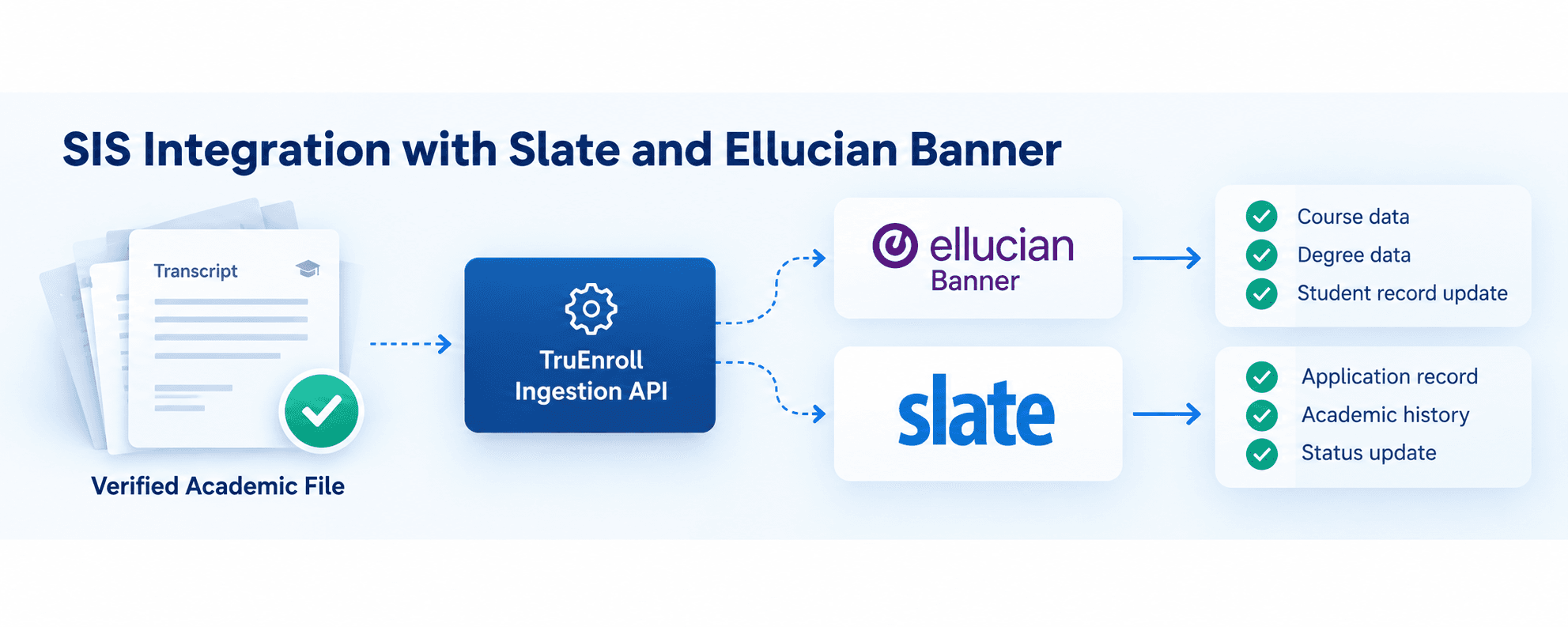
Ellucian Banner Integration
Once verified, the engine maps structured course and degree data directly into Banner database tables via secure APIs:
SHATERM: Populates term-by-term institutional academic history and standing.SHADEGR: Records verified degree of conferral dates, majors, minors, and institutional honors.SHATRNS: Writes articulated transfer coursework, earned credit units, and converted quality points directly into transfer evaluation screens without staff data entry.
Technolutions Slate Integration
For institutions managing recruitment in Slate, verified credentials update student records instantly:
Automated Checklist Fulfillment: Inbound verified transcripts automatically update and satisfy required application checklist items, releasing application holds.
Custom Dataset Mapping: Conferred degrees, GPA calculations, and course-level data map directly to custom Slate fields and Reader tabs.
Audit-Ready Logging: Generates immutable, timestamped verification logs tied to the applicant's record, satisfying regional accreditation compliance reviews.
Frequently Asked Questions
What constitutes an official academic credential versus an unofficial student record?
How do admissions offices detect tampered digital PDF transcripts?
Can an automated transcript verification service replace third-party evaluation agencies?
How does automated credential verification ensure FERPA compliance?
Check out recent blogs

The Institutional Guide to 4.0 GPA Conversion: Standards, International Normalization, and Automated Recalculation

How Registrars Automate Quarter Credit to Semester Credit Conversion and College Credit Transfer
What Qualifies as an Official Academic Transcript? Standards, Fraud Detection, and Automated Intake for Higher Ed Copy