What Qualifies as an Official Academic Transcript? Standards, Fraud Detection, and Automated Intake for Higher Ed Copy

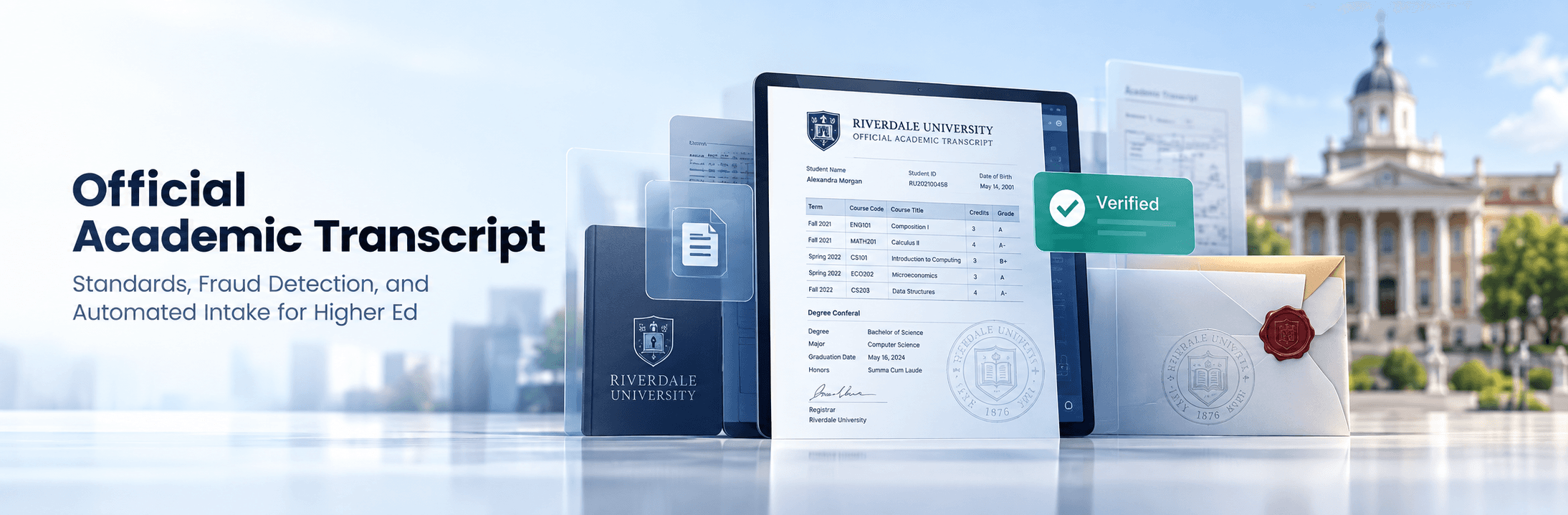
Admissions offices evaluate thousands of incoming credentials every cycle. Some arrive via electronic data exchanges, others as secure PDFs in shared intake inboxes, and a remaining fraction as physical envelopes bearing embossed registrar seals. Determining whether an incoming record legally qualifies as an official academic transcript—while simultaneously protecting the institution from sophisticated PDF alterations and diploma mill credentials—consumes hundreds of evaluator hours each term.
INSTITUTIONAL GOVERNANCE NOTICE: This operational guide is developed exclusively for campus registrars, admissions operations managers, and credential evaluators establishing institutional intake policies and automated verification pipelines. It does not provide student ordering portals, fee disbursement tools, or individual credential replacement services.
When evaluation teams spend weeks verifying chains of custody, authenticating digital signatures, and re-keying verified coursework into their Student Information System (SIS), enrollment velocity stalls. Establishing automated, policy-compliant verification protocols allows institutions to maintain strict academic governance without sacrificing processing speed.
Defining the Official Academic Transcript
Under standard guidelines established by the American Association of Collegiate Registrars and Admissions Officers (AACRAO), an official academic transcript is a comprehensive record of a student's academic history issued directly by the governing registrar's office. An academic record is only recognized as official if it retains an unbroken institutional chain of custody, is transmitted through authorized delivery channels, and features uncompromised security credentials verifying that no unauthorized party altered the document after generation.
The foundational principle of credential integrity is that academic transcripts cease to be official the moment they pass through the applicant's personal possession, email account, or physical custody.
Even a digitally authenticated PDF loses its official standing if downloaded, forwarded through personal channels, or delivered without its cryptographic certificate intact.
The 5 Institutional Standards of Official Academic Transcripts
To satisfy accreditation compliance and institutional transfer policies, an official academic transcript must satisfy five technical and administrative criteria upon receipt:
1. Direct, Unbroken Chain of Custody
The credential must transit directly between the issuing institution (or its contracted agent) and the receiving institution. This transfer occurs via:
Electronic Data Delivery: Direct transmission via secure Electronic Data Interchange (EDI), PESC XML format, or certified electronic exchange networks (e.g., Parchment Exchange, National Student Clearinghouse, SPEEDE).
Physical Postal Intake: Unopened, tamper-evident envelopes sent directly from the issuing registrar, sealed with registrar signature tape, embossed stamps, or chemical heat-reactive security seals.
2. Cryptographic Validation or Security Paper Properties
Digital Records: Certified PDFs must include an active, unrevoked digital signature backed by the Adobe Approved Trust List (AATL) or Certified Document Services (CDS). The public key infrastructure (PKI) certificate must confirm that the file has not been modified since the digital signature was applied.
Physical Paper: Security features must include blue or green “void” pantograph backgrounds that activate when photocopied, microprinted border text, watermark patterns embedded into the paper stock, and thermochromic reactive inks.
3. Comprehensive Academic and Course-Level Ledger
The document must present an exhaustive academic history, including term-by-term enrollments, institutional course numbers, full descriptive titles, credit values (quarter, semester, or clock hours), assigned grades, and clear notations for repeated courses, withdrawals, or academic probation.
4. Explicit Institutional Degree Conferral Data
For matriculation and graduate admissions, the record must provide definitive graduation milestones, including the specific degree conferred, graduation date, major(s), minor(s), and honors notations.
5. Accreditation and Institutional Authority Statements
Legitimate academic transcripts include the governing institution’s recognized accreditation status (verified through regional accreditors or national ministries of education) and an explicit registrar signature certifying the document’s legal authenticity.
The Modern Fraud Landscape: Detecting Tampered Academic Transcripts
As admissions offices transitioned from locked physical envelopes to digital file downloads, document fraud shifted from crude paper alterations to sophisticated PDF manipulation. Today’s evaluators encounter doctored academic transcripts that bypass standard visual checks.
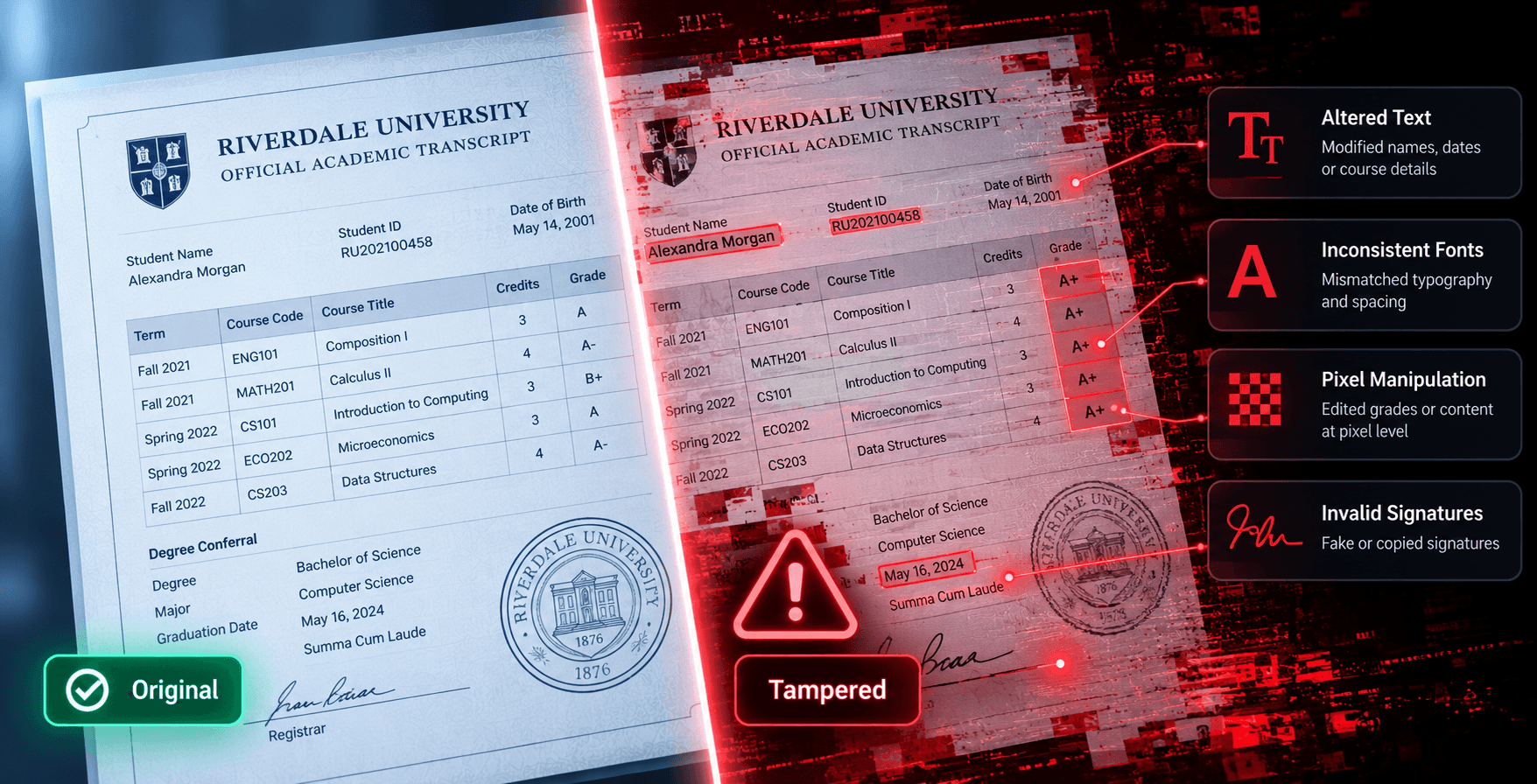
Admissions teams must screen for four specific fraud indicators during manual or automated intake:
Stripped or Broken Cryptographic Signatures: Fraudulent digital submissions often arrive as “flattened” PDFs where the applicant stripped the original AATL digital certificate to edit course grades in desktop design software. If an electronic transcript lacks a live, clickable certificate validation banner in Adobe Acrobat, its official standing is invalid.
Kerning and Baseline Typography Shifts: Alterations made to course codes, credit weights, or letter marks often introduce subtle pixel artifacts, mismatched anti-aliasing around characters (e.g., turning a
Dinto aB), or subtle variations in baseline font height.Arithmetic Ledger Mismatches: Forged records frequently contain mathematical errors where forged course-level grade points do not calculate accurately into cumulative grade point averages or term GPA summaries.
Accreditation Laundering and Diploma Mills: Predatory entities create elaborate websites, fictitious transcripts, and illegitimate evaluation reports designed to mimic regional accrediting bodies. These operations require cross-referencing against verified databases like the Council for Higher Education Accreditation (CHEA) or the US Department of Education database.
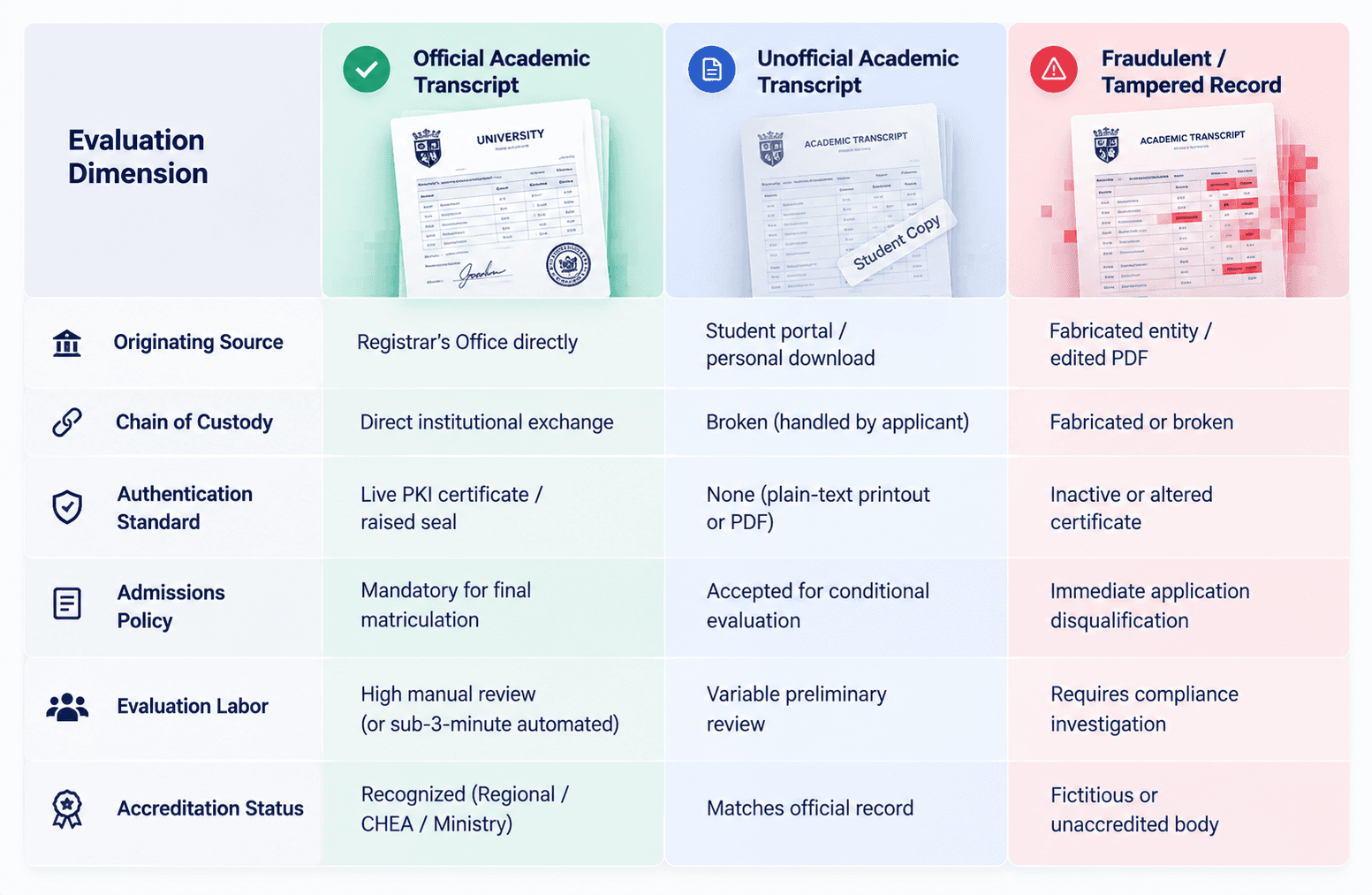
Comparison Matrix: Official vs. Unofficial vs. Fraudulent Records
The "Conditional-to-Official" Admissions Policy Framework
Requiring an official academic transcript at the initial point of application creates unnecessary friction. Institutions that mandate official records before completing an initial review report a 25% to 35% drop-off in prospective transfer and graduate applications.
Forward-thinking enrollment teams adopt a two-phase verification framework:
Image
Phase 1 (The Speed Phase): Accept unofficial student portals or Self-Reported Academic Records (SRAR) to generate an immediate credit articulation and extend conditional admission offers. Speed drives transfer yield.
Phase 2 (The Integrity Phase): Require the final official academic transcript prior to course registration or financial aid disbursement.
The traditional operational breakdown in this two-phase model occurs during July and August, when thousands of final academic transcripts hit the registrar's office at once. Evaluators spend weeks manually reconciling final official documents against the conditional records evaluated months earlier. Automating this ingestion pipeline allows institutions to clear holds and protect enrollment revenue without risking compliance.
The Technical Engine: How Automated Systems Ingest and Authenticate Transcripts
Modern transcript automation software manages the entire journey from raw digital file intake to verified SIS database entry across four coordinated stages:
Image
Stage 1: Chain of Custody & Certificate Verification
Incoming files from electronic document exchanges are ingested via secure API or SFTP. The software inspects the document’s cryptographic wrapper, validating the digital certificate against the Adobe Approved Trust List (AATL). It scans the file’s metadata for evidence of post-generation modification via image editing applications.
Stage 2: Deep Vision Extraction
Specialized computer vision models process the document structure:
Strips visual background noise, scanning artifacts, and security pantographs.
Extracts multi-column course tables, distinguishing lecture lines, lab requirements, and developmental coursework.
Isolate institutional grading legends and credit unit indicators (e.g., quarter vs. semester hours).
Stage 3: Institutional Logic & Articulation Rules
The extracted data passes through the platform’s articulation engine:
Queries your campus course database to identify direct catalog equivalencies.
Converts non-standard grading systems (e.g., ECTS credits, Indian percentage divisions, British Honours) into a normalized 4.0 GPA standard aligned with institutional policy.
Flags novel or unmapped courses for a one-click faculty chair review.
Stage 4: Direct SIS & CRM Writeback
Instead of requiring staff to type verified courses into Ellucian Banner, Slate by Technolutions, or Workday Student, the system pushes the verified course records, grade point conversions, and credential attributes directly into the appropriate SIS tables (such as Banner’s SHATRNS articulation screens).
Frequently Asked Questions About Official Academic Transcripts
Can a digital PDF transcript qualify as an official academic transcript?
What invalidates the official status of physical academic transcripts?
How does automated intake software detect altered academic transcripts?
Why do institutions reconcile unofficial transcripts against final official records?