Indian Degree Evaluation in the USA: The Institutional Blueprint for 3-Year Degrees, NEP 2020, and GPA Normalization


Institutional Governance Notice -This operational blueprint is designed for US graduate admissions directors, associate registrars, and international credential analysts establishing campus evaluation standards. It does not provide individual evaluations for H-1B visa petitions, USCIS immigration filings, or personal third-party agency requests.
India remains the single largest feeder market for US graduate programs, yet evaluating Indian academic credentials continues to be one of the most acute operational bottlenecks in higher education admissions. Unlike educational systems governed by a single uniform credit and grading framework, India’s higher education sector spans more than 1,100 universities, 45,000 affiliated colleges, legacy 3-year degree models, and newly graduated cohorts under the National Education Policy (NEP) 2020.
For admissions teams, the consequences of slow or inconsistent evaluation policies are immediate. Indian graduate applicants routinely apply to six to ten US universities in a single cycle. Because exam controllers at Indian state universities often take four to eight weeks to issue physical attested transcripts, institutions that force applicants through third-party evaluation agencies lose admitted students to faster competitors evaluating files in-house. Standardizing Indian degree evaluation in the USA requires clear campus equivalency rules paired with automated, high-precision intake.
Indian Degree Architecture: 10+2+3, 10+2+4, and NEP 2020 Comparability
An Indian degree evaluation in the USA benchmarks Indian 10+2+3, 10+2+4, and NEP 2020 qualifications against the 120-semester-credit US Bachelor’s standard by verifying sovereign UGC or AICTE recognition, auditing complete sets of individual semester mark sheets, and normalizing native percentage or 10-point CGPA scales onto a 4.0 US GPA.
Understanding how to evaluate Indian degrees in the USA begins with mapping the structural duration and credit volume of the credential under India’s National Credit Framework (NCrF).

1. Four-Year Professional Degrees (10+2+4)
Four-year undergraduate degrees in engineering, technology, pharmacy, architecture, and medicine follow a 10+2+4 (or 10+2+5.5) structure:
Common Credentials: Bachelor of Technology (B.Tech), Bachelor of Engineering (B.E.), Bachelor of Pharmacy (B.Pharm), Bachelor of Architecture (B.Arch), and Bachelor of Medicine, Bachelor of Surgery (MBBS).
US Comparability: These credentials represent 160 or more Indian credits (converting to 120+ US semester credit hours) and hold universal direct parity with a 4-year regionally accredited US Bachelor’s degree.
2. NEP 2020 Four-Year Undergraduate Programme (FYUP)
Following the rollout of India’s National Education Policy (NEP) 2020, central, state, and private universities have introduced 160-credit, 4-year undergraduate programs across arts, sciences, and commerce. Evaluators must distinguish between two distinct 4-year tracks on incoming transcripts:
Bachelor’s (Honours) - 160 Credits: Awarded upon completing four full years (eight semesters) of disciplinary coursework and skill modules without a formal research dissertation. Comparable to a 4-year US Bachelor’s degree.
Bachelor’s (Honours with Research) - 160 Credits: Restricted to students who achieve a minimum of 7.5 CGPA (75%) across their first six semesters and complete a mandatory 12-credit supervised research project or dissertation in their final year. Comparable to a 4-year US Bachelor’s degree with strong preparation for direct doctoral or research-track graduate admission.
3. Three-Year Bachelor’s Degrees (10+2+3 — 120 Credits)
Traditional non-engineering degrees—such as Bachelor of Commerce (B.Com), Bachelor of Science (B.Sc), Bachelor of Arts (B.A.), Bachelor of Business Administration (BBA), and Bachelor of Computer Applications (BCA)—follow a 10+2+3 structure totaling 120 Indian credits (roughly 90 US semester credit hours).
The Institutional Policy Split
While some US graduate schools strictly require an additional 1-year Postgraduate Diploma (PGD) or Master’s Part I to reach 16 years of total education, a growing majority of regionally accredited US universities grant direct graduate admission to 3-year degree holders under a selective quality threshold:
The degree was awarded in First Division (60% or higher), AND
The conferring university or autonomous college holds top-tier national accreditation.
Actionable Policy Rule
Codify your graduate school's 3-year degree policy explicitly in your admissions manual so evaluators apply identical criteria across every applicant file rather than relying on ad-hoc departmental exceptions.
4. Multi-Entry / Multi-Exit & Academic Bank of Credits (ABC)
Under NEP 2020 flexibility rules, students can exit after Year 1 (Undergraduate Certificate), Year 2 (Undergraduate Diploma), or Year 3 (3-Year Bachelor’s), or transfer credits between institutions via India’s Academic Bank of Credits (ABC). When reviewing ABC-linked transcripts, evaluators must audit the originating institution's accreditation for every transferred block of credits—not just the final degree-granting university.
Auditing Sovereign Indian Recognition: UGC, AICTE, NAAC Reforms & Online Degrees
Determining how to evaluate Indian degrees in the USA requires verifying that both the awarding institution and the specific program hold statutory authorization under India’s regulatory architecture.
1. The Statutory Recognition Stack
University Grants Commission (UGC): The primary statutory body governing university-level education in India. Evaluators must confirm that central, state, private, or "Deemed-to-be" universities appear on the official UGC consolidated list under Section 2(f) and hold degree-awarding authority under Section 22.
All India Council for Technical Education (AICTE): Technical programs (B.Tech, B.E., MBA/PGDM, MCA, B.Pharm) offered by affiliated institutions or standalone institutes must hold program-specific AICTE approval for the academic years the student attended. (Note: Standalone AICTE-approved institutes award a Post Graduate Diploma in Management [PGDM] rather than an MBA degree; when accredited by NBA and granted AIU equivalence, a 2-year PGDM is comparable to a US Master's degree).
2. Adapting Campus Policies to NAAC’s Accreditation Overhaul
Historically, US admissions policies stipulated that 3-year Indian degrees were acceptable only if the institution held a National Assessment and Accreditation Council (NAAC) grade of "A" or higher (A, A+, or A++).
However, following the Radhakrishnan Committee reforms, NAAC transitioned away from legacy single-letter grades toward a two-stage model:
Binary Accreditation: Classifying institutions simply as Accredited, Awaiting Accreditation, or Not Accredited.
Maturity-Based Graded Levels (MBGL): Ranking accredited institutions from Level 1 to Level 5 based on institutional maturity, research output, and governance.
Evaluator Update: Admissions teams must update their institutional rubrics to recognize both legacy NAAC letter grades (for earlier cohorts) and modern MBGL Levels 3–5 (or Institutions of Eminence / NIRF Top-100 rankings) when evaluating 3-year Bachelor’s eligibility.
3. Auditing Online and Distance-Mode Indian Degrees (UGC-DEB)
India has experienced rapid growth in fully online degrees (such as Online BCA, Online BBA, and Online MCA). Before accepting an online or distance credential:
Cross-check the university against the UGC Distance Education Bureau (DEB) entitlement list for the exact academic year of enrollment.
Verify program permissibility: UGC regulations strictly prohibit online or distance delivery in laboratory-heavy and clinical fields (including Engineering, Medicine, Pharmacy, Agriculture, and Architecture). Any Indian degree in these disciplines earned via distance mode is invalid for US admissions.
4. Affiliated Colleges vs. Autonomous Institutions
India’s affiliating university model frequently confuses evaluators unfamiliar with local governance:
Affiliated Colleges: Thousands of local colleges teach the curriculum and conduct internal assessments, but a large parent state university (such as the University of Mumbai, Anna University, Savitribai Phule Pune University, or Visvesvaraya Technological University) issues their semester mark sheets and final degree certificates. Institutional recognition is determined by the parent university.
Autonomous Colleges: High-performing colleges granted autonomous status by the UGC design their own syllabi, conduct exams, and issue individual semester mark sheets under the college's own name, while the parent university confers the final degree certificate (Sanad). Evaluators must verify the college's UGC autonomous status alongside the parent university’s charter.
Indian Document Forensics: Semester Mark Sheets, Backlogs & Digital Registries
Indian universities issue academic documentation differently from North American registrars. Enforcing strict document standards prevents hidden academic deficiencies and eliminates months of courier delays.

1. Why Consolidated Transcripts Are Never Enough
Most Indian universities issue both individual semester (or annual) mark sheets and a single summary "Consolidated Statement of Marks."
The Backlog Blind Spot: Consolidated transcripts frequently display only the final passing grade for each course, omitting original failed attempts, supplementary/compartment examination sittings, and grace marks awarded to clear a subject.
The Evaluator Rule: Always mandate complete sets of individual semester mark sheets (all 6 semesters for a 3-year degree; all 8 semesters for a 4-year degree) in addition to the consolidated record. Auditing each semester sheet chronologically exposes repeated courses and ensures accurate quality-point calculation.
2. Provisional Certificate vs. Final Degree Certificate (Sanad)
Formal convocation ceremonies at major Indian public universities often take place 12 to 24 months after final examinations conclude.
Conditional Clearance: Evaluators should accept an official Provisional Degree Certificate signed and sealed by the university Registrar or Controller of Examinations to grant conditional graduate admission and issue Form I-20 documentation.
Matriculation Hold: Place a registration hold requiring the final convocation Degree Certificate (Sanad) once issued by the university.
3. Replacing Physical Envelopes with Digital Indian Registries
Requiring Indian applicants to mail physical, wax-sealed envelopes from university exam offices adds four to eight weeks of administrative drag. Modern admissions offices authenticate Indian records electronically using sovereign digital infrastructure:
National Academic Depository (NAD) & DigiLocker: Under Government of India mandates, universities deposit cryptographically signed digital mark sheets and degree certificates into NAD/DigiLocker. Evaluators can verify authenticity in seconds via unique DigiLocker certificate URIs, QR codes, or academic verification portals.
University Online Verification Portals: Major feeder universities (including VTU, Anna University, Manipal, and Delhi University) maintain direct institutional verification portals allowing admissions staff to confirm registration numbers and CGPA records online.
Calibrating Indian Grading Scales: Divisions, CBCS 10-Point CGPA & University Variance
Applying linear mathematical division to Indian marks (62% / 25 = 2.48 GPA) is one of the most damaging errors in international admissions. Indian grading systems operate on compressed distribution curves where scoring 70% to 75% places a student in the top decile of their graduating cohort.

1. Standardizing Percentage and 10-Point CBCS Scales
While most autonomous and private universities have adopted the UGC’s 10-point Choice Based Credit System (CBCS), many traditional state universities still report raw percentages or hybrid credit-percentage scores.

2. Accounting for Inter-University Grading Strictness
Not all 70% scores or 8.0 CGPAs reflect identical grading generosity:
Traditional Affiliating State Universities: Institutions like the University of Mumbai, Savitribai Phule Pune University, or University of Calcutta maintain rigorous external examination standards where cohort averages hover around 58%–65%. A 68% in these systems represents high academic distinction.
Autonomous & Private Deemed Universities: Institutions operating internal continuous evaluation often exhibit higher average CGPAs (8.0–9.0).
Evaluator Best Practice: Always check the grading legend printed on the reverse of the semester mark sheet. Many Indian universities print an official university-specific formula (e.g., Percentage = (CGPA - 0.75) X 10 or CGPA X 9.5) alongside class-rank percentiles, allowing evaluators to calibrate the conversion accurately.
3. Stripping Mandatory Non-Credit UGC Courses
Indian undergraduate curricula mandate several non-academic audit courses—such as Environmental Studies, Constitution of India, Professional Ethics, National Service Scheme (NSS), or Physical Education. These courses typically carry zero credits or pass/fail ("Satisfactory") designations and must be excluded from cumulative GPA calculations.
Eliminating the Indian Transcript Bottleneck with In-House Automation
Executing this methodology manually across thousands of Indian applications creates a severe seasonal bottleneck. Parsing eight individual semester mark sheets for a single B.Tech applicant—extracting 45 to 55 courses, checking for hidden re-sits, verifying UGC/NAAC/DEB status, and applying non-linear grading curves—consumes 45 to 60 minutes of a senior analyst’s time.

Modern graduate admissions teams eliminate this backlog by bringing evaluation in-house with TruEnroll:
High-Variance Mark Sheet Extraction: Deep-vision OCR parses complex, multi-column layouts across more than 1,000 Indian universities—capturing subject codes, theory/practical credit splits, internal vs. external marks, and concealed supplementary exam attempts in seconds.
Automated Regulatory & Accreditation Checks: Upon upload, the platform automatically verifies the parent university, autonomous college status, NAAC accreditation tier, and UGC-DEB online program approvals.
Byte-Level Document Forensics: Automated PDF inspection flags altered digits, mismatched font kerning, and suspicious metadata timestamps before files enter academic review.
Configurable Policy Engine & SIS Sync: Apply your institution's exact rules (such as auto-clearing 3-year degrees from top-accredited institutions with Division I marks) and write normalized 4.0 GPAs and course-by-course tables directly into Technolutions Slate or Ellucian Banner in under three minutes.
Frequently Asked Questions
Are 3-year Indian Bachelor’s degrees (B.Com, B.Sc, B.A.) equivalent to a US Bachelor’s degree?
How do US universities evaluate the new NEP 2020 4-year Indian Bachelor’s (Honours with Research) degree?
Are Indian online degrees valid for US graduate school admission?
Why do US universities require individual semester mark sheets in addition to a consolidated Indian transcript?
How do you convert an Indian 10-point CGPA or percentage into a 4.0 US GPA?
Stop Losing Admitted Indian Graduate Students to 4-Week Transcript Delays
Evaluate multi-page Indian semester mark sheets in minutes instead of weeks. Upload a complex B.Tech, NEP 2020 Honours, or 3-year B.Com dossier to TruEnroll to verify UGC and NAAC standing, uncover concealed backlogs, and generate an audit-ready 4.0 GPA evaluation in under three minutes.
Check out recent blogs
Indian Degree Evaluation in the USA: The Institutional Blueprint for 3-Year Degrees, NEP 2020, and GPA Normalization

Evaluating Foreign High School Diplomas: Fast-Tracking Secondary Verification Without Agency Delays
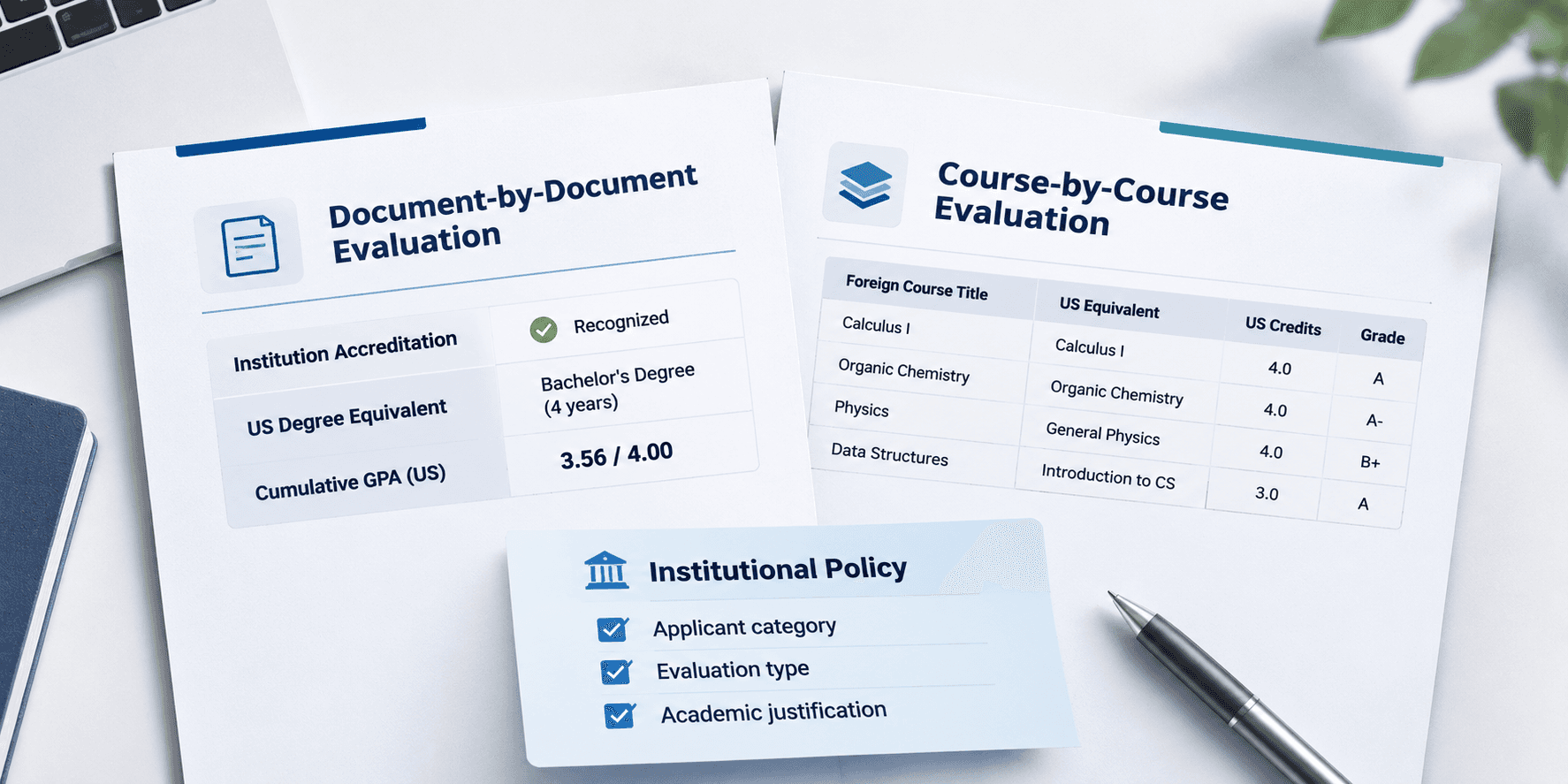
Course-by-Course vs. Document-by-Document Evaluation: Ending the Transcript Articulation Bottleneck