How Registrars Automate Quarter Credit to Semester Credit Conversion and College Credit Transfer


Transfer articulation officers face an operational bottleneck every time an applicant transfers from a quarter-system institution to a semester-based campus. While electronic transcripts arrive instantly through credential networks, the evaluation process stalls over arithmetic: translating 5-credit quarter courses into fractional 3.33 semester hours, reconciling general education deficiencies, and manually typing articulated equivalencies into Ellucian Banner or Slate.
Institutional Governance Notice: This operational guide is designed for university registrars, transfer coordinators, and enrollment operations teams establishing credit articulation policy and automated intake workflows. It does not provide student GPA calculation tools, personal transfer credit checks, or individual transcript request services.
When evaluators manually calculate conversion ratios across dozens of transfer files each day, backlogs stretch from days into weeks. Accelerating college credit transfer requires understanding both the underlying conversion of mathematics and the automated infrastructure that replaces manual spreadsheet entry with instant, audit-ready student information system (SIS) writeback.
The Mathematical Foundation: Quarter Credit to Semester Credit Conversion
The standard formula governing a quarter credit to semester credit conversion is built on the academic calendar ratio of a three-term quarter system (excluding summer) to a two-term semester system:

While the arithmetic is straightforward, institutional execution introduces edge cases. Evaluators routinely handle fractional units that do not align cleanly with standard 3-credit or 4-credit course requirements:

The Fractional Credit Dilemma in Institutional Articulation
The friction in a quarter credit to semester credit conversion stems from policy rather than basic math. When a student transfers a 5-quarter-credit Calculus course (equal to 3.33 semester credits) to fulfill a 4-semester-credit prerequisite, the receiving campus faces a policy fork:
Strict Unit Enforcement: Force the transfer student to complete a 1-credit independent study or supplementary course to make up the missing 0.67 semester hours.
Competency-Based Waivers: Articulate the course as satisfying the core subject of competency while absorbing the 0.67 credit deficit into the general elective balance.
Sequential Bundling: Evaluate multi-course sequences (e.g., three quarter terms of General Chemistry) as a collective block (15 Quarter Credits = 10 Semester Credits) rather than evaluating each class independently.
Evaluating these exceptions by hand forces evaluators to cross-reference static PDF equivalency tables, check department memos, and consult academic deans—slowing down the entire transfer intake pipeline.
Manual Review vs. Outsourced Agencies vs. Automated Credit Evaluation Services
To manage transfer volume, institutions rely on three operational models for their transcript evaluation pipelines:

While outsourced credit evaluation services offer temporary relief during seasonal staffing shortages, they introduce institutional friction. External agencies produce static evaluation reports that staff must still read and manually re-enter into campus databases. Modern admissions operations bring evaluation in-house by pairing internal articulation rules with automated intake software.
The Technical Engine: Automating College Credit Transfer
An automated intake pipeline turns incoming transcripts into articulated student records through four systematic steps:
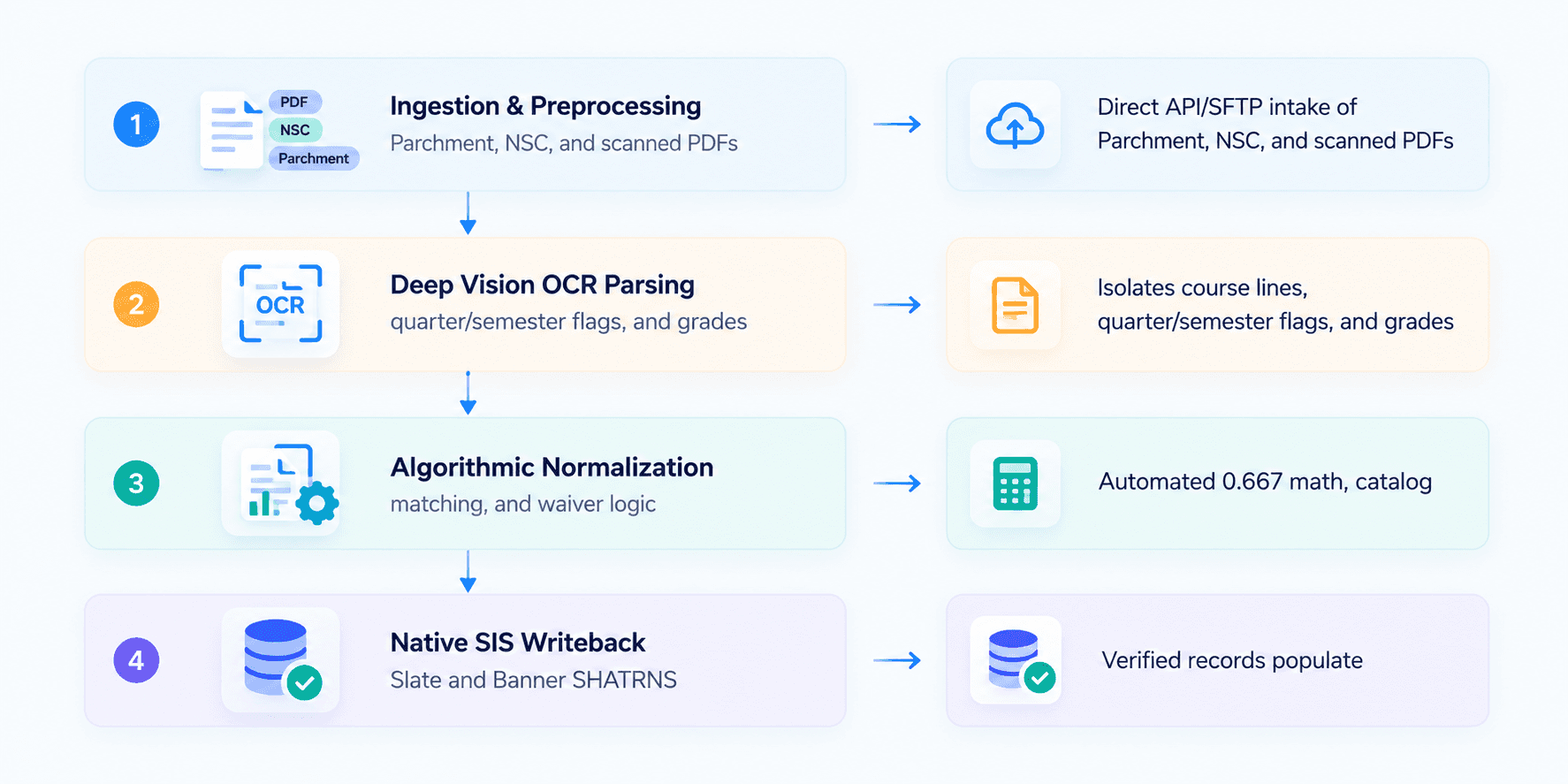
1. Ingestion & Preprocessing
The engine monitors electronic exchange endpoints (Parchment, National Student Clearinghouse) and intake email inboxes. Incoming PDF records are ingested, deskewed, and matched to active applicant files within the CRM.
2. Deep Vision OCR & Field Parsing
The system reads complex tabular transcripts without relying on rigid zone templates. It captures:
Institution-specific term calendars (identifying quarter terms vs. semester terms automatically).
Departmental course codes, descriptive titles, earned grades, and attempted versus earned credits.
Grading keys, identifying pass/no-pass thresholds, remedial courses, and repeated attempts.
3. Algorithmic Normalization & Articulation
Once parsed, the platform applies institutional transfer rules:
Calculates the exact quarter-to-semester credit conversion automatically.
Queries from the university’s historical transfer database match verified course equivalencies.
Implements automated rounding and fractional waiver rules (e.g., auto-flagging a 3.33-credit conversion as fulfilling a 3.0-credit major requirement).
Routes unprecedented courses to the appropriate academic department chair with syllabus excerpts pre-attached for a single-click equivalency decision.
4. Direct SIS Writeback
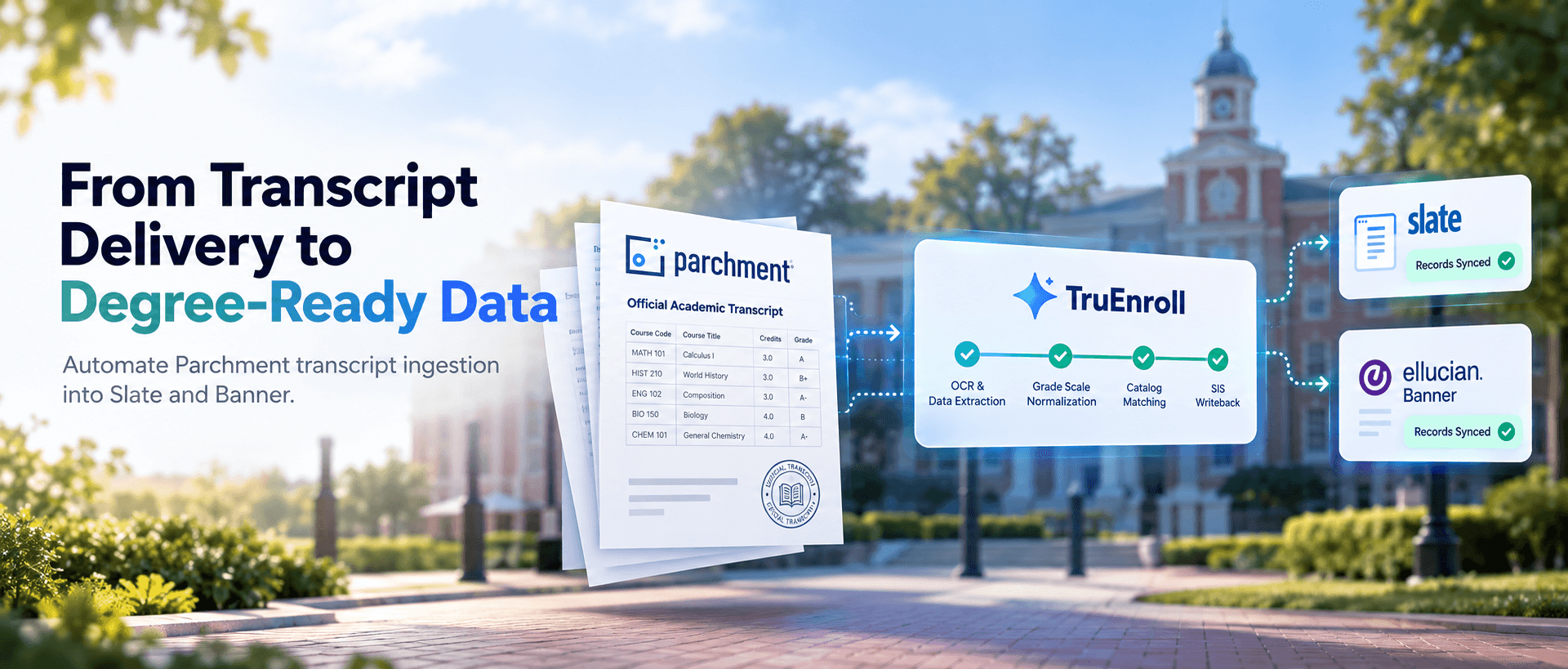
Instead of requiring staff to type articulated courses row by row, the verified data—including converted semester hours, normalized grades, and equivalency codes—synchronizes directly into Ellucian Banner (SHATRNS), Slate by Technolutions, Ellucian Colleague, or Workday Student.
Why Speed in Credit Articulation Drives Transfer Enrollment Yield
Transfer students rarely wait for slow admissions processes. In competitive recruitment environments, the single highest predictor of transfer student matriculation is evaluation of velocity.
Transfer applicants submit files to multiple regional institutions simultaneously. When a university delivers an official transfer credit articulation alongside the initial acceptance letter, the student immediately understands:
Which completed courses transfer toward their major.
Exactly how many credits remain to finish their degree.
Their projected graduation timeline and associated tuition costs.
Conversely, if credit evaluation takes three to four weeks, the applicant often commits to a competing campus that answers first. Automating the intake and conversion workflow protects institutional yield, lowers cost-per-acquisition, and eliminates the administrative backlog that overwhelms staff in every transfer cycle.
Frequently Asked Questions
How does an automated system calculate quarter credit to semester credit conversions?
How does automated articulation handle fractional credit gaps?
Can automated software replace third-party credit evaluation services?
How do convert credits sync into Ellucian Banner or Slate?