How Can Higher Ed Eliminate Transcript Evaluation Backlogs in 2026?

Vibhor Sharma

Every November, admissions offices hit the exact same wall. Files pile up. Staff burns out. Your evaluators are squinting at crooked smartphone photos of foreign mark sheets, fighting password-protected PDFs from regional community colleges, and staring down an inbox with 900 unread transfer files.
Meanwhile, that admitted student you spent months recruiting commits to a competing campus. Why? Because the school down the road delivered an official transfer credit evaluation two weeks before your team even opened the file.
Operational Notice: This guide is written for university registrars, admissions directors, and enrollment operations analysts evaluating institutional intake. It does not cover student-facing transcript ordering or individual credential requests.
If your team wants to protect transfer yield and stop working mandatory overtime every spring, manual data entry must go. Relying on slow, external transcript services or manual spreadsheet calculations just can't keep pace. Moving to modern automated transcript processing gives your staff a reliable way to ingest, evaluate, and post academic records on the day they arrive.
The Intake Reality: Where Manual Workflows Break Down
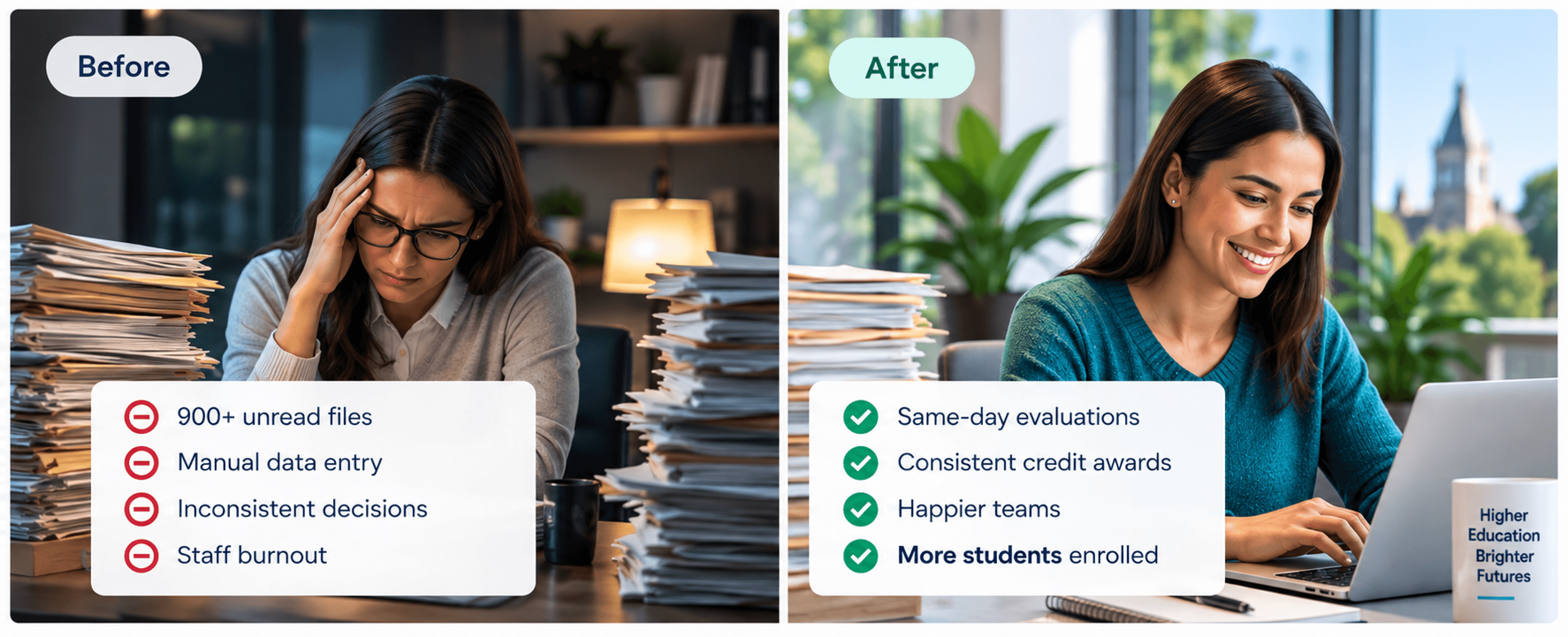
Processing incoming transfers and foreign credentials always sounds straightforward in an operations manual. In practice, admissions teams run into the same four bottlenecks every cycle:
1) Document Intake & Triage:
The Daily Friction: Admissions inboxes are a mess of Parchment deliveries, Slate batch uploads, physical mail, and unsearchable scans. Evaluators spend their first two hours every morning rotating upside-down pages, fixing corrupt files, and sorting an incoming transcript for high school applicants from multi-institution college transfer files.
Automated Execution: Incoming files from your CRM or secure inbox are automatically deskewed, split into correct applicant folders, and pushed into active processing queues within seconds. Whether parsing a domestic transcript for high school admissions or an unformatted foreign university record, the system routes the file immediately.
2) Data Transcription & GPA Calculations:
The Daily Friction: An evaluator wastes 40 minutes on a single international file. They are manually typing course titles and cross-referencing conversion charts—whether that is AACRAO EDGE or an internal binder from 2014—just to recalculate foreign grading tiers.
Automated Execution: Multi-engine OCR extracts tabular coursework at 99%+ field accuracy. ECTS credits, UK degree classifications, and Indian percentage marks are converted to an institutional 4.0 scale on upload.
3) The Course Articulation Chase:
The Daily Friction: A transfer course lacks a clean match. The file sits in departmental purgatory for three weeks while your team chases down a missing syllabus from a faculty chair who hasn't answered email all month. Evaluator decisions drift, leading to inconsistent credit awards.
Automated Execution: The system clears all known equivalencies against your historical database instantly. Only novel, unmapped courses get flagged for a quick staff check.
4) SIS Writeback:
The Daily Friction: The evaluation is finally complete, but someone still has to hand-type every single semester, course, and credit into Banner or Colleague. It is slow, mind-numbing work that invites clerical errors.
Automated Execution: Articulated credit data transfers directly into your system of record, letting you deliver an actionable credit summary alongside the acceptance letter.
An Operational Comparison: Software vs. Outsourced Transcript Services
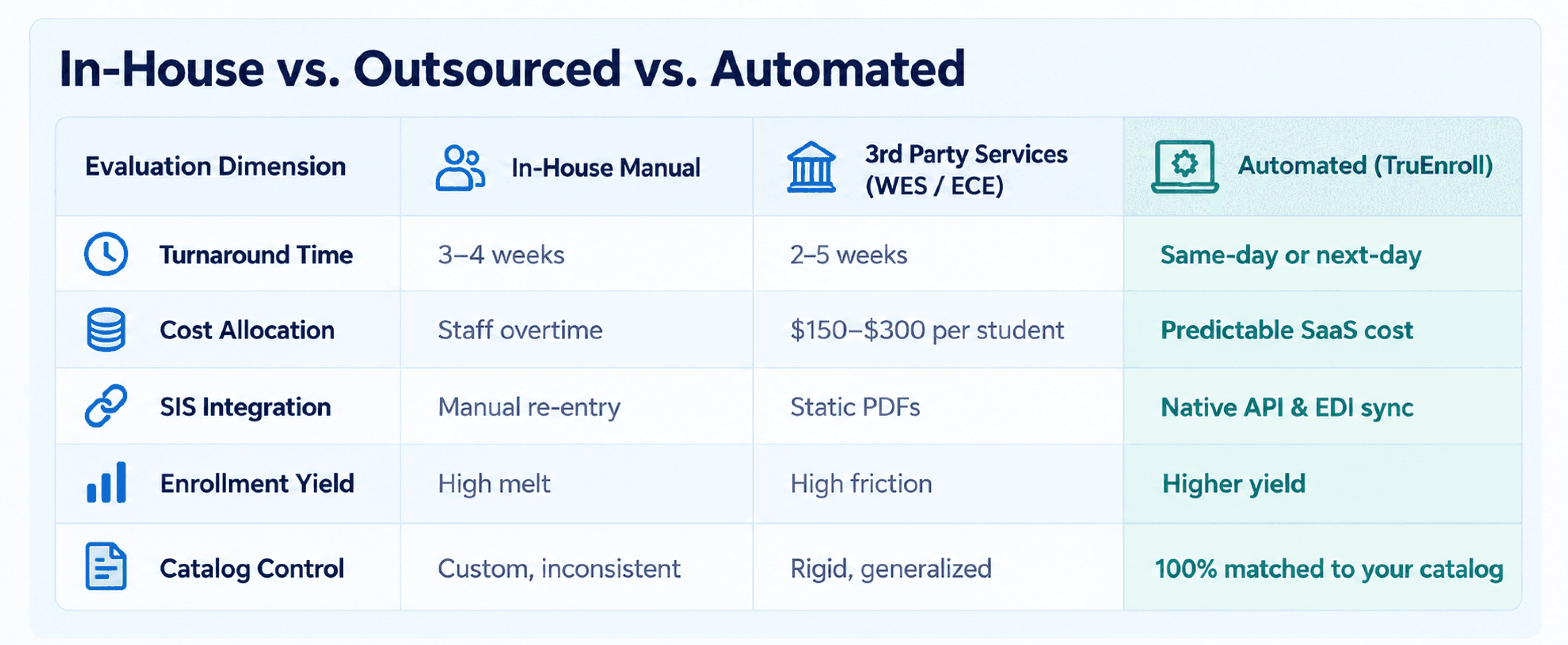
When admissions volume spikes, many campuses turn to third-party transcript services or credential evaluation agencies (such as WES or ECE). While outsourcing removes manual typing, third-party transcript services shift heavy fees onto applicants and create weeks of third-party delays that drive summer to melt.
Bringing an automated transcript evaluation platform in-house gives your department complete control over turnaround and data integrity.
Under the Hood: How the Ingestion Pipeline Runs
Automating evaluation does not mean handing your admissions rules over to a black box. It means building an auditable, rules-based pipeline engineered around higher-ed registrar standards:
Ingestion Layer: Ingests unstandardized files across every channel—unsearchable PDFs, camera uploads, high-res scans, PESC XML, and EDI batches coming out of Slate or Parchment. It seamlessly handles both a freshman applicant's transcript for high school graduation verification and multi-page collegiate transcripts.
OCR & Computer Vision: Strips out background noise, isolates course tables, and parses multilingual text across 50+ languages without third-party translation delays.
The Logic Engine: Executes institutional rules to calculate quarter-to-semester credit ratios, track prerequisite completions, and match active catalog equivalencies.
Human-in-the-Loop Review (Crucial Audits): If the parser hits an ambiguous course title or a damaged document, it flags that specific field for a one-click human verification. No guess.
SIS & CRM Sync: Transmits final equivalencies directly into Slate, Ellucian Banner, Ellucian Colleague, PeopleSoft, or Workday Student.
Measurable Results Across Admissions Operations
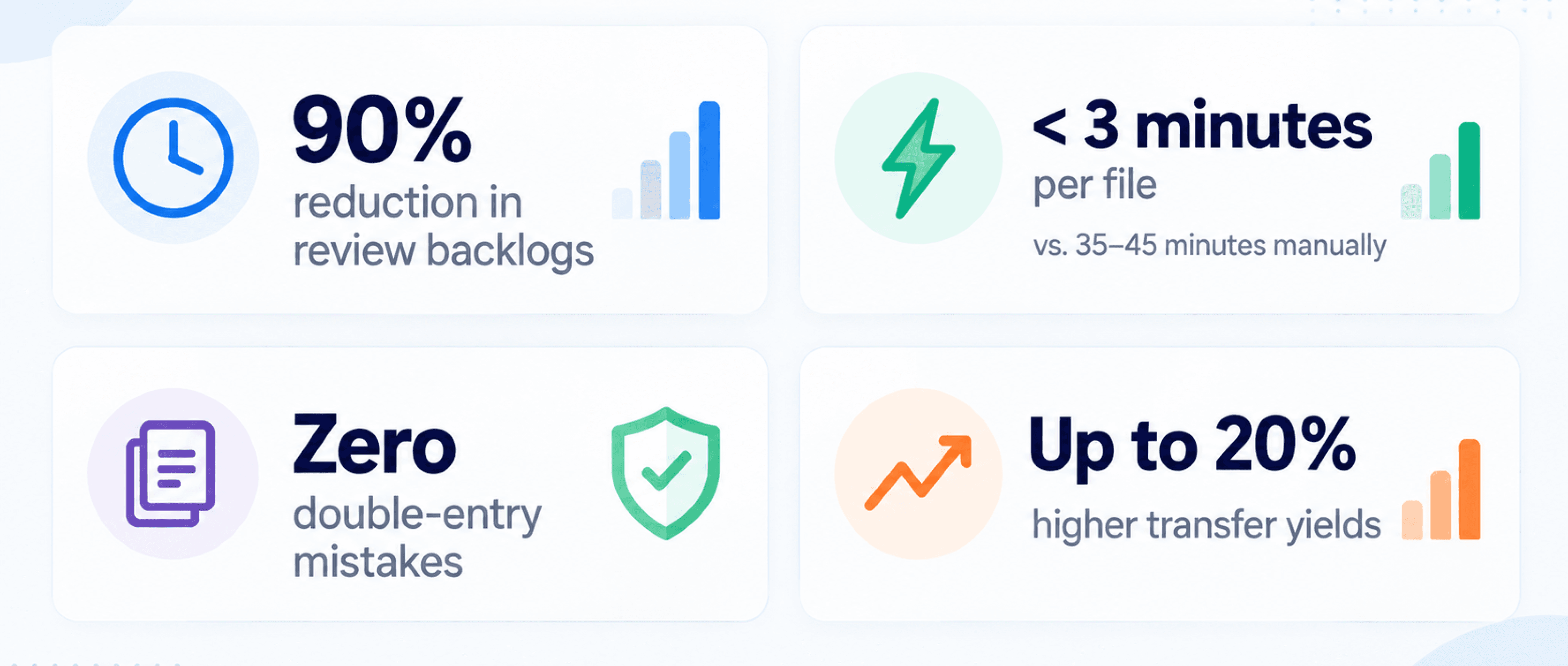
Automating intake produces immediate, operational relief that registrars can track on a dashboard:
90% cut in review backlogs. Peak December and March application waves stop paralyzing your admissions staff.
Under 3 minutes per file. Replaces 35 to 45 minutes of manual re-typing and scale conversions on complex foreign files.
Zero double-entry mistakes. Direct SIS integration stops manual typos in course numbers and credit allocations cold.
Higher transfer yields. Delivering an accurate credit evaluation within 48 hours gives applicants a concrete path to graduation, increasing transfer yield by up to 20%.
Frequently Asked Questions

How does automated transcript evaluation handle students with transcripts from multiple colleges?
Can automated software process a transcript for high school as easily as college files?
Why choose automated software over third-party transcript services?
Does this replace our admissions evaluators?
How are data security and compliance handled?