Foreign Degree Accreditation in the USA: The Institutional Guide to International Credential Recognition and In-House Articulation


As international applicant volume surges across undergraduate, graduate, and professional programs, admissions offices and credential evaluation teams face a complex operational reality. Evaluating foreign academic credentials requires navigating varied sovereign education systems, non-standard degree lengths, diverse grading rubrics, and disparate ministerial quality assurance directories.
Unlike domestic high schools and colleges governed by standardized regional accreditors, international qualifications arrive from thousands of autonomous institutions operating under fundamentally different legal frameworks.
Institutional Governance Notice - This operational framework is engineered specifically for university admissions directors, international credential evaluators, and registrar teams establishing campus recognition policies and automated international intake. It does not provide individual student evaluation reports, immigration/USCIS credential certificates, or personal document translation services.
When university admissions offices rely on slow, outsourced evaluation agencies or manual spreadsheet cross-referencing, review queues stall for weeks. Establishing an automated, in-house verification pipeline allows institutions to determine foreign degree accreditation in the USA with audit-ready accuracy while accelerating international enrollment yield.
Regulatory Reality: Does the US Accredit Foreign Degrees?
In the United States, there is no federal ministry of education or central governmental body that evaluates, validates, or grants foreign degree accreditation in the USA. The US Department of Education (USDE) and the Council for Higher Education Accreditation (CHEA) oversee domestic regional and national institutional accreditors; their statutory authority does not extend beyond US borders.
Under the decentralized US higher education model, the legal and academic authority to recognize a foreign degree rests entirely with the receiving institution (the university admissions office) or state professional licensing boards.
Admissions evaluators do not seek an elusive "US accreditation" seal on an international credential. Instead, their task is to establish academic comparability:
Confirming that the issuing foreign institution holds legitimate sovereign recognition in its home country.
Determining whether the completed program of study is comparable in level, scope, academic rigor, and credit volume to a degree conferred by a regionally accredited US university.
Understanding this operational reality is critical. Framing the evaluation process around institutional recognition and academic comparability enables universities to bring foreign credential assessment in-house rather than offloading decisions to third-party bureaus.
The 3-Tier Hierarchy of Foreign Institutional Recognition
To determine whether an international university holds legitimate foreign degree accreditation, professional evaluators apply a three-tiered quality assurance hierarchy:

1. Sovereign National Recognition (The Ministry Standard)
The primary test of an international credential’s validity is whether the institution is officially chartered, recognized, or accredited by the sovereign authority governing education in that jurisdiction:
Statutory Oversight: In most nations, higher education quality assurance is exercised directly by a national Ministry of Higher Education or statutory councils (e.g., the University Grants Commission and NAAC in India, the Ministry of Education in China, the National Universities Commission in Nigeria, or the Standing Conference of the Ministers of Education and Cultural Affairs / Anabin database in Germany).
Institutional Charter Types: Evaluators verify whether the sending school is a chartered public university, a recognized private non-profit institution, or an autonomous degree-granting college—differentiating them from unchartered post-secondary trade schools or private training centers.
2. Supranational Directories & International Quality Frameworks
To verify legitimate institutional charters beyond national borders, admissions teams cross-reference international multilateral registries:
UNESCO IAU WHED: Evaluators utilize the UNESCO International Association of Universities (IAU) World Higher Education Database (WHED). Each recognized institution carries a unique WHED Global Identifier (e.g.,
IAU-012345), certifying its government-recognized degree-granting status.Multilateral Quality Accords: Frameworks such as the Lisbon Recognition Convention (governing the 49 nations of the European Higher Education Area) establish legal presumptions that qualifications from member nations are comparable unless substantial differences in learning outcomes are proven.
3. Comparative Placement Benchmarks (AACRAO EDGE)
Once recognition is confirmed, credential analysts consult placement recommendations published by the American Association of Collegiate Registrars and Admissions Officers (AACRAO) Electronic Database for Global Education (EDGE). AACRAO EDGE provides country-specific historical research, grading distribution analyses, and degree-level equivalency recommendations widely adopted by US university faculties
Navigating the 3-Year Degree Dilemma: Bologna vs. Indian Credentials
The single most contentious operational policy in international graduate admissions is the evaluation of 3-year international bachelor's degrees against the standard 4-year (120-semester-hour) US baccalaureate standard.

The European Bologna Accord (180 ECTS)
Historically, US graduate schools rejected all 3-year international bachelor's degrees. However, the adoption of the Bologna Process across the European Higher Education Area (EHEA) standardized European higher education into a three-cycle framework:
Bachelor’s degrees represent 180 to 240 ECTS credits (equivalent to 90–120 US semester hours).
The standardized workload, strict quality assurance protocols, and verified learning outcomes mean that modern US graduate admissions policies almost universally accept Bologna-compliant 3-year degrees as satisfying undergraduate preparation requirements.
The Indian 3-Year Bachelor’s Challenge (B.Com, B.Sc, B.A.)
India represents the largest feeder market for US graduate programs, where thousands of applicants hold 3-year degrees in commerce, science, and arts. A rigid policy requiring 4 years of undergraduate study creates an operational impasse.
Forward-thinking graduate admissions offices adopt nuanced evaluation standards based on institutional quality:
The NAAC Accreditation Standard: Accepting 3-year Indian bachelor's degrees provided the issuing institution holds an 'A' or 'A+' Grade accreditation from the National Assessment and Accreditation Council (NAAC) and the candidate graduated with First Division (60%+) standing.
The "12+3+1" / "12+3+2" Bridge Model: Requiring applicants with a standard 3-year degree to present an affiliated 1-year Post-Graduate Diploma (PGD) or a completed master's degree (M.Com, M.Sc, M.A.) to bridge the credit gap.
Departmental Competency Review: Allowing academic departments to review syllabi and waive credit deficits when core major prerequisites are satisfied.
Outsourced Evaluation Agencies (WES/ECE) vs. Manual Review vs. Automated In-House Software
To manage international transcript intake, admissions leaders typically balance three operational approaches:

While requiring an external evaluation report from an agency belonging to NACES (National Association of Credential Evaluation Services) or AICE (Association of International Credential Evaluators) protects internal staff bandwidth, it imposes severe friction on applicants.
Forcing international students to pay $200+ and wait a month for a report causes high application abandonment rates. Competitor institutions that process international credentials in-house deliver admission offers weeks earlier, capturing the top international cohort. Modern admissions operations bring evaluation in-house by pairing policy automation with deep-vision intake software.
Institutional SOP: Step-by-Step Foreign Degree Verification & Articulation
Standardizing the intake and articulation of international academic records requires a rigorous five-step standard operating procedure:

Step 1: Document Authenticity & Cryptographic Verification
Verify the document’s provenance before evaluating its contents:
Direct Electronic Delivery: Ingest files received through secure sovereign exchange platforms (e.g., India’s DigiLocker / NAD, China’s CHESICC / CSSD, or certified international exchange networks).
Forensic PDF Inspection: Audit submitted digital transcripts for active cryptographic signatures, inspect metadata streams for consumer graphic design software (Photoshop, Canva), and flag "Print-to-PDF" flattening exploits.
Step 2: Sovereign Institutional Accreditation Audit
Cross-reference the issuing institution against legitimate quality assurance authorities:
Registry Query: Validate the university against the UNESCO IAU WHED directory and national ministry portals.
Affiliation Check: For affiliated colleges (common in South Asian systems), verify that the degree is awarded by the parent chartered university rather than the unchartered local campus.
Step 3: Programmatic & Level Comparability Assessment
Determine how the qualification aligns with the US higher education degree hierarchy:
Credential Hierarchy: Map degree nomenclature (e.g., Licence, Licenciatura, Maîtrise, Diplom, Magister, Honours Bachelor, High National Diploma) to US Associate, Baccalaureate, Master's, or Doctoral equivalents.
Pre-Requisite Check: Verify that secondary school preparation satisfied standard entry requirements for university study in the host country (e.g., 12 years of formal primary-secondary education).
Step 4: Non-Linear Grading Normalization
Standardize foreign academic marks without using flawed mathematical division ($Marks \div 25$):
Distribution-Based Mapping: Apply historical grade distribution matrices. For example, a 65% on a British or Indian university transcript represents high academic achievement (First Division / Upper Second, equivalent to a US 3.50–3.70 GPA), whereas linear division would inaccurately calculate it as a 2.60 (C+/B-).
Credit Ratios: Calculate credit conversions using established calendar ratios (e.g., 1 ECTS Credit = 0.5 to 0.67 US Semester Hours; 1 UK CATS Point = 0.25 US Semester Hours).
Step 5: Native Course Extraction & SIS Writeback
Transfer verified course lines, normalized grades, converted credits, and confirmed degree milestones directly into institutional databases:
Automatically populate custom datasets and application review tabs in Technolutions Slate.
Update transfer and degree articulation tables (
SHADEGR,SHATRNS,SHATERM) in Ellucian Banner without manual dual-monitor data entry.
Managing Dual-Language Transcripts, Certified Translations, and Apostilles
A significant point of failure in international credential evaluation occurs during document translation intake. International applicants routinely submit translated mark sheets that obscure institutional grading keys, erase fail/re-sit notations, or introduce unauthorized grade inflation through third-party translator error.
1. The "Dual-Document" Rule
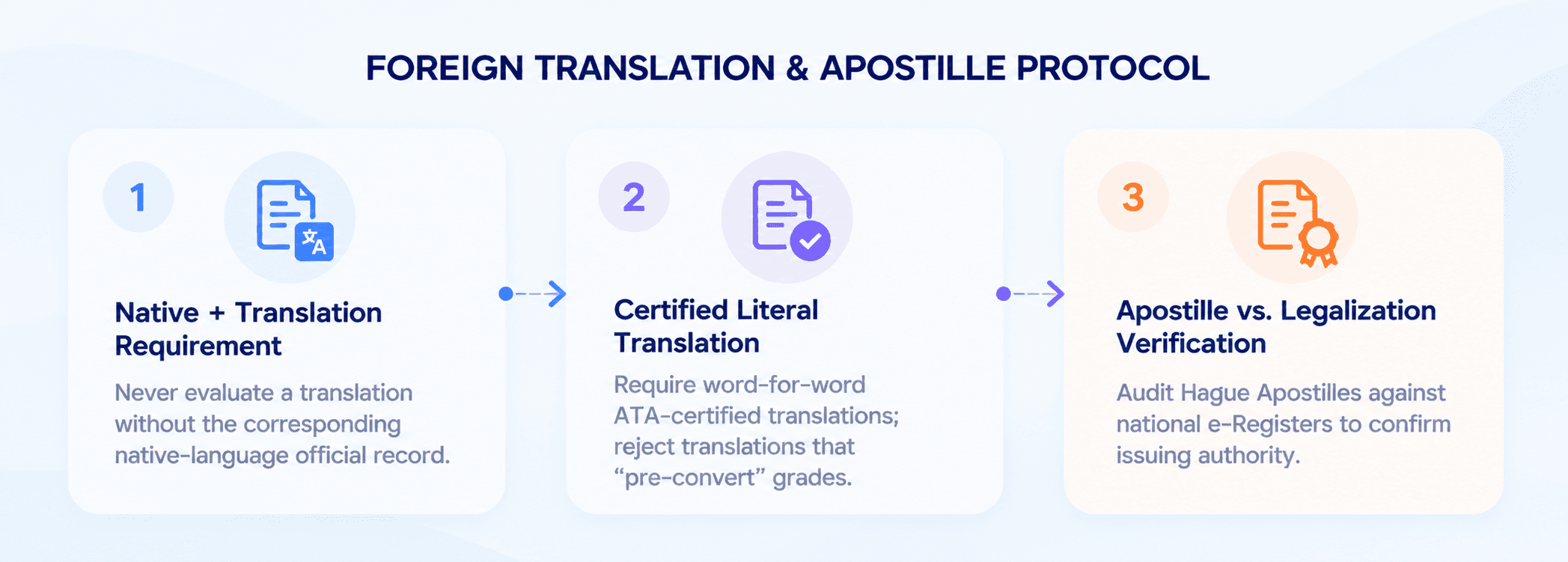
Campus evaluation policy must enforce the dual-document rule: a translation is an interpretive aid, not an official academic record. Evaluators must never review an English translation in isolation. Intake workflows must require:
The official transcript in the native language of instruction is issued directly by the university registrar.
A word-for-word certified English translation produced by an American Translators Association (ATA) certified translator, a court-appointed translator, or the issuing university itself.
2. The Danger of "Pre-Converted" Translations
Private translation bureaus frequently attempt to "help" US admissions offices by translating foreign marks directly into US letter grades (e.g., converting a 62% in India into a "C" or a 14/20 in France into a "B").
This practice distorts evaluation:
Translators are linguists, not professional credential analysts; their ad hoc grade conversions violate institutional transfer policy.
Institutional policy must mandate literal translations that preserve original terminology (e.g., leaving "Très Bien," "First Division," or "Pass with Distinction" intact) so your internal evaluation engine can apply standard institutional normalization rules.
3. Hague Apostilles vs. Consular Legalization
For countries to party to the Hague Apostille Convention, documents carry a standardized numbered Apostille certificate. Evaluators should not simply verify that an Apostille stamp is present; automated intake should verify the Apostille’s registration number against the issuing nation’s electronic register (e-APP) to confirm that the signing official was an authorized government registrar.
Frequently Asked Questions
Does the US Department of Education evaluate or accredit foreign degrees?
What is the difference between institutional recognition and regional accreditation for foreign universities?
Can a 3-year international degree be accepted for graduate admissions in the United States?
What is NACES, and is an agency of evaluation legally required by US universities?
How do automated credential intake systems verify foreign ministry accreditation?
Check out recent blogs

Document Authenticity Verification in Admissions: Standards, Forensics, and Automated Intake

The Registrar’s Blueprint to Verify Academic Credentials: Standards, Workflows, and Automated Intake

The Institutional Guide to 4.0 GPA Conversion: Standards, International Normalization, and Automated Recalculation