Why Does Traditional Academic Transcript Translation Stall International Admissions?

Vibhor Sharma

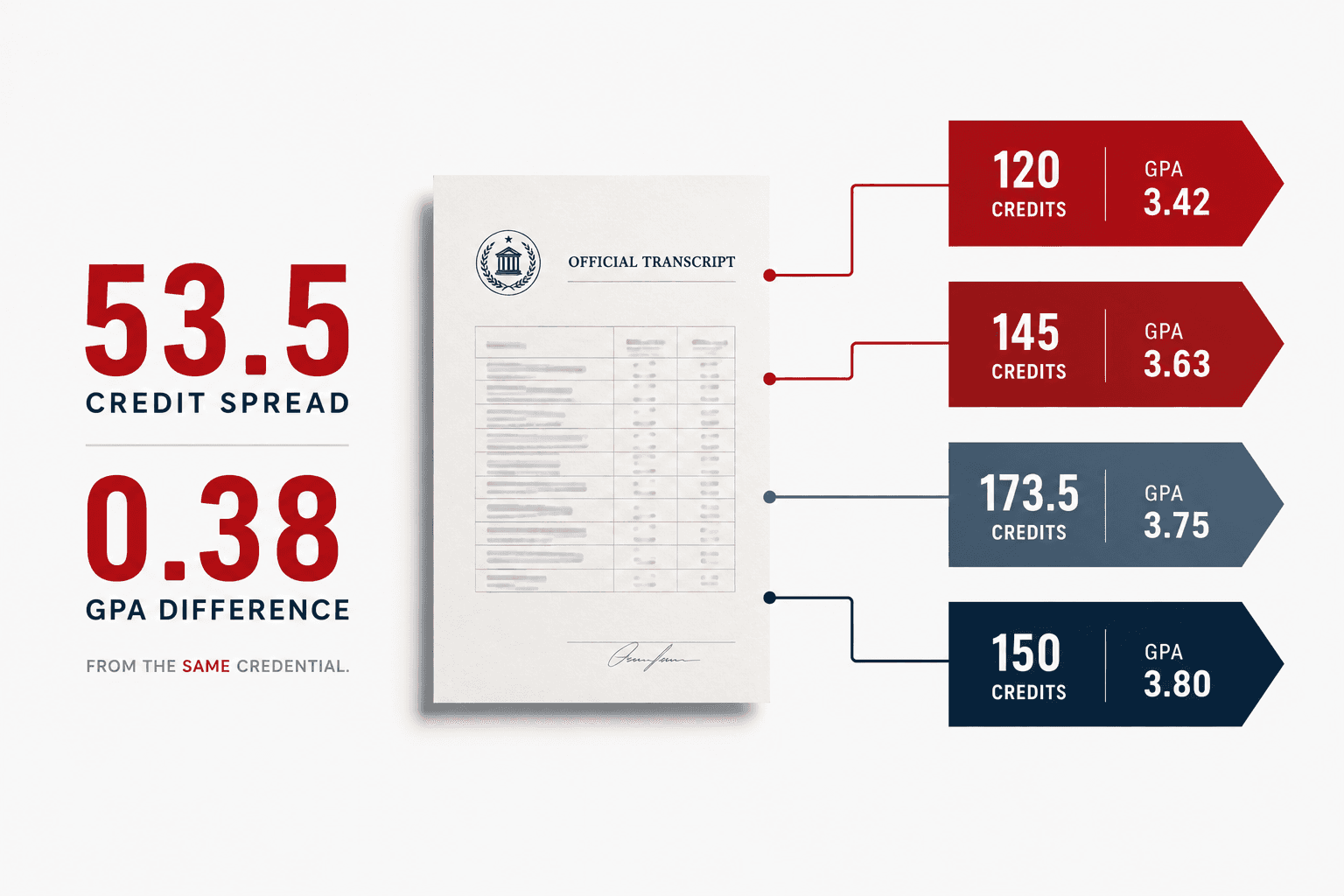
Every spring, international admissions offices hit an invisible wall. Applications pour in from Latin America, East Asia, and Europe. Files look complete on paper, yet evaluations grind to a halt. The culprit is almost always the same: non-English academic records.
Your admissions evaluators find themselves staring at native-language mark sheets covered in embossed notary stamps, or worse, reviewing a student-submitted "certified" translation that reads like a word puzzle.
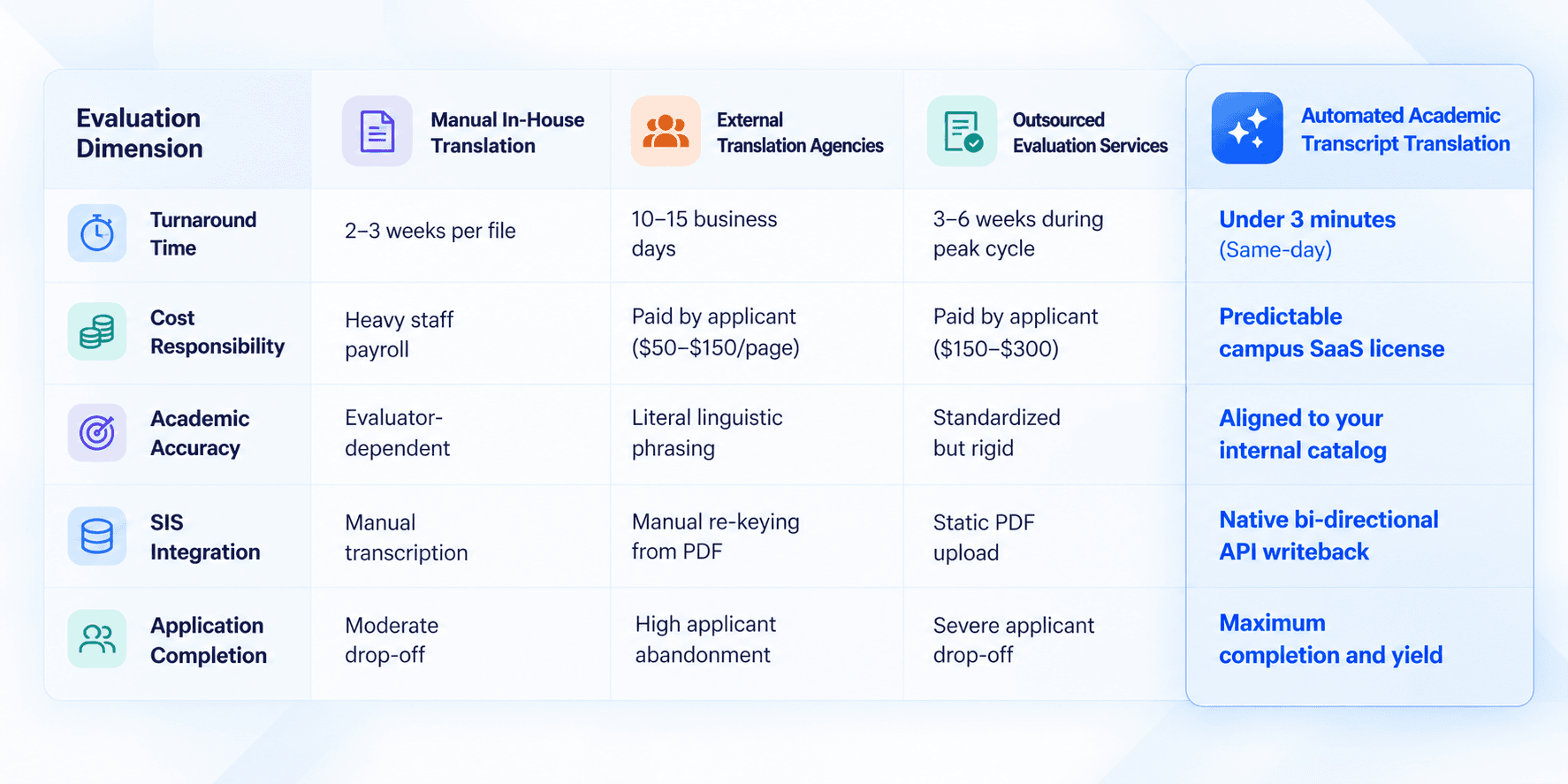
Mandating that applicants hire third-party translation vendors creates weeks of back-and-forth, forces students to spend hundreds of dollars out of pocket, and frequently yields translations that your academic deans reject anyway.
Institutional Operational Notice: This operational framework is written specifically for university registrars, international admissions directors, and enrollment operations analysts evaluating institutional intake systems. It does not address student-facing certified translation orders or individual credential requests.
To reverse applicant melt and protect international enrollment yield, colleges are bringing foreign credential intake in-house. Implementing modern automated transcript processing software allows admissions teams to handle academic transcript translation, grading scale normalization, and course credit equivalencies until the instant records arrive.
The Critical Gap: Word-for-Word Translation vs. Academic Articulation
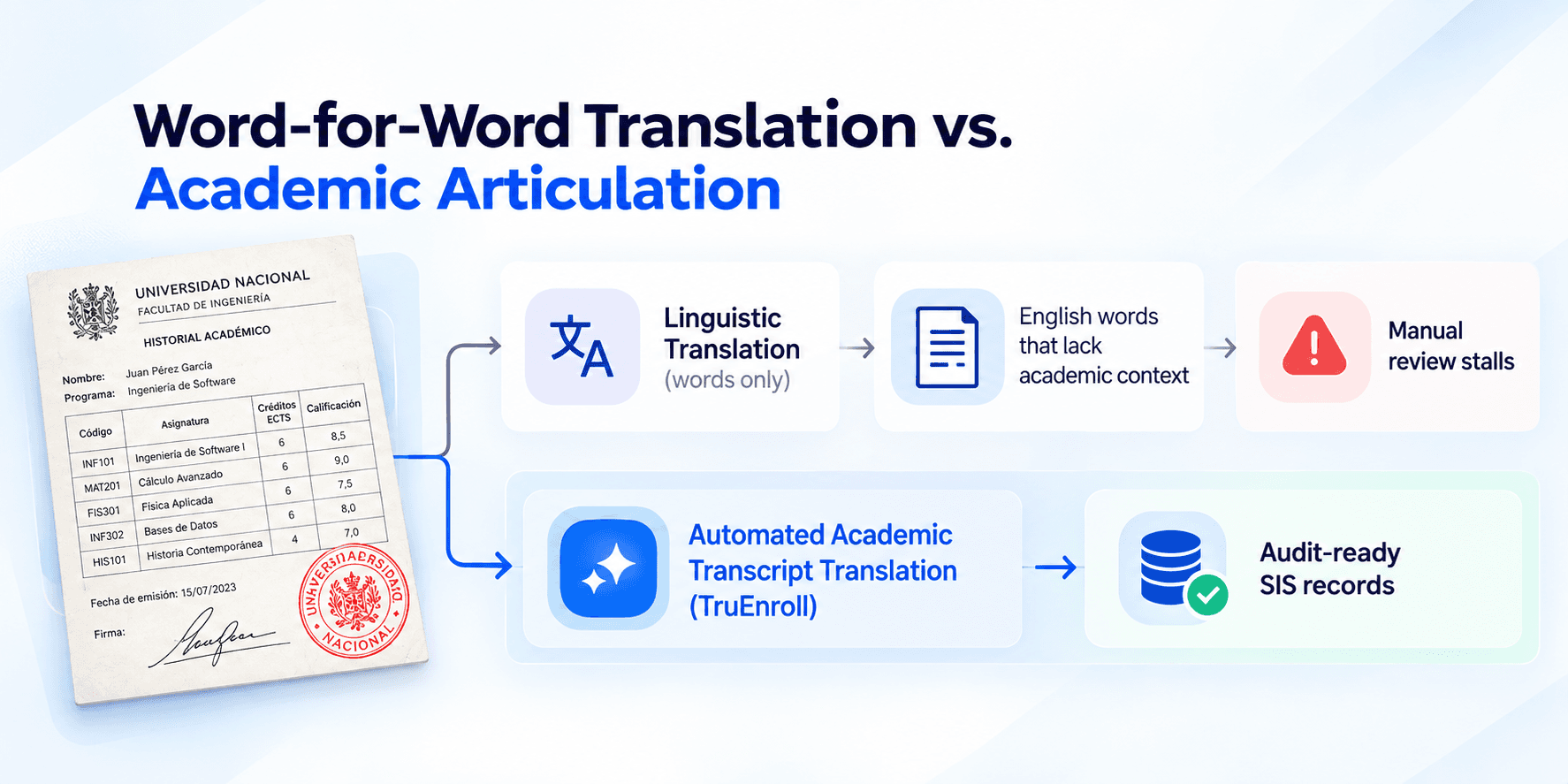
A common misconception among admissions leadership is that any certified translation solves the international intake bottleneck. In practice, certified linguistic translators convert words, not academic context. When an office mandates external foreign transcript translation, the registrar often receives an English document that still cannot be articulated into the student information system.
Why Certified Translation Services Still Create Work for Staff
1) Linguistic Translators Lack Higher-Ed Curriculum Knowledge:
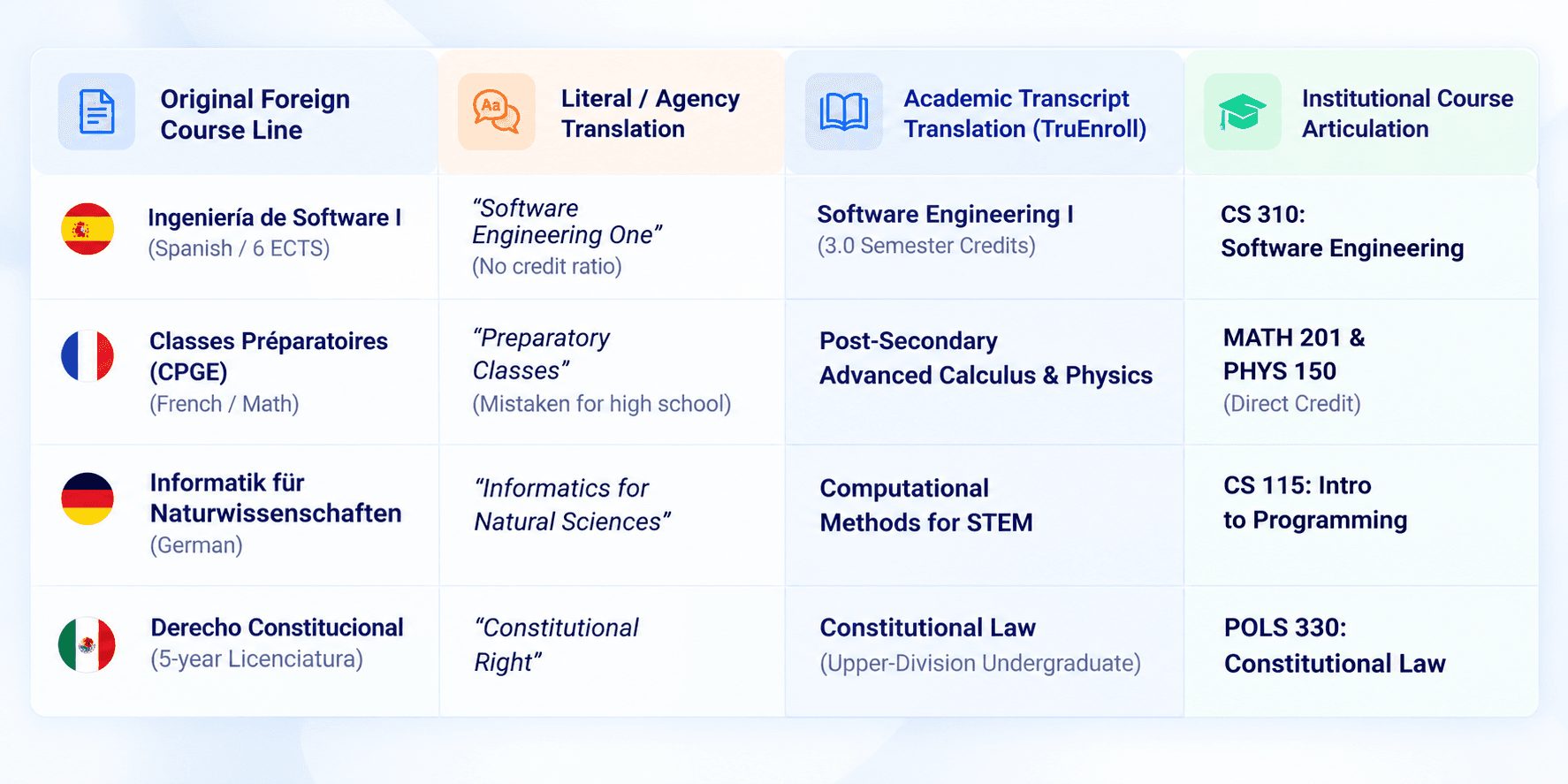
A certified legal translator understands legal syntax, not university degree requirements. They routinely translate specialized academic course titles literally, turning a foundational engineering course into "General Calculations" or an advanced European seminar ("Cátedra") into "Academic Chair." Your faculty chairs reject these descriptions, triggering a weeks-long syllabus chase.
2) Translations Ignore Grading and Credit Frameworks:
A standard certified document does not convert a French 20-point scale, an Indian division classification, or a German 1-to-5 inverted grading scale into an institutional 4.0 equivalent. Your evaluators still have to stop what they are doing and consult reference manuals like AACRAO EDGE by hand.
3) Applicant Drop-Off During Peak Cycles:
Directing applicants to external academic transcript translation services imposes an extra $50 to $150 fee per page alongside a 10-to-15-day turnaround delay. This friction leads up to 30% of prospective international students to abandon their files in favor of institutions that evaluate foreign records without upfront barriers.
The Anatomy of an Academic Mistranslation
General-purpose translation models and freelance linguists frequently produce literal phrasing that breaks transfer credit rules. Purpose-built academic transcript translation translates courses into standard higher-ed terminology:
Compliance and Accreditation: What Makes a Translation “Official”?
Registrars often worry that regional accreditors (like SACSCOC, HLC, or MSCHE) mandate third-party sworn translation stamps.
In reality, state boards and higher-education accrediting bodies evaluate institutional integrity based on verifiable source tracking and audit defensibility, not agency stamps:
Primary Document Linking: Every translated course record must link directly to the unedited, native-language scan in your document repository.
Standardized Academic Taxonomy: Course names and credit ratios must follow established higher-ed precedents rather than ad-hoc evaluator notes.
Immutable Decision Trails: Automated systems must maintain an unalterable log documenting the extraction date, translation rule applied, and registrar sign-off.
How Does an Automated Academic Transcript Translation Pipeline Work?
Modern software executes academic transcript translation through a coordinated four-stage process that runs behind the scenes:
1) Multilingual Script Parsing & Document Cleanup
The platform ingests multi-format files (PDFs, mobile scans, PESC XML) and identifies the source language and script structure. Advanced computer vision cleans background noise, removes skew, and isolates course-by-course tables even when obscured by ink stamps or official watermarks.
2) Academic Domain Extraction
The system runs specialized language models trained on global university curricula. It parses Latin-based scripts alongside non-Latin alphabets (including Mandarin Hanzi, Arabic, and Cyrillic), distinguishing between introductory survey coursework and advanced technical seminars.
3) Credit Normalization & Grade Conversion
The software converts foreign credit metrics (such as ECTS units or UK contact hours) into standard US semester hours. Native marks are cross-referenced against historical scale rules to output an audit-ready 4.0 GPA.
4) Direct SIS & CRM Writeback
Translated, articulated records sync directly into Slate by Technolutions, Ellucian Banner, Ellucian Colleague, Oracle PeopleSoft, or Workday Student. Course codes, credit totals, and translated titles appear in the degree audit engine without manual transcription.