NACES Evaluation vs. In-House Credential Assessment: What Regional Accreditors Actually Require


Institutional Governance Notice - This compliance and operational guide is written for U.S. university provosts, enrollment vice presidents, registrars, and admissions directors establishing campus evaluation standards. It does not provide individual evaluation reports for H-1B visa petitions, USCIS immigration filings, or personal employment applications.
Across U.S. higher education, thousands of admissions offices still require international applicants to purchase third-party NACES evaluation reports before their files will even be reviewed. Rarely is that policy driven by enthusiasm for external vendors. Instead, it persists because academic leaders assume that regional accreditors or federal Title IV auditors legally mandate a NACES stamp to validate foreign degrees.
That assumption is false - and it is costing universities substantial international enrollment yield. Requiring prospective students to pay $160 to $250+ out of pocket and wait weeks for sealed third-party reports creates severe application abandonment, while delivering static PDFs that registrar staff still must re-key manually into the student information system (SIS). Replacing external agency mandates with a documented, automated in-house framework preserves full accreditation compliance while cutting admissions turnaround times from weeks to minutes.
What Regional Accreditors and the U.S. Department of Education Actually Require
Regional accreditors (HLC, SACSCOC, MSCHE, NECHE, NWCCU, WSCUC, and ACCJC) do not require U.S. universities to use NACES-member agencies. Under federal guidelines and accreditation standards (34 CFR Part 602), higher education institutions have full authority to evaluate international transcripts in-house, provided they apply consistent, documented policies that verify sovereign recognition and academic comparability.
To build an audit-proof admissions workflow, enrollment leaders must separate statutory federal and accreditation rules from vendor-driven myths.

1. The U.S. Department of Education’s Official Position
The U.S. Department of Education’s official guidance on the Recognition of Foreign Qualifications explicitly designates educational institutions themselves as the competent authority for recognizing prior education for academic study. Specifically, federal guidance establishes four foundational facts:
In-House Evaluation Is Standard Practice: The Department notes that many U.S. colleges and universities evaluate international credentials directly within their own admissions and registrar offices rather than referring applicants to outside companies.
No Federal Regulation: There is no federal regulation of private credential evaluation services in the United States.
No Endorsement of NACES or Any Agency: The U.S. Department of Education explicitly states that it does not endorse or recommend any individual credential evaluation service or any association of credential evaluation services.
No Standardized Agency Methodology: Federal guidance warns that credential evaluations are performed by private, non-governmental entities on a case-by-case basis, and different agencies may evaluate identical foreign credentials differently according to their own internal criteria.
2. What Institutional Accreditors Actually Audit Under 34 CFR Part 602
Institutional accrediting commissions—including the Higher Learning Commission (HLC), Southern Association of Colleges and Schools Commission on Colleges (SACSCOC), Middle States Commission on Higher Education (MSCHE), New England Commission of Higher Education (NECHE), Northwest Commission on Colleges and Universities (NWCCU), and WASC Senior College and University Commission (WSCUC)—operate under federal recognition rules codified in 34 CFR Part 602.
During reaffirmation of reviews or transfer-of-credit audits, peer evaluators never ask whether an international file carries a NACES seal. Under 34 CFR § 602.24, accreditors verify that the institution maintains written, transparent, and consistently applied policies for evaluating admissions and transfer credits—ensuring comparable academic rigor, non-discriminatory treatment, and documented evidence that the foreign awarding institution holds recognized standing in its home country. Moreover, federal rulemaking under 34 CFR § 602.15 directs accrediting bodies to administer standards in a manner that avoids unnecessary compliance costs and administrative burdens on member institutions.
3. Separating University Admissions from State Licensure and Immigration
Confusion over NACES requirements frequently stems from conflating university admissions with statutory professional licensing:
State Licensing Boards: State-level regulatory authorities—such as State Boards of Accountancy (CPA), Nursing, Physical Therapy, or Engineering—often write specific NACES-member agencies directly into state administrative code for professional licensure.
Employers & Immigration Petitions: Private employers or immigration attorneys filing USCIS employment petitions often request third-party advisory opinions to support specialty-occupation filings.
Higher Education Admissions: To admit undergraduate, graduate, or transfer students, your university has sovereign academic authority to determine equivalency in-house.
Inside NACES: Trade Association Architecture vs. Institutional Autonomy
Understanding what NACES is helps academic senates and graduate councils reclaim governance over international admissions standards.
The National Association of Credential Evaluation Services (NACES) is a private trade association composed of 18 independent, private evaluation businesses (including organizations such as WES, ECE, and The Evaluation Company, formerly SpanTran). As NACES states directly on its own directory, NACES itself does not perform credential evaluations—its individual member companies operate independently, set up their own fee schedules, and maintain proprietary evaluation methodologies.
The Inter-Agency Inconsistency Problem
Because each NACES agency maintains its own internal conversion tables and country rules, outsourcing evaluations does not guarantee uniform academic standards:
Conflicting GPA Outcomes: Two applicants from the exact same engineering cohort in India or China with identical native marks can receive noticeably different converted GPAs—for example, a 3.75 from one agency versus a 3.40 from another—simply because each firm applies different grade-distribution curves.
Divergent 3-Year Degree Rulings: One NACES agency may equate a 3-year Indian Bachelor of Commerce (10+2+3) to three years of undergraduate study, while another grants full 4-year U.S. Bachelor’s equivalency based on NAAC accreditation tiers.
When an institution outsources evaluations to third-party agencies, it surrenders control over GPA normalization and degree comparability to external vendors—introducing unintended inequities across its own applicant pool.
The Operational Price of Outsourcing: Yield Melt, Application Taxes, and Manual Re-Entry
Beyond academic governance, mandating an external NACES degree evaluation inflicts three measurable operational penalties on enrollment management teams.

1. The $200+ Student Application Tax
A course-by-course evaluation with rush delivery or international courier fees routinely costs an international student $160 to $250+ per institution. Because international graduate and undergraduate candidates typically apply to five to eight U.S. institutions simultaneously, an upfront agency mandate functions as a punitive application tax. Price-sensitive applicants simply abandon incomplete applications and matriculate at competing universities that evaluate uploaded transcripts in-house at zero extra cost.
2. The 3-to-8 Week Turnaround Bottleneck
During peak admissions windows from November through March, third-party agency queues routinely stretch from three to eight weeks—particularly when agencies require physical, sealed documents mailed directly from foreign university registrars. While a file sits in an external vendor queue, agile peer institutions evaluating transcripts in-house issue conditional offer letters and Form I-20 packets within 48 hours, securing the student's enrollment deposit before the NACES report is ever delivered.
3. The Static PDF Re-Entry Burden
Even after an applicant pays for and waits weeks for a NACES report, the deliverable arriving in your admissions inbox is an unstructured PDF. Registrar analysts and transfer coordinators still spend 45 to 60 minutes per student manually transcribing 40 to 60 foreign course titles, credit hours, and converted grades into Ellucian Banner, PeopleSoft, or Technolutions Slate.
The Audit-Proof Blueprint: Building a Compliant In-House Credential Policy
Transitioning away from external agency mandates does not mean making informal, ad hoc admissions decisions. To satisfy regional accreditors, Title IV auditors, and faculty governance committees, an in-house evaluation framework must rest on four documented pillars.
Pillar 1: Written Equivalency and Grading Rubrics
Codify your campus evaluation rules in a formal Registrar and Graduate Admissions SOP aligned with established comparative benchmarks (such as AACRAO EDGE):
Degree Comparability Rules: Explicitly define how your campus treats 3-year Bologna Process degrees, 3-year Commonwealth/Indian Bachelor’s degrees (e.g., NAAC accreditation and Division I thresholds), and 11-year versus 12-year secondary diplomas.
Credit Conversion Formulas: Document standard multipliers for translating European ECTS credits (typically 2 ECTS = 1 U.S. semester credit), UK CATS credits (4 CATS = 1 U.S. semester credit), and contact-hour systems.
Calibrated Grading Scales: Replace flawed linear percentage division with documented, non-linear grade conversion tables tailored to major feeder nations.
Pillar 2: Sovereign Institutional Recognition Logs
Accreditors require proof that incoming degrees and transfer of credits originate from legitimate, degree-granting institutions recognized by their home country's Ministry of Education or statutory authority. Every evaluated file should log verification against sovereign registries—such as India’s UGC/AICTE, China’s Ministry of Education (MOE), the UK’s Office for Students (OfS), or the WHED (World Higher Education Database).
Pillar 3: Document Authenticity and Digital Registry Verification
Rather than relying solely on slow physical mail, modernize chain-of-custody verification by authenticating records through official national digital portals—including India’s DigiLocker / National Academic Depository (NAD), China’s CHESICC (Xuexinwang), West Africa’s WAEC Digital Certificate platform, and Cambridge CIE Direct—paired with file-level forensic inspection of uploaded PDFs.
Pillar 4: Standardized Evaluator Audit Trails
Maintain an immutable audit log inside your CRM or SIS recording the date of review, the evaluator or automated ruleset applied, the institutional recognition source checked, and the exact quality-point calculation behind the final converted GPA.
Automating Audit-Ready In-House Evaluations Without Adding Staff
Historically, universities hesitated to drop NACES mandates because performing in-house evaluations manually across thousands of international applications required specialized country experts and massive spreadsheet labor. Modern credential intake automation removes that trade-off entirely.

TruEnroll enables universities to bring foreign credential evaluation completely in-house without adding administrative headcount:
Byte-Level Document Forensics: Upon upload, TruEnroll inspects inbound PDF transcripts at the binary and metadata level—detecting altered grade digits, font-kerning anomalies, and PDF flattening exploits before an evaluator reviews the file.
Automated Sovereign Recognition & Registry Verification: The platform automatically cross-checks the awarding university against national ministry recognition lists and verifies digital registry credentials in real time.
Deterministic Campus Policy Engine: Instead of suffering inter-agency GPA variance, TruEnroll applies your institution's exact grading scales, 3-year degree rules, and credit conversion multipliers uniformly across every applicant.
Line-Item Extraction & Direct SIS Sync: Deep-vision OCR extracts every semester course, credit value, and grade—even across dense 8-semester mark sheets—and pushes structured course-by-course tables, converted 4.0 GPAs, and timestamped accreditation audit trails directly into Technolutions Slate or Ellucian Banner in under three minutes.
Frequently Asked Questions
Do regional accreditors (HLC, SACSCOC, MSCHE, WSCUC) require universities to use NACES-member agencies?
Does the U.S. Department of Education regulate or endorse NACES evaluation services?
When international applicants search "how to evaluate my degree in the USA," why should universities offer in-house evaluation instead of sending them to external agencies?
How can a university prove accreditation compliance if it evaluates foreign transcripts in-house?
Are NACES evaluations still required for professional licensure or USCIS immigration petitions?
In many cases, yes. State professional licensing boards (such as nursing, accounting, or engineering boards) and certain employers or USCIS visa petitions specify NACES or AICE member reports under state licensing statutes or immigration regulations. However, those external licensing rules do not govern university admissions.
Check out recent blogs

Indian Degree Evaluation in the USA: The Institutional Blueprint for 3-Year Degrees, NEP 2020, and GPA Normalization

Evaluating Foreign High School Diplomas: Fast-Tracking Secondary Verification Without Agency Delays
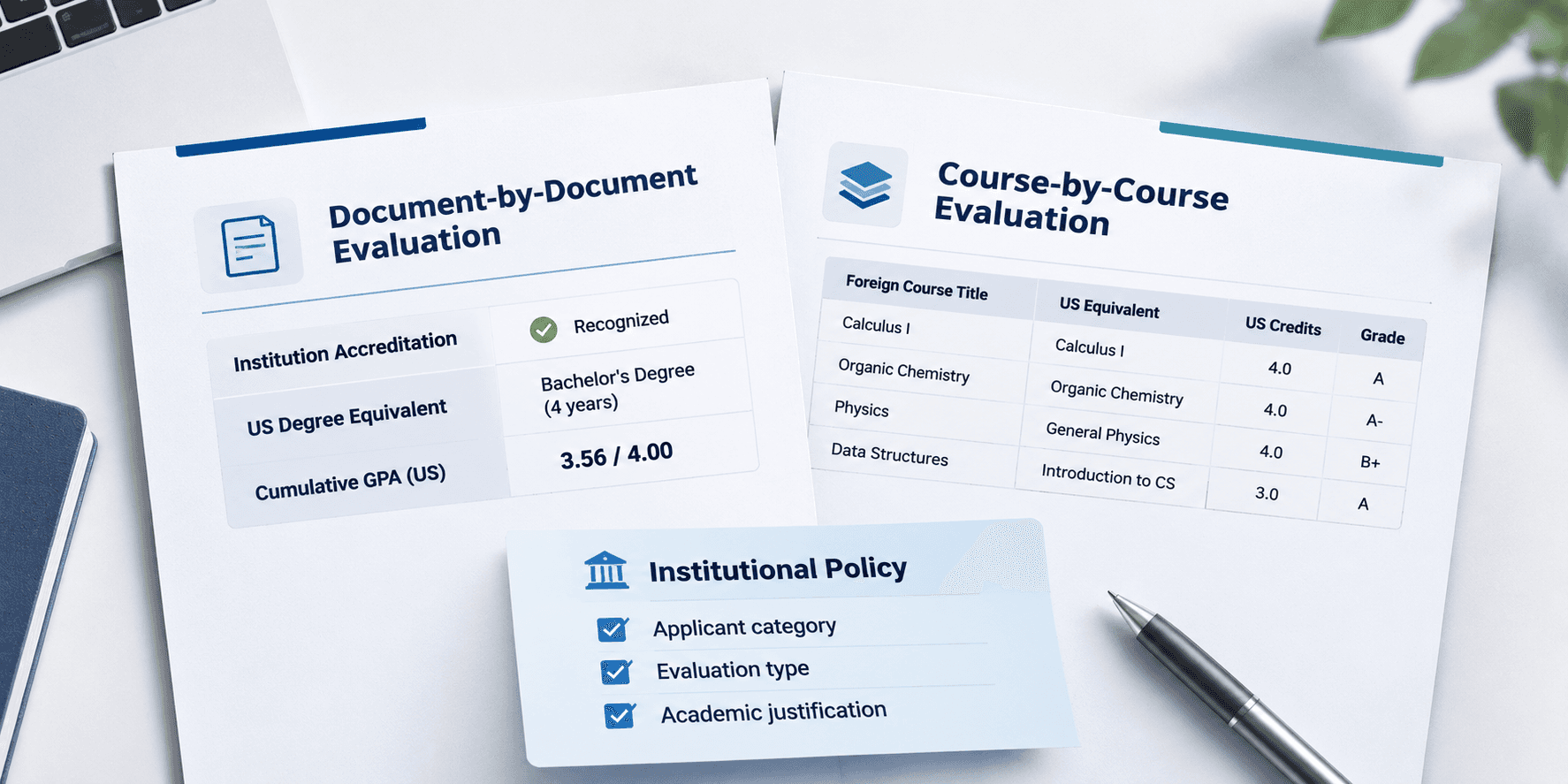
Course-by-Course vs. Document-by-Document Evaluation: Ending the Transcript Articulation Bottleneck