How to Bring Credential Evaluation In-House: A Practical Guide for Admissions Teams

Dev Srivastava

Part 2 of a two-part series. Part 1 examined why the outsourcing model no longer serves universities or their applicants.
TL;DR: In-house credential evaluation is already standard practice at a great many institutions, including highly selective ones. The barrier has always been capacity, and platform-assisted evaluation removes most of it.
This piece covers the four operations bundled into the phrase "credential evaluation" and which of them move internally; why primary source verification and fraud detection are separable from equivalency judgment; four institutional archetypes with a migration path for each; how to set divergence thresholds before you parallel-run; CRM and SIS integration requirements; how to build grading scales from AACRAO, TAICEP, and ENIC-NARIC baselines and refine them against your own outcome data; how to route edge cases; and what a realistic first cycle looks like.
What Part 1 established
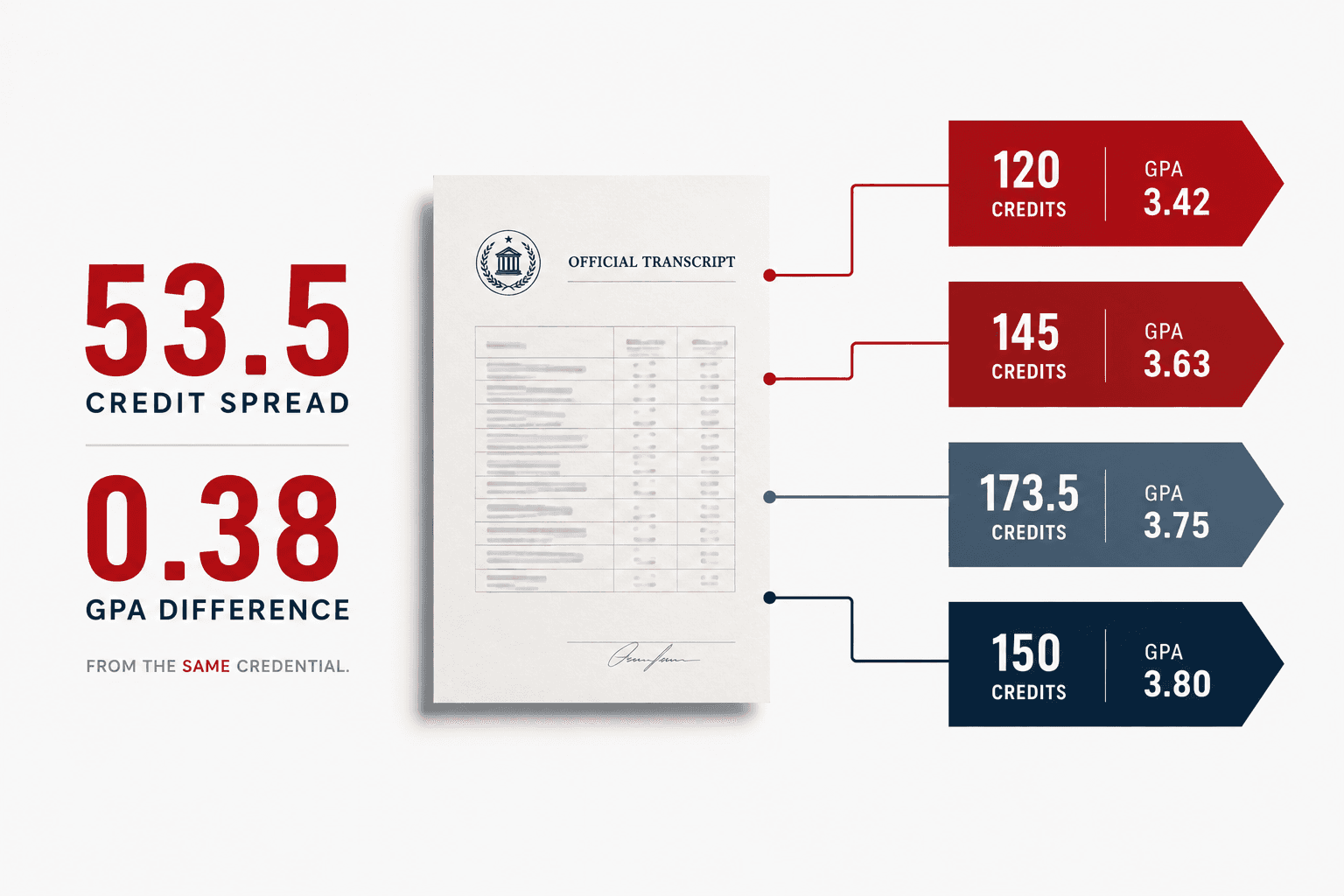
Part 1 documented what happens when the same two credentials — IIT Kanpur and Bocconi — go to four NACES-accredited evaluators. Credit conversion on a single credential came back at 153, 157.5, 166.25, and 206.5: a spread of 53.5 credits, close to two full US academic years. GPA ranged from 3.47 to 3.85. The equivalency statements disagreed just as sharply. One returned a generic "bachelor's and master's degree" with no field specified. Another assigned different fields of study and read a standalone Bocconi master's as a combined bachelor's and master's. The last report landed roughly seven weeks after the first.
That is the accreditation model working as designed. NACES accredits process and professional ethics, and its own published guidance is explicit that conclusions can legitimately differ between members. [1][2]
The consequences fall on two parties. Applicants absorb the cost and the wait. Universities absorb something subtler: comparative admissions decisions made across a pool where each file has been interpreted by a different vendor on a different scale, with no visibility into the reasoning behind any of it.
This piece is about what to do instead.
"But then we own the risk": answering the core objection
The first question most registrars ask is some version of: if we bring this in-house, we own the risk.
Three things in response.
In-house evaluation is already standard practice. Institutions across the selectivity range already do it. Several read international credentials internally at both undergraduate and graduate level, without requiring external evaluation at the application stage. [3] Others treat external evaluation as encouraged rather than required, and need it only after an offer is accepted, to satisfy enrolment verification. At least one large public graduate division declines to accept third-party evaluations in place of official records issued directly by the awarding institution. [4] Where the requirement does exist, it usually attaches to specific programs: professional degrees routed through centralized application services, licensure-adjacent fields, and post-admission verification. [5][6][7]
There is professional infrastructure supporting this work. For decades, AACRAO has published credential evaluation guidance and country-by-country frameworks for institutions evaluating internally, and its EDGE database is the standard reference for institutional placement recommendations. [8] TAICEP operates as a working community where in-house evaluators share methodologies and case approaches. [9] In Europe, the ENIC-NARIC network publishes recognition guidance under the Lisbon Recognition Convention. An institution moving in-house draws on the same underlying body of knowledge that accredited evaluators work from. The methodology has a published starting point.
The ownership-of-risk framing inverts the actual liability picture. When an evaluation is outsourced and a student disputes the outcome — or an accreditor asks how a conversion decision was reached — the university is defending a conclusion it cannot explain, because the methodology belongs to the vendor. When evaluation happens in-house on a platform that preserves a full audit trail, every equivalency traces back to the source document and the specific scale applied. That position is easier to defend to a disputing applicant, to a faculty committee, and to an auditor. Outsourcing leaves the admissions decision exactly where it was and removes your ability to account for it.
The barrier has always been capacity. Document volume, the number of grading systems in play, the manual labor of extraction and conversion, the difficulty of retaining specialist evaluators — these were real constraints, and for most institutions they were decisive. They are also the constraints current technology addresses directly. Classification, extraction, and equivalency application are now automatable to a standard that holds under review. What remains for a human evaluator is judgment, the part of the work that draws on institutional knowledge.
Before anything else: check your regulatory constraints
One pre-flight check comes before the rest of this guide, because it determines scope.
Map your programs against their governing bodies. Where a state board, licensing authority, or professional accreditor mandates a report from a named agency or an approved list, that requirement stands regardless of what your admissions office would prefer. USCIS requirements for certain visa categories operate the same way and sit downstream of admissions entirely.
Nursing is the clearest and most restrictive case. State boards of nursing typically maintain approved evaluator lists narrower than NACES membership; CGFNS (now TruMerit) is required or strongly preferred in many states; and a general-purpose NACES report may fail to satisfy the board even where it satisfies the university. The lists differ by state, and they change.
The constraint is usually narrower than institutional habit suggests, and it typically attaches to specific degrees rather than whole schools. Do this check first, so that you scope the rest accurately.
Step 4: Get it into your existing workflow
An evaluation capability that lives outside your CRM creates a new manual step, which defeats much of the purpose. The evaluation should appear where the decision is being made; if your team has to context-switch to reach it, adoption suffers regardless of output quality.
TruEnroll integrates with Slate, Salesforce, PeopleSoft, and other standard admissions CRMs. In Slate specifically — the system of record for a large share of US admissions offices — the workflow runs as a closed loop: documents already in the applicant record are sent for evaluation, and completed reports return automatically, without staff leaving the record or managing a parallel process. [10][11] Whatever platform you assess, treat integration depth as a requirement.
The same applies to data flow after evaluation. If equivalency outputs need manual re-entry into a SIS, the downstream time savings disappear. Scope the full handoff — CRM to platform, platform back to CRM, CRM to SIS — before committing.
Step 5: Calibrate your grading scales
Everything to this point is operational. This is the part that is only possible in-house.
Outsourcing means inheriting a vendor's equivalency framework. Evaluating internally means encoding your own, and "your own" can reflect things a vendor structurally cannot know.
Start from a published baseline. AACRAO EDGE placement recommendations, ENIC-NARIC country profiles, and the country documentation TAICEP members maintain give you a defensible starting position for most systems you will encounter. Refine from there against your own evidence.
Grading scale conversion. The Indian 10-point CGPA is the canonical case. Linear division by 2.5 is common practice and demonstrably crude, because it ignores how grades distribute at a given institution. A 7.5 that sits comfortably above the cohort median in an engineering program is a different thing from a 3.0 at an institution where 3.0 is unremarkable. If your department has years of enrolled-student outcome data from a particular feeder institution, you can encode that relationship. No external evaluator has access to that data, because it is yours.
Credit conversion. The ECTS convention — 60 ECTS to a year, roughly 30 US semester credits — is well understood and rarely the problem. The problem is programs with heavy laboratory or project components, where contact hours and credit weighting diverge from the classroom norm. Whatever your registrar's policy is for domestic transfer credit in those situations, your international evaluation should apply the same rule. Outsourcing almost guarantees that it will not, because the vendor does not know your transfer policy.
Degree-level characterization. Three-year bachelor's degrees are the perennial case. Whether to require a bridging qualification, admit directly, or assess by discipline or institution is a decision your graduate faculty should own. Outsourced, the vendor's default becomes your policy by accident.
Institution-level differentiation, and the constraint on it. Grading stringency varies enormously within the same country, and a national conversion table flattens all of it. Where you have documented evidence to differentiate — enrolled-student performance data, outcome records from established partnerships — you can, and this is the clearest case of in-house evaluation being more accurate as well as faster.
It is also the part of this work that requires the most care, and any institution attempting it should have counsel review the design before it goes live. Differentiating between sending institutions on the basis of documented outcome data is defensible. Differentiating on reputation or impression is not and sending institutions correlate with national origin closely enough that an undocumented adjustment is difficult to defend if it is ever challenged. Four guardrails keep this on the right side of the line:
Ground every differentiation in recorded evidence, rather than in institutional folklore.
Document the evidence and the reasoning at the time you make the adjustment, not retrospectively.
Apply it to grade conversion only, so that the scale informs an admissions decision which remains a human judgment.
Review the adjustments on a fixed schedule, because a differentiation that was evidence-based in 2023 becomes an assumption by 2027 unless someone re-checks it.
Handled that way, the practice is more transparent than the vendor default it replaces, where the same differentiation may be happening invisibly inside a proprietary framework.
On drift. In-house scales can become systematically biased over time without external calibration. An institution that never benchmarks against anything outside itself can drift toward leniency under chronic enrolment pressure, or toward arbitrary rigidity if the scales are never examined. The discipline is periodic comparison: run a sample of cases through an external evaluator annually and examine the divergence pattern against the Step 3 thresholds. Institutional judgment should be calibrated, and calibration requires an outside reference point.
Practically: start from a defensible baseline, refine against your own outcome data over successive cycles, and document each decision and its rationale as you go. That documentation is what makes the system auditable, what you hand to an accreditor or a disputing applicant, and what survives staff turnover. It also compounds — the framework improves every cycle, and the improvement stays with the institution.
If you are starting without in-house expertise, this is where senior evaluator support earns its keep. Initial calibration is the highest-judgment task in the process; ongoing maintenance is far lighter.
One note on dependency. Running evaluation on a platform is a vendor relationship, and pretending otherwise would be dishonest. The question is what the vendor holds, and what it costs you when the relationship underperforms.
Part 1 documented two costs of the outsourced version, and both follow from the vendor holding the methodology and the conclusion. Turnaround was invisible and uncontrollable: seven-business-day promises against six-to-ten-week realities, with Indian credentials documented at five months. Outcomes varied by design across a field of independent evaluators, with no mechanism to reconcile the differences and no way to audit the logic that produced them. Under a platform relationship, the vendor holds the processing layer while the scales, the reasoning, and the audit trail stay with the institution. When an outsourced report runs ten weeks late, you wait. When a platform underperforms, you can see where it happened, in your own audit trail, on your own files, and correct it inside your own cycle.
The practical test of whether that distinction is real is exportability. Ask any provider whether your grading scales, your decision rationale, and your evaluation history leave with you if you leave. Some institutions with mature frameworks use a platform for processing and extraction only, continuing to apply scales they have spent years refining. That configuration should be available to you, and its availability tells you something about the relationship.
Step 6: Handle edge cases deliberately
Every evaluation operation has a tail. The goal is to keep it small, identified, and routed sensibly.
Cases that typically warrant escalation:
Institutions absent from recognized databases, or with unclear accreditation status
Credentials from systems in transition — post-conflict states, post-reform curricula, institutions that merged or closed
Non-standard program structures: sandwich degrees, integrated masters, professional qualifications with unclear academic equivalence
Anything where an automated confidence score falls below your threshold
Two design choices matter more than the list.
Make escalation automatic where possible. If confidence thresholds and fraud signals route cases to review without a human deciding to escalate, exception handling is reliable. If it depends on an admissions officer noticing something odd during peak season, it is not.
Treat the escalation queue as a feedback loop. Every edge case is information about where your scales are underspecified. When a category keeps reappearing, it has become a gap in your framework, and it should be resolved into policy rather than handled individually forever. Review the queue at cycle end and ask which recurring patterns should become rules.
Finally, for edge cases beyond your staff's capability, TruEnroll provides evaluator support directly. The bulk of instances run end-to-end without intervention; the small remainder have specialist support available, through TruEnroll or through the credential evaluation agencies.
Pro-tip: The TAICEP community is an active forum where admissions officers and credential evaluators regularly discuss exactly these edge cases. Consider joining if you haven't.
What changes for applicants
A predictable objection is that applicants lose the portable report they can send to multiple institutions.
The portability is thinner than it looks. Each recipient costs an additional delivery fee on top of the base evaluation, so an applicant to six programs pays a base fee plus five delivery charges, and the total climbs well past the headline number — the $600–1,000 cycle cost Part 1 documented. [12][13]
Portability also does not deliver consistency. Applicants to programs across the US, UK, and Europe already encounter entirely different regimes: some require NACES reports, some require ENIC-NARIC recognition, some evaluate internally, some require nothing at all. Within the US, the same report may be accepted by one program, rejected by a second that mandates a specific provider, and superseded by a third that reads the transcript itself anyway. A single WES report has never been a universal passport.
The arithmetic also runs the opposite way from what the objection assumes. Under in-house evaluation, the marginal evaluation costs the applicant nothing, because the institution absorbs it. Being evaluated separately by six universities is cheaper for the applicant than buying one report and paying five delivery fees, and the benefit lands hardest with exactly the applicants least able to absorb the current stack.
What genuinely changes is that the applicant no longer receives a recalculated GPA as a portable document. It becomes an internal working figure used for review.
That has a real benefit: it removes the optimizable number that makes evaluation shopping possible. An applicant cannot audition three evaluators and submit the most favorable result when the evaluation happens inside the institution reading the file. The equity problem Part 1 described dissolves at the source.
It also creates an obligation. Institutions evaluating internally owe applicants a documented path to question how their credentials were read: who to contact, what evidence is considered, and what the timeline is. Build it deliberately at the outset. An internal process without a visible appeals route reproduces the opacity Part 1 objected to, in a new location.
The cycle-time and cost argument
Part 1 established that turnaround costs enrolment. The operational question is where the time goes.
Published turnaround times describe the evaluation stage alone, typically seven business days. [14] The stages around it are where the delay lives: applicant research and payment, institutional document dispatch, physical transit, document review and acceptance, verification correspondence with the issuing institution, queueing, and per-recipient delivery. Part 1 documented real end-to-end timelines running six to ten weeks in ordinary cases, with Indian credentials extending considerably further. [15][16] None of it is visible or controllable from the university's side, and every day sits on the critical path to an enrolment decision.
The in-house path collapses most of those stages. Documents are already in your CRM, because the applicant uploaded them when they applied. Evaluation triggers from the applicant record. The platform classifies, extracts, structures, and applies your scales. A reviewer confirms the output. Verification triggers where policy or fraud signals call for it and runs in parallel rather than as a gate on everything else.
How fast is the result? Internal benchmarking across TruEnroll users puts platform processing plus human review at roughly five minutes per case, once a team is past the initial learning curve. What that looks like at your institution depends on staff experience, policy complexity, and how much scale customization is in play, so establish your own baseline during a pilot. The order of magnitude is the point: the constraint moves from weeks of external dependency to minutes of internal processing.
Three things follow.
You can make offers earlier, into a market where international applicants weigh competing offers against visa timelines and funding deadlines. You can accommodate late or incomplete applications that the outsourced timeline would have made impossible to process. And you stop losing candidates in the gap between application and decision — attrition that never appears in funnel metrics as a process failure, because it looks like a student who simply went elsewhere.
The cost dimension points the same direction. Per-applicant platform costs sit well below the $160–200 an applicant currently pays for a single course-by-course report, before delivery charges. Some of that saving accrues to the institution. The more consequential share accrues to applicants.
A realistic first cycle
If you are starting from a fully outsourced position, a sensible first year looks roughly like this.
Before the cycle. Run the regulatory mapping. Choose your archetype and scope accordingly. Establish baseline scales from AACRAO EDGE and ENIC-NARIC country profiles, with senior evaluator support if you lack internal expertise. Set your Step 3 divergence thresholds. Configure the integration and test it against real historical files rather than synthetic ones.
Communicate the change before applicants encounter it. This is the step most migration plans skip, and most admissions offices regret skipping. Update your application instructions and international admissions pages before the cycle opens. State plainly whether you will still accept a third-party evaluation an applicant has already paid for; grandfathering existing reports for one cycle costs you very little and prevents a category of complaint that is entirely avoidable. Brief your recruitment agents, school counsellors, and partner institutions, since they will be asked and their default answer will be the old policy. Publish the appeals route at the same time as the policy change.
Early cycle. Run your highest-volume corridors through the platform. If you are coming off a vendor relationship, run parallel for this stage. Set confidence thresholds deliberately and expect to tune them.
Mid-cycle. Review the escalation queue for patterns. Resolve recurring categories into policy. Track actual review time per evaluation — that number matters when anyone asks about capacity.
End of cycle. Compare in-house outputs against the vendor benchmark, using your Step 3 thresholds. Refine scales against enrolled-student outcomes as they become available. Document what changed and why. Decide scope for the following cycle.
The framework matters more than the specific milestones. What you are building improves every cycle, and it stays with the institution.
Closing
Part 1 argued that outsourcing was a rational response to constraints that no longer bind. The constructive version of that argument is this.
Universities are the only party in the process holding the complete picture of an applicant — the transcript alongside the statement of purpose, the recommendations, the research history, the departmental context, and years of accumulated evidence about how students from a given institution actually perform once enrolled. External evaluation discards all of that by design and returns a number your committee then must re-contextualize anyway.
Bringing evaluation in-house puts judgment back where the information already is, and it takes a cost and a delay off applicants who are already carrying more of both than the process requires.
Frequently asked questions
Can we bring credential evaluation in-house without hiring a credential evaluator?
Yes, at most volumes. Routine confirmation of platform output is an admissions officer task requiring familiarity with your institutional scales, which is trainable in days for staff already reading international files. The judgment-heavy work concentrates in initial scale calibration and in a thin tail of unusual credentials, both of which can be covered through external senior evaluator support without a permanent hire. Institutions frequently start that way and reassess after one cycle, with real data on tail volume.
What do we build our grading scales from?
AACRAO EDGE placement recommendations, ENIC-NARIC country profiles, and TAICEP country documentation give you a defensible, published baseline for most systems. From there, you refine against enrolled-student outcome data from your own feeder institutions, which is evidence no external evaluator has access to.
Do we lose fraud detection by going in-house?
The detection layer sits in primary source verification, and Trential runs PSV for a substantial share of the major evaluators, so in many cases the capability was never the evaluating agency's own to begin with. Verification produces ground truth: every confirmed or contradicted credential is a labelled example, and tens of thousands of them are what the fraud signals are trained on, alongside general digital tampering checks. Going in-house surfaces those signals to you directly, attached to a specific document and a specific reason, rather than absorbed into a report you cannot inspect. You additionally gain pattern visibility across your own applicant history, which the external model cannot offer.
How do we handle primary source verification without an agency?
Verification and equivalency are separable. Verification confirms that a credential exists; equivalency determines what it is worth at your institution. Verification infrastructure can be triggered directly, rather than reached by routing an entire evaluation through a third party. Ask about coverage and turnaround in your specific recruitment markets, since coverage is uneven and no provider covers everything.
What about nursing, teaching, and other licensure-adjacent programs?
Where a state board or licensing authority mandates a named agency or an approved list, that requirement stands. State boards of nursing typically maintain lists narrower than NACES membership, with TruMerit (formerly CGFNS) required or preferred in many states. Separate the two purposes: evaluate in-house for the admissions decision, while the applicant obtains the mandated report for licensure on the regulator's timeline.
Isn't platform-assisted evaluation just a different vendor dependency?
It is a vendor relationship with a different shape. Outsourcing puts the methodology, the conclusion, and the timeline in the vendor's hands, which is why Part 1 found seven-business-day promises against six-to-ten-week realities, and outcome variance with no reconciliation mechanism. A platform holds the processing layer, while the scales, the reasoning, and the audit trail stay with the institution. The test of whether that distinction is real is exportability: ask whether your scales, decision rationale, and evaluation history leave with you if you leave.
Does going in-house make things harder for applicants?
The opposite, on cost. Under in-house evaluation, the marginal evaluation costs the applicant nothing, so being evaluated by six institutions is cheaper than one report plus five delivery fees. What applicants lose is a portable recalculated GPA, which was never a universal passport in practice. What they gain is the removal of a $600–1,000 pre-application cost stack. Institutions taking this on owe applicants a documented appeals route in exchange.
How long does in-house credential evaluation take per file?
Internal benchmarking across TruEnroll users puts platform processing plus human review at roughly five minutes per case, once teams are past the initial learning curve. The realistic figure at your institution depends on staff experience, policy complexity, and scale customization, so establish it during a pilot. The order-of-magnitude change is from weeks of external dependency to minutes of internal processing.
TruEnroll integrates with Slate, Salesforce, PeopleSoft, and other CRM and ERP systems, and is FERPA, GDPR, and SOC 2 compliant. To discuss what a pilot would look like at your institution, get in touch.
Sources
NACES, Frequently Asked Questions — https://www.naces.org/faq
NACES, Statement of Professional Standards — https://www.naces.org/standards
Yale Jackson School of Global Affairs, credential evaluation FAQ — https://jackson.yale.edu/faq/do-i-need-to-provide-international-transcript-credential-evaluations-for-my-application
UC Riverside Graduate Division, International Academic Records — https://graduate.ucr.edu/international-academic-records
University of Minnesota School of Public Health, International Applicants — https://www.sph.umn.edu/prospective/application-process/international-applicants/
Indiana University School of Public Health, Masters Admissions FAQ — https://publichealth.indiana.edu/masters/apply/faq.html
SOPHAS, Association of Schools and Programs of Public Health — https://aspph.org/student-journey/sophas/
AACRAO International Education Services — https://www.aacrao.org/resources/AACRAO-International
TAICEP, The Association for International Credential Evaluation Professionals — https://www.taicep.org/taiceporgwp/
TruEnroll Integration, Slate Knowledge Base (Technolutions) — https://knowledge.technolutions.net/docs/truenroll-credential
TruEnroll's Slate CRM Integration — https://trential.com/blog/truenroll-slate-crm-integration
WES, Evaluations and Fees, Graduate Admissions — https://www.wes.org/evaluations-and-fees/education/graduate-admissions/
ECE, Services and Fees — https://www.ece.org/ECE/Credential-Evaluations/US-Institutions/Services-and-Fees
WES, processing time — https://us-help.wes.org/support/solutions/articles/14000126436-how-long-does-it-take-wes-to-complete-a-u-s-evaluation-
CanadaVisa forum, WES turnaround discussion — https://canadavisa.com/canada-immigration-discussion-board/threads/wes-evaluation-taking-too-long.480505/post-5873114
Settlement.org, extended verification delays — https://discuss.settlement.org/topic43265-extremely-slow-servicecredential-evaluation.aspx