How Can Higher Ed Automate Parchment Transcript Ingestion into Slate and Banner?

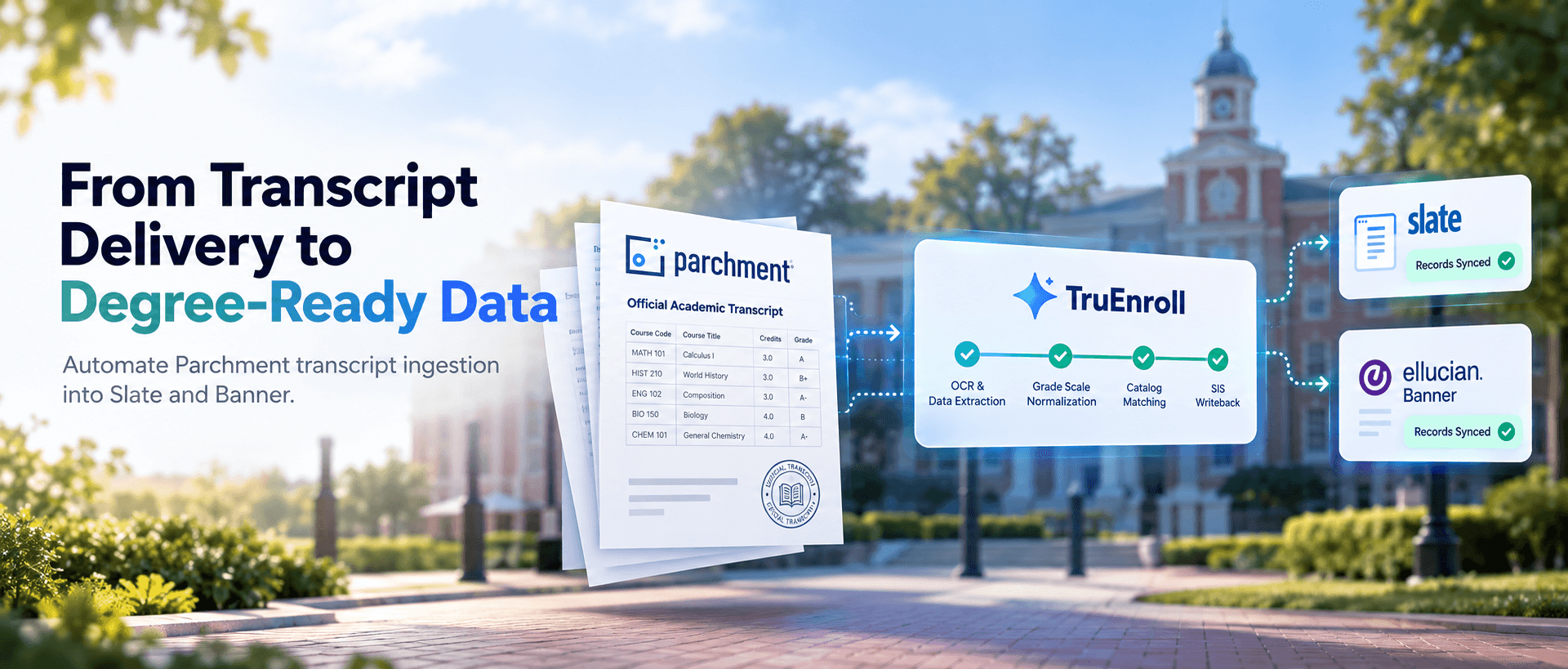
Electronic transcript exchange networks have replaced the campus mailroom, but they have quietly created a new operational bottleneck inside admissions offices. During peak November and March intake cycles, admissions teams download hundreds of secure PDF records every morning through their Parchment transcript service.
The documents arrive digitally, yet the evaluation workflow remains entirely manual.
Evaluators spend 35 to 45 minutes on each file: opening a locked PDF on one monitor, re-typing course titles and credit hours into Ellucian Banner or Slate on the other, deciphering unfamiliar grading scales, and emailing faculty chairs to track down missing syllabi. While delivery is instantaneous, course articulation remains stuck in a multi-week queue.
Institutional Operational Notice: This operational framework is written specifically for university registrars, admissions directors, and enrollment operations analysts evaluating institutional intake automation. It does not address student-facing transcript orders, fee payments, or personal credential fulfillment.
To eliminate processing backlogs and improve transfer yield, institutions are implementing automated intake layers. Connecting automated transcript processing software directly to your electronic exchange pipelines allows campus evaluators to parse, articulate, and sync records into the student information system (SIS) the moment they arrive.
What Is Automated Ingestion for a Parchment Transcript Service?
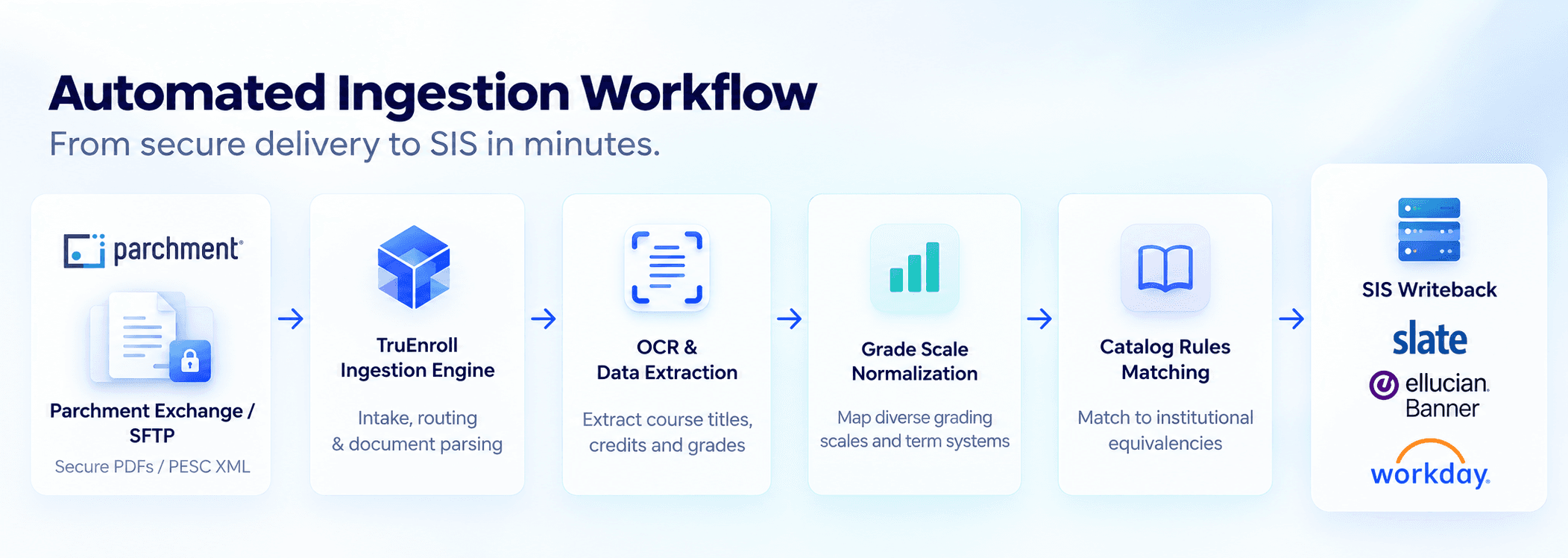
Automated ingestion for a Parchment transcript service is an institutional software pipeline that connects electronic credential exchange networks directly to a campus student information system. The software automatically ingests incoming Parchment transcripts, extracts course titles, credits, and grades using optical character recognition (OCR), normalizes diverse grading scales, matches courses against internal catalogs, and writes articulated records into Slate, Banner, or Colleague without manual data entry.
By bridging the gap between electronic document delivery and degree audit execution, an automated parchment transcript service workflow transforms static document downloads into live, actionable applicant data.
The "Last-Mile" Intake Problem: Why Electronic Transcripts Still Cause Delays
The widespread adoption of electronic credential exchanges solved document logistics, but it stopped short of solving evaluation mechanics. Higher education institutions face four compounding points of friction after records arrive:
1. Static PDFs vs. Structured Data
When an admissions office receives records through a Parchment transcript service, the delivery format is usually a certified, tamper-evident PDF or an unparsed data packet. While cryptographically secure, an unindexed PDF is just a flat image to an admissions system. The registrar’s office must still dedicate manual staff hours to extract the tabular course history locked inside each document.
2. The Dual-Monitor Transcription Treadmill
Evaluators spend hours every day performing repetitive clerical transcription:
Reading course codes, credit weights, and earned grades off incoming parchment transcripts.
Calculating cumulative grade point averages across non-standard term calendars (quarters, trimesters, or 4-1-4 academic calendars).
Manually keying course lines into Slate by Technolutions, Ellucian Banner, Ellucian Colleague, or Workday Student.
This manual hand-off averages 35 to 45 minutes per transfer file and introduces a 3% to 5% clerical error rate across course numbers and credit allocations.
3. Articulation Inconsistency and Syllabus Chasing
When transfer of coursework lacks an established institutional equivalency, the file sits in departmental purgatory for weeks while staff contact department chairs for course syllabus reviews.
Without an automated articulation database, different evaluators routinely assign varying transfer credits to identical courses, leading to articulation drift and compliance issues during accreditation reviews.
4. Yield Loss on Admitted Transfer Students
Transfer students prioritize institutions that provide transparent degree pathways early. When evaluation queues take three to four weeks, admitted students accept offers from competing universities that delivered an official credit evaluation alongside their acceptance letter.
Traditional Intake vs. Automated Parchment Ingestion
Relying on portal downloads and manual evaluation turns electronic speed into an internal bottleneck. Here is how standard document intake compares to an automated ingestion and articulation architecture:

How Does an Automated Pipeline Process Parchment Transcripts?
A purpose-built intake engine processes incoming Parchment transcripts through a coordinated four-stage technical pipeline:

1. Automated Stream Ingestion
The software connects directly to your institutional delivery inbox via secure SFTP or API. As applicant records are released by the sending institution through a Parchment transcript service, the platform ingests both PDF files and PESC XML data packets instantly. The document engine strips out digital security wrappers that typically prevent automated document handling, matches the file to the applicant's existing CRM record, and queues the document for extraction.
2. Tabular Course Extraction
General-purpose scanning tools fail when encountering multi-column transcripts, micro-print annotations, or embossed registrar seals. Specialized computer vision models:
Deskew and clean document artifacts across varying institutional formats.
Parse semester-by-semester course grids, isolating course numbers, descriptive titles, earned grades, and attempted vs. earned credit hours.
Reconcile institutional grading keys, differentiating between developmental coursework, repeated classes, and pass/fail notations.
3. Catalog Articulation & Scale Normalization
Once data extraction is complete, the rules engine queries the university's historical transfer articulation database:
Identifies direct equivalencies (e.g., matching
ENG 101from an accredited community college directly to your institution'sENGL 1100).Normalizes non-standard grading systems (quarter credits, international marks, or percentage grades) into an audit-ready 4.0 GPA equivalent.
Flags unmapped, novel courses for a single-click staff review, auto-attaching extracted course descriptions to eliminate syllabus chasing.
4. Native SIS Writeback
Instead of requiring staff to key in transfer data, the platform writes structured course lines, cumulative transfer credits, and normalized GPA fields directly into Slate by Technolutions, Ellucian Banner, Ellucian Colleague, Oracle PeopleSoft, or Workday Student.
Measurable Campus ROI: What Automated Ingestion Delivers
Transitioning from manual document review to an integrated ingestion pipeline produces measurable gains across institutional admissions operations:
90% Reduction in Evaluation Queues: Eliminate review backlogs during peak application spikes, clearing files in hours instead of weeks.
Under 3 Minutes Total Processing Time: Replaces 35 to 45 minutes of manual re-typing and grading scale recalculations per credential.
Zero Double-Entry Clerical Errors: Automated field-level extraction stops manual typos in course numbers, term codes, and credit values before they reach the official academic record.
Up to 20% Higher Transfer Yield: Transfer applicants commit to the campus that delivers an actionable degree audit first. Issuing clear credit awards alongside acceptance letters protects institutional yield against regional competitors.
Frequently Asked Questions About Parchment Transcript Ingestion

Does a parchment transcript service articulate transfer credit automatically?
How does automated software ingest parchment transcripts into Slate or Ellucian Banner?
What is the difference between PESC XML delivery and PDF parchment transcripts?
Can automated ingestion handle international credentials delivered through electronic services?


